Design Control SOP – ISO 13485, EU MDR & FDA QMSR
€74.00
A regulatory consultant charges €150–200/hour. This SOP replaces 6–10 hours of work
ISO 13485 & MDSAP Ready
Editable Word & Excel
ISO 13485 / MDSAP / FDA QMSR
Used by 100+ quality teams
The design control SOP ISO 13485 package addresses one of the most complex and most frequently cited areas of nonconformity in medical device quality management system audits. Design and development controls — required under ISO 13485:2016 (Clause 7.3), EU MDR 2017/745 (Annex II), and FDA QMSR (21 CFR Part 820) — govern the entire product development lifecycle from initial planning through design transfer to production. Inadequate design inputs, missing verification and validation records, undocumented design changes, and absent design transfer procedures are among the top findings in Notified Body conformity assessments and FDA inspections globally.
This Design Control SOP package gives your quality and development team a complete, audit-ready framework to plan, execute, document, and transfer medical device designs — fully aligned with ISO 13485:2016 Clause 7.3, EU MDR 2017/745 Annex II, and FDA QMSR.
What’s Included
The following SOPs and templates are included in the package:
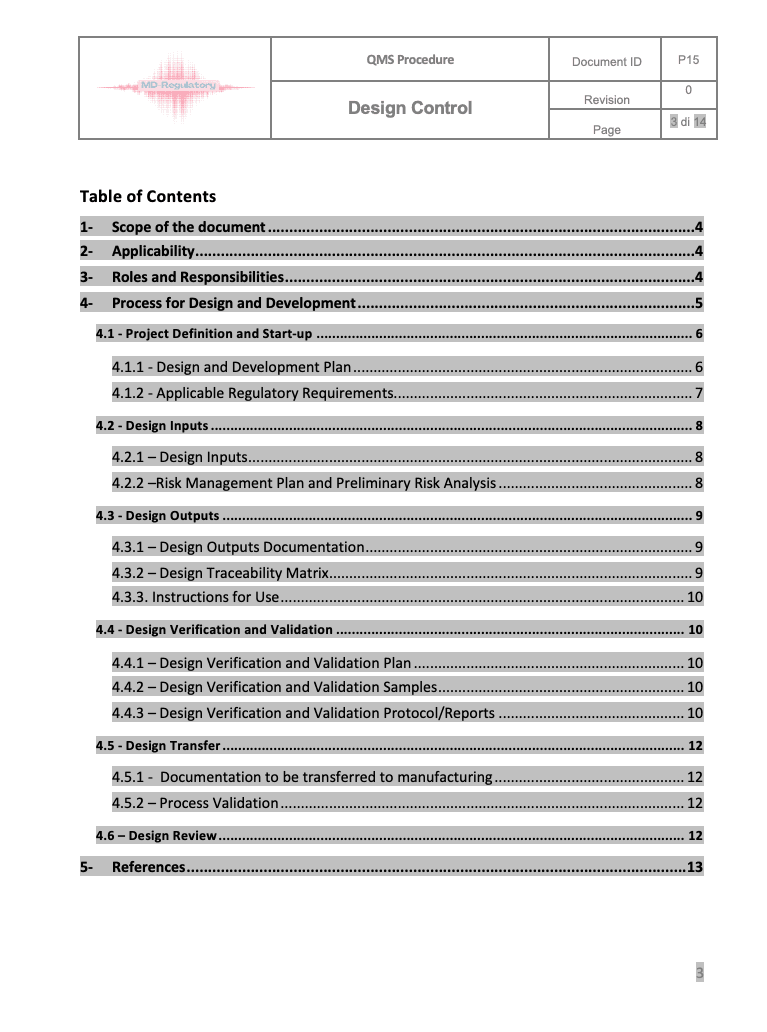
- P-15 Design and Development Procedure — step-by-step instructions covering design planning requirements, design input definition and review, design output specification, design review conduct and documentation, design verification methodology, design validation planning and execution, design transfer to production, design change control, and Design History File structure and maintenance requirements
- F15-1 Design Review Template — pre-formatted template to conduct and document formal design reviews at defined project milestones, including attendees, agenda, findings, and action items
- F15-2 Design History File Index Template — ready-to-use index template to organize and maintain all design and development records for each device in a structured, auditable Design History File
- F15-3 Device Master Record Index Template — structured index template to organize all documents and records that constitute the Device Master Record — the complete set of production and quality specifications for a finished device
- F15-4 Design and Development Plan Template — pre-formatted, editable template to define the scope, phases, responsibilities, review points, verification and validation activities, and resource requirements for each design project
- F15-5 Traceability Matrix Template — structured template to establish and maintain bidirectional traceability between design inputs, design outputs, verification and validation activities, and risk management findings throughout the design lifecycle
- F15-6 Design Verification Plan Template — ready-to-use template to plan and document verification activities confirming that design outputs meet design inputs, including test methods, acceptance criteria, and results
- F15-7 Design Inputs Template — structured template to capture, review, and approve all functional, performance, safety, regulatory, and usability requirements that form the basis for device design
- F15-8 Design Transfer Checklist — structured checklist to formally document the transfer of the device design from development to production, confirming that manufacturing processes, work instructions, and quality controls are in place before commercial manufacturing begins
Who Is This For
Quality managers, R&D managers, regulatory affairs professionals, and development engineers at medical device companies designing new devices, managing design changes, seeking ISO 13485 certification, preparing for EU MDR conformity assessment, or maintaining FDA QMSR compliance — particularly organizations building their design control infrastructure for the first time or standardizing an inconsistent design documentation approach across multiple projects.
Why This SOP and Not Starting from Scratch
Design control is the most documentation-intensive process in a medical device QMS. Developing a compliant design and development procedure and all eight associated templates from scratch takes 15–25 hours of a regulatory professional’s time — and carries significant risk if key elements required by ISO 13485, EU MDR, or FDA QMSR are missed. This package is immediately usable, written by an experienced ISO 13485 Lead Auditor and former Notified Body auditor — built to withstand scrutiny from Notified Bodies, FDA investigators, and technical reviewers across all major regulatory markets.
✓ Instant download after purchase ✓ Fully editable Word format ✓ Compatible with ISO 13485:2016, EU MDR 2017/745, FDA QMSR ✓ Updated April 2026 ✓ Used by quality and development teams across EU, US and Canada
Frequently Asked Questions
Q: Does this procedure cover software design and development? A: The procedure covers the design and development process requirements of ISO 13485:2016 Clause 7.3, which applies to all medical devices including those incorporating software. For devices where software is the primary component, the procedure should be used in conjunction with a dedicated software development lifecycle procedure aligned with IEC 62304.
Q: How does the Design History File template relate to the EU MDR technical documentation? A: The Design History File is the QMS record of the design and development process. Under EU MDR, the technical documentation required by Annex II draws directly from the DHF — including design inputs, verification and validation records, and design change history. A well-maintained DHF significantly reduces the effort required to compile EU MDR technical documentation.
Q: Does the Biological Risk Assessment template cover ISO 10993 requirements? A: Yes. The F-DC-8 template is structured to support the biological risk assessment process aligned with ISO 10993-1, covering material identification, contact classification, existing biocompatibility data, and gaps requiring additional testing.
Q: How does the Design Transfer Checklist integrate with process validation? A: The design transfer checklist confirms that all elements required for commercial manufacturing — including process validations, work instructions, equipment qualifications, and incoming inspection criteria — are in place before design transfer is formally approved. It serves as the gate between development and production.
Q: Can these templates be used for design changes as well as new device development? A: Yes. The procedure and templates are designed to support both new device development projects and design changes — with the design change control section of the procedure defining when a full design review cycle is required versus a simplified change assessment.
Q: In what format are the documents delivered? A: All nine documents — the procedure and eight templates — are delivered in fully editable Microsoft Word (.docx) format, instantly after purchase.
€74.00
Related products