EU MDR Transition Deadlines 2027 and 2028: The Complete Guide for Medical Device Manufacturers
Last updated 5 August 2026. The 26 May 2026 deadline for custom-made Class III implantable devices has passed. The next hard date is 27 November 2026, for EUDAMED registration of legacy devices.Table of Contents
- Introduction
- Where the EU MDR transition stands today
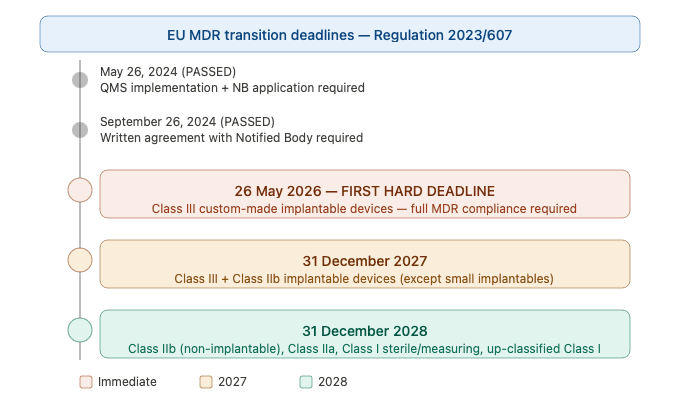
- MDD to MDR transition timeline — the complete deadline table
- Background: why the EU MDR transition was extended
- Conditions for benefiting from the 2027 and 2028 extended deadlines
- The 26 May 2026 deadline — what happened, and what it means now
- The 31 December 2027 deadline — high-risk devices
- The 31 December 2028 deadline — lower-risk devices
- EUDAMED — the next mandatory deadline, 27 November 2026
- The Notified Body bottleneck — the most urgent risk
- How to demonstrate legacy device status
- What happens if you miss the deadline?
- Practical action plan for manufacturers
- Frequently asked questions
- Conclusions
Introduction
The EU MDR transition deadlines are now in their final phase. The first hard date under the extended timeline — 26 May 2026, for Class III custom-made implantable devices — has passed. What remains is the main body of the transition: 31 December 2027 for high-risk devices, 31 December 2028 for everything else, and, before either of them, the EUDAMED registration obligation on 27 November 2026.
This article sets out exactly which deadline applies to which device class, what conditions had to be met to benefit from the extended transition, what EUDAMED obligations are now imminent, and what manufacturers must do to protect their EU market access in the time that is left.
Where the EU MDR transition stands today
| Date | What it covers | Status as of August 2026 |
|---|---|---|
| 26 May 2024 | QMS in place and Notified Body application submitted | Passed — a precondition, not a deadline for certification. Manufacturers who missed it lost the extension. |
| 26 September 2024 | Written agreement signed with the Notified Body | Passed — same consequence. |
| 26 May 2026 | Class III custom-made implantable devices | Passed. No further extension exists for this category. |
| 27 November 2026 | EUDAMED registration of legacy devices | Next hard date. Applies regardless of whether your transition deadline is 2027 or 2028. |
| 31 December 2027 | Class III and most implantable Class IIb devices | Open — but shorter than a typical Notified Body review cycle. |
| 31 December 2028 | Class IIa, non-implantable Class IIb, Class Is/Im/Ir, up-classified Class I | Open. |
The practical reading. Two of the three qualifying conditions closed in 2024 and cannot be recovered. If your organisation met them, the work now is to reach certification before your class deadline and to complete EUDAMED registration by November. If it did not, the transitional provisions never applied to your devices and full MDR compliance is already required.
MDD to MDR transition timeline — the complete deadline table
The MDR transition period was originally set to end on 26 May 2024. Regulation (EU) 2023/607 replaced that single cut-off with a staggered timeline based on device risk class, and removed the sell-off deadline entirely. The table below is the complete picture.
| № | Device category | Examples | Deadline | Conditions apply? |
|---|---|---|---|---|
| 1 | Class III custom-made implantable devices | Patient-specific implants manufactured to prescription | 26 May 2026 — passed | Own transitional provision |
| 2 | Class III devices (other than custom-made implantable) | Heart valves, active implantables, drug-device combinations | 31 December 2027 | Yes — all three 2024 conditions |
| 3 | Class IIb implantable devices | Orthopaedic implants, non-active implantables | 31 December 2027 | Yes — all three 2024 conditions |
| 4 | Class IIb implantable devices on the exception list | Sutures, staples, dental fillings, dental braces, tooth crowns, screws, wedges, plates, wires, pins, clips, connectors | 31 December 2028 | Yes — all three 2024 conditions |
| 5 | Class IIb non-implantable devices | Ventilators, infusion pumps, surgical lasers | 31 December 2028 | Yes — all three 2024 conditions |
| 6 | Class IIa devices | Diagnostic imaging software, hearing aids, dental prostheses | 31 December 2028 | Yes — all three 2024 conditions |
| 7 | Class I sterile, measuring, or reusable surgical (Is / Im / Ir) | Sterile dressings, measuring syringes, reusable instruments | 31 December 2028 | Yes — all three 2024 conditions |
| 8 | Class I self-certified under MDD, up-classified under MDR | Devices moved up by MDR Annex VIII classification rules | 31 December 2028 | Yes — plus a declaration of conformity drawn up before 26 May 2021 |
Background: why the EU MDR transition was extended
The EU Medical Device Regulation 2017/745 (EU MDR) became fully applicable on 26 May 2021, replacing the previous Medical Device Directive (MDD 93/42/EEC) and the Active Implantable Medical Devices Directive (AIMDD 90/385/EEC). From that date, all new devices placed on the EU market had to comply with the new regulation.
However, the original transition timeline quickly proved unworkable. With 21,376 products holding certificates issued under the old Directives and expiring by 26 May 2024, Notified Bodies estimated they could only issue around 7,000 MDR certificates by that date, creating the risk of massive device shortages across Europe.
In response, the European Commission adopted Regulation (EU) 2023/607 in March 2023. This amendment extended the MDR transition timelines and removed the earlier sell-off deadlines: Class III and most implantable Class IIb legacy devices can remain on the market until 31 December 2027, and other Class IIb, Class IIa, Class Is/Im, and certain up-classified Class I devices until 31 December 2028, subject to strict conditions.
The removal of the sell-off period was a significant change — it means that qualifying legacy devices placed on the market before the transition deadline can continue to be sold without a fixed end date for stock clearance.
Build your ISO 13485 QMS with confidence.
- ✓ 30 SOPs covering the full QMS scope
- ✓ 56 templates ready to customise
- ✓ Aligned with EU MDR + FDA QMSR
Conditions for benefiting from the 2027 and 2028 extended deadlines
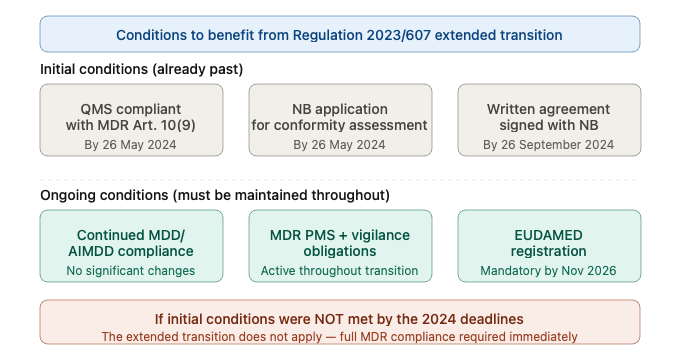
Not every manufacturer of legacy devices benefits from the extended deadlines. Regulation 2023/607 provides that the measures should not be applied indiscriminately, but only to companies that had already embarked on the path of MDR compliance. All three qualifying conditions had deadlines in 2024, and all three have passed.
| Condition | What was required | By when | Evidence to hold on file |
|---|---|---|---|
| 1 · Quality management system | A QMS in line with MDR Article 10(9) implemented and operating | 26 May 2024 | QMS documentation with effective dates; ISO 13485 certificate where held |
| 2 · Formal application | Application lodged with an MDR-designated Notified Body for conformity assessment of the legacy device | 26 May 2024 | Dated application and the Notified Body’s acknowledgement of receipt |
| 3 · Written agreement | A signed written agreement with the Notified Body covering the conformity assessment | 26 September 2024 | Countersigned agreement identifying the devices in scope |
| Alternative route | For certificates that expired before 20 March 2023: a signed written agreement in place, or a Competent Authority derogation granted, before expiry | Before certificate expiry | Agreement or Article 59(1) / 97(1) decision |
If your company did not meet these conditions, the extended transition deadlines do not apply to your devices. Your MDD/AIMDD legacy devices are not entitled to remain on the EU market under the transitional provisions, and full MDR compliance is required now, not in 2027 or 2028.
Beyond the three entry conditions, the extension is not unconditional for the rest of its duration. The device must continue to comply with the directive under which it was certified, must not undergo significant changes in design or intended purpose, and must not present an unacceptable risk to health and safety. Any of the three failing removes the benefit of the extension.
The 26 May 2026 deadline — what happened, and what it means now
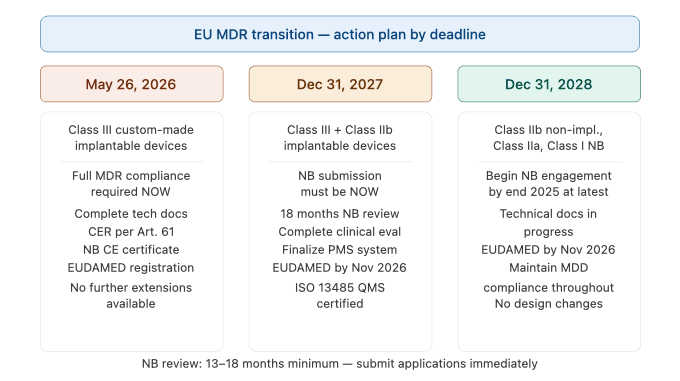
The 26 May 2026 deadline was the first hard date under the extended transition, and it applied exclusively to Class III custom-made implantable devices. Custom-made devices in this category sit under their own transitional provision, separate from the general legacy device framework governing the 2027 and 2028 deadlines.
That date has now passed, and no further extension exists for this category. In practice this means:
- A Class III custom-made implantable device without MDR conformity can no longer be placed on the EU market.
- Devices already supplied to healthcare institutions before the deadline may continue to be used — the distinction between placing on the market and use in the field still applies.
- Manufacturers who did not complete the transition and continue to supply are outside the transitional provisions entirely, and exposed to market surveillance action.
For any manufacturer still working through this category, full MDR compliance means all of the following:
- Complete technical documentation per Annex II and Annex III of EU MDR 2017/745
- Clinical evaluation report meeting the requirements of MDR Article 61 and Annex XIV
- Post-market surveillance plan and system in place
- Quality management system compliant with MDR Article 10(9) — typically demonstrated through ISO 13485 certification
- EUDAMED registration of the device and the manufacturer
- The conformity assessment route required for custom-made Class III implantables, which involves a Notified Body
The 31 December 2027 deadline — high-risk devices
The 31 December 2027 deadline is the most consequential for the majority of high-risk medical device manufacturers. It applies to all Class III devices other than custom-made implantables, and to Class IIb implantable devices other than those on the exception list — sutures, staples, dental fillings, dental braces, tooth crowns, screws, wedges, plates, wires, pins, clips and connectors, which fall under 2028.
Notified Bodies report that the average time for a successful MDR certification review is 13 to 18 months, and for complex devices it can be longer. Measured against that, the window has effectively closed: a manufacturer starting a conformity assessment in the second half of 2026 has less time remaining than a typical review takes.
This is the practical implication of the 2027 deadline. If your conformity assessment is not already well advanced, the realistic planning assumption is that certification will not be complete by 31 December 2027 — and the conversation to have with your Notified Body now is about their queue position and their view of your file, not about whether to submit.
What must be complete and submitted to the Notified Body for Class III devices:
Technical documentation (Annex II/III): Complete device description, design and manufacturing information, general safety and performance requirements (GSPR) checklist, risk management file per ISO 14971, clinical evaluation report per Article 61 and Annex XIV, post-market surveillance plan, and labelling and IFU in all required EU languages. See the EU MDR technical documentation guide for the full breakdown.
Clinical evaluation: For Class III devices, the clinical evaluation requirements under EU MDR are significantly more demanding than under the MDD. The CER must demonstrate clinical evidence sufficient to support the device’s claims, and for many devices this will require clinical investigation data or a robust equivalence demonstration under MDCG 2020-5 criteria.
Quality management system: Full MDR-compliant QMS, typically ISO 13485 certified, covering design and development, manufacturing, post-market surveillance, CAPA, and all MDR-specific requirements including PRRC designation.
The 31 December 2028 deadline — lower-risk devices
The 31 December 2028 deadline applies to Class IIb non-implantable devices, the implantable exceptions listed above, Class IIa devices, Class I devices that are sterile or have a measuring function or are reusable surgical instruments, and Class I devices self-certified under the MDD but up-classified under MDR.
Two and a half years sounds comfortable. It is not, for two reasons.
The first is EUDAMED. Legacy devices must be registered by 27 November 2026 — under four months away at the time of writing — regardless of whether the transition deadline is 2027 or 2028.
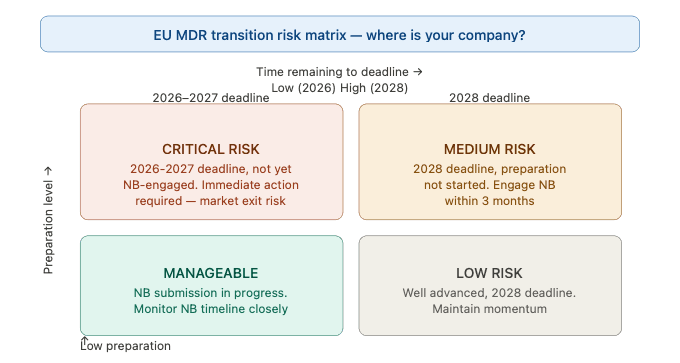
The second is the preparation timeline. For Class IIa and non-implantable Class IIb devices, the path from starting technical documentation to holding a CE certificate typically runs 18 to 24 months. Add the Notified Body queue on top and a manufacturer who has not yet begun substantive MDR compliance work in August 2026 is already behind schedule for 2028.
Find the documentation you need — instantly.
- ✓ Complete bundles or individual packages
- ✓ 45 process packages from €69 each
- ✓ ISO 13485 · MDSAP · Combined Kit
EUDAMED — the next mandatory deadline, 27 November 2026
Of everything on this page, the EUDAMED obligation is the one closest at hand and the one most frequently overlooked. Regulation 2024/1860 changed how the database goes live: instead of waiting for every module to be ready, EUDAMED becomes mandatory module by module.
Actor registration: Already mandatory. Every manufacturer placing medical devices on the EU market must be registered as an Actor before doing so.
UDI and device registration: Legacy devices must be registered by 27 November 2026. This applies even to legacy devices still operating under the MDD/AIMDD transitional provisions, and it does not move with your class deadline.
Vigilance and post-market surveillance modules: Expected to become mandatory progressively through 2026 and 2027.
EUDAMED registration is not an administrative formality. It requires manufacturers to assign Unique Device Identifiers to their devices, register every model and variant, maintain accurate product information, and link the registration to their Notified Body certificates. For a manufacturer with a large portfolio, the data preparation alone can take months — which, with under four months remaining, is the reason this belongs at the top of the August 2026 to-do list rather than the bottom.
The Notified Body bottleneck — the most urgent risk
The final phase of the MDR transition tests more than regulatory compliance — it tests operational resilience across the industry. The remainder of 2026 and 2027 will be the most demanding stretch yet, and those who delay face certification gaps, market disruption, or withdrawal of devices from the EU market.
The capacity constraint is not theoretical. The number of MDR-designated Notified Bodies remains limited, review queues are growing, and the complexity of MDR technical documentation means review cycles are substantially longer than under the MDD.
Data presented by Team-NB indicates that Notified Body reviews of technical documentation under MDR 2017/745 mostly take up to 18 months. Applied to the calendar, that does not leave room for a review begun in 2026 to complete comfortably before the 2027 deadline, nor for one begun in 2027 to complete before 2028.
The practical implication is stark: for the 2027 deadline, manufacturers not already deep into conformity assessment are at serious risk of missing it, regardless of how well-prepared their technical documentation is. Notified Body slots are finite, and the industry-wide rush toward 2027 and 2028 is creating a bottleneck that will worsen as the dates approach.
How to demonstrate legacy device status
A practical challenge many manufacturers face is how to demonstrate to customers, distributors, and market surveillance authorities that their legacy devices remain legally on the market despite apparently expired MDD certificates. No new certificates with new expiry dates are issued by Notified Bodies under the MDD or AIMDD — the extension of a certificate’s validity happens automatically by law, for as long as the conditions are fulfilled.
The European Commission and industry associations have outlined three approaches:
Manufacturer self-declaration: A statement confirming that the extension requirements of Regulation 2023/607 have been fulfilled, clearly identifying the devices covered and the CE certificates to which it applies. MedTech Europe has published a template for this purpose.
Notified Body confirmation letter: A letter from the Notified Body stating that it received the manufacturer’s application and concluded a written agreement, identifying the devices covered and the applicable certificates.
Certificate of Free Sale: Manufacturers or their authorised representatives can request one from a Competent Authority, which can be issued noting the extended CE marking validity period.
Any of these, provided to customers or customs authorities, serves as evidence that the device remains legally on the EU market despite an expired certificate date.
What happens if you miss the deadline?
The consequences of failing to achieve MDR compliance by the applicable deadline are immediate. A device without a valid MDR CE certificate by its deadline — and not qualifying for the transitional provisions — must be withdrawn from the EU market. It cannot be placed on the market, sold to distributors, or transferred to end users.
Devices already placed on the market may continue to be made available and used — this is the practical effect of the removal of the sell-off period by Regulation 2023/607. However, no new stock can be placed on the EU market after the deadline. For manufacturers with complex supply chains, the distinction between placed on the market and in use requires careful legal analysis, because it determines what remains saleable in the distribution channel.
The financial consequences of a market withdrawal can be severe, particularly for manufacturers who rely on the EU for a significant portion of their revenue. Beyond the immediate revenue impact, there is the reputational damage, the cost of emergency regulatory remediation, and the effect on patients who depend on the device.
Practical action plan for manufacturers
Whichever deadline applies to your devices, the actions are fundamentally the same — only the urgency differs.
Now — register in EUDAMED. This is the nearest obligation and the one most often left late. Legacy device registration closes on 27 November 2026, regardless of your class deadline. Begin UDI assignment and data preparation immediately; for a large portfolio this is a project, not a task.
Now — assess your portfolio status. Map every product against the transition deadlines. For each device, determine whether it qualifies as a legacy device under Regulation 2023/607, which deadline applies, and whether the 2024 qualification conditions were met and can be evidenced. Any device where the answer to the last question is uncertain needs resolving first, because the whole extension rests on it.
Now — talk to your Notified Body about queue position. If discussions have not started, they should start immediately. If they have, the useful question in August 2026 is no longer whether to submit but where your file sits in the queue and what would move it.
Within 3 months — complete your technical documentation gap analysis. Compare your existing MDD technical file against the EU MDR Annex II and III requirements. The most significant gaps are usually in clinical evaluation depth, post-market surveillance, and EUDAMED-related documentation.
Ongoing — maintain full MDD/AIMDD compliance. Until MDR certification is achieved, the legacy device must remain fully compliant with the directive under which it was certified. Any significant design change risks invalidating the extension entirely.
Frequently asked questions
When does the MDR transition period end?
It ends on different dates depending on device class. 26 May 2026 for Class III custom-made implantable devices, which has passed. 31 December 2027 for Class III devices and most implantable Class IIb devices. 31 December 2028 for Class IIa, non-implantable Class IIb, Class Is/Im/Ir, the listed implantable exceptions, and Class I devices up-classified under MDR. All of these apply only to manufacturers who met the three qualifying conditions in 2024.
How long is the MDR transition period?
The original transition ran from 26 May 2021 to 26 May 2024. Regulation (EU) 2023/607 extended it to 31 December 2027 or 31 December 2028 according to risk class, and removed the sell-off deadline that had previously limited how long existing stock could be sold.
Can I still sell my MDD-certified device in the EU after the transition deadline?
No — once the deadline for your device class has passed, you cannot place new stock on the EU market without a valid MDR CE certificate. Stock already placed on the market before the deadline, meaning transferred to distributors or end users, can continue to be made available and used. New placements require MDR certification.
Do I need a new Notified Body for my MDR certification?
Not necessarily. If your MDD Notified Body is also designated under EU MDR, you can continue with them. If it is not MDR-designated, you must engage one that is. The NANDO database holds the current list of MDR-designated Notified Bodies.
My MDD certificate expired before 20 March 2023 — can I still benefit from the transition?
Potentially yes, if you had a signed written agreement with a Notified Body for MDR conformity assessment before the certificate expired, or if you obtained an Article 59(1) derogation or Article 97(1) authorisation before expiry. The conditions are complex and warrant specialist regulatory advice.
What counts as a “significant change” that would invalidate my legacy device status?
MDCG 2020-3 provides the guidance. Broadly, changes affecting the device’s safety, performance, or intended purpose — design, materials, manufacturing processes, or sterilisation methods — are likely to be significant. Minor changes to labelling or documentation generally are not. Where uncertain, seek Notified Body confirmation before making the change, not after.
Is EUDAMED registration mandatory for legacy devices?
Yes. Even legacy devices operating under the transitional provisions must be registered. The deadline is 27 November 2026, regardless of whether the device’s transition deadline is 2027 or 2028.
Conclusions
The EU MDR transition deadlines represent the final chapter of one of the most complex regulatory transitions in the history of the medical device industry. The extended timeline provided by Regulation 2023/607 was a necessary response to Notified Body capacity and industry readiness — but the extensions have an end, and for one category that end has already arrived.
For Class III custom-made implantable devices, 26 May 2026 has passed and no further extension exists. For Class III and implantable Class IIb devices, 31 December 2027 is now closer than a typical Notified Body review cycle, which means the decisive variable is queue position rather than submission date. For everything else, 31 December 2028 offers more room — but the EUDAMED obligation on 27 November 2026 lands first, and applies whatever your class deadline is.
The manufacturers who will navigate the remaining dates successfully are those treating MDR compliance not as a regulatory burden but as a business-critical project — with dedicated resources, proactive Notified Body engagement, and technical documentation work that is already under way.
Related articles