ISO 20916: Good Study Practice for IVD Performance Studies
Table of Contents
- Introduction
- What changed when ISO 20916 became a harmonised standard
- What the standard covers, and the studies it deliberately leaves out
- How much of the standard applies to your study
- Ethical considerations, and the consent problem that is specific to IVDs
- Planning is clause 5, and clause 5 is most of the standard
- Initiation, conduct and monitoring
- Close-out, the study report and what has to be retained
- Adverse events for an IVD, and the false result rule
- The banked specimen trap
- What ISO 20916 is used to raise
- Frequently asked questions
- Conclusions
Introduction
ISO 20916 stopped being optional reading the moment EN ISO 20916:2024 was cited in the Official Journal in support of the IVDR, and most manufacturers have not adjusted. A harmonised standard confers a presumption of conformity with the general safety and performance requirements it covers, which changes the burden of argument: applying it is now the default, and departing from it is the position that has to be justified in the file rather than in a conversation with an assessor.
This guide walks the standard in the order it runs a study — ethics, planning, initiation, conduct, close-out, audit — and stops at the three points where it collides productively with the IVDR: one protocol or two, what counts as an adverse event when the device never touches the patient, and the specimen selection decision that quietly determines whether the sensitivity claim will survive the market. For the regulatory frame around all of it, start with the IVDR guide, and for whether your study needs an authorisation before it starts, the MDCG 2025-5 guide works through the pathway.
What changed when ISO 20916 became a harmonised standard
ISO 20916:2019 was published in May 2019 by ISO/TC 212 as the first edition of a standard on clinical performance studies for in vitro diagnostics. CEN adopted the text without modification as EN ISO 20916:2024, adding an Annex ZA that maps the standard's normative clauses to the general safety and performance requirements of Regulation (EU) 2017/746 and to the system and process requirements around them — quality management, risk management, post-market surveillance, performance studies, clinical evidence and post-market performance follow-up. MDCG 2025-10 lists it among the documents it was drafted against, and records that it is harmonised and cited in the Official Journal in support of the IVDR.
Two practical consequences follow, and neither is about compliance in the abstract. The first is that compliance with the normative clauses listed in Table ZA.1 gives a presumption of conformity with the requirements they cover, within the limits of the standard's scope. That presumption is worth having and it is not free: it applies to the clauses you actually complied with, which means the file has to show which ones.
The second is the change in default. Before harmonisation, a sponsor could reasonably run a clinical performance study to an internal procedure and reference ISO 20916 as one input among several. After it, a notified body reviewing a performance evaluation encounters a harmonised standard covering exactly the activity that produced the data, and a study run outside it needs an explanation that stands up. That explanation exists — the standard is voluntary, and alternative means of meeting the requirements are permitted — but it has to be written, and it is a harder document to write than a gap analysis.
What the standard covers, and the studies it deliberately leaves out
ISO 20916 defines good study practice for the planning, design, conduct, recording and reporting of clinical performance studies carried out to assess the clinical performance and safety of IVDs for regulatory purposes. The scope statement sets four intentions: that the conduct of the study leads to reliable and robust results, that the responsibilities of the sponsor and the principal investigator are defined, that sponsors, contract research organisations, investigators, ethics committees, regulatory authorities and conformity assessment bodies are assisted, and that the rights, safety, dignity and well-being of the subjects providing specimens are protected.
Three exclusions matter. Analytical performance studies are outside the scope — though the standard notes that where specimens are collected specifically for an analytical study and the collection creates additional risk for subjects, its elements and particularly its annexes can be useful for subject safety. Studies run for purposes other than pre-market and post-market regulatory ones, reimbursement being the named example, are outside it. And it does not address whether the technical specifications of the device are adequately covered by the study, which is a performance evaluation question rather than a good study practice one.
The most consequential boundary is with ISO 14155. That standard excludes IVDs from its scope, and ISO 20916 is explicit that except in one situation the two should not be read together. The exception is an integrated system in which an IVD and a medical device are used together — the standard's own example is a lancet, a test strip and a glucose meter — where the jurisdiction's classification decides which regulation applies and aspects of both standards may need to be considered. Outside that case, importing ISO 14155 habits into an IVD study imports definitions that were written for a different risk model.
How much of the standard applies to your study
ISO 20916 is not applied uniformly, and the flowchart in its introduction exists to sort studies into tiers. The main body of the document, together with Annex G on adverse event categorisation, contains the minimum requirements for all studies. No additional requirements apply to studies using left-over or archived specimens, or to studies where the specimen collection procedures pose no additional risk to the subject.
Additional requirements sit in Annexes A to F, and they apply to two kinds of study: interventional studies, and studies in which the specimen collection procedures pose a risk to subjects recruited primarily for the study. The standard's reasoning is that the nature of these studies warrants an increased level of stringency in how they are conducted, and the annexes cover the areas where that stringency bites — additional general requirements, the protocol, the investigator brochure, the study report, communication with the ethics committee, and informed consent.

The two questions are the same two questions the IVDR asks. Does the collection procedure put a recruited subject at risk, and do the results influence patient management during the study? ISO 20916 uses the answers to decide how much of the standard applies; the IVDR uses them to decide between an application, a notification and neither. Answering them once, in the risk evaluation, settles both.
Ethical considerations, and the consent problem that is specific to IVDs
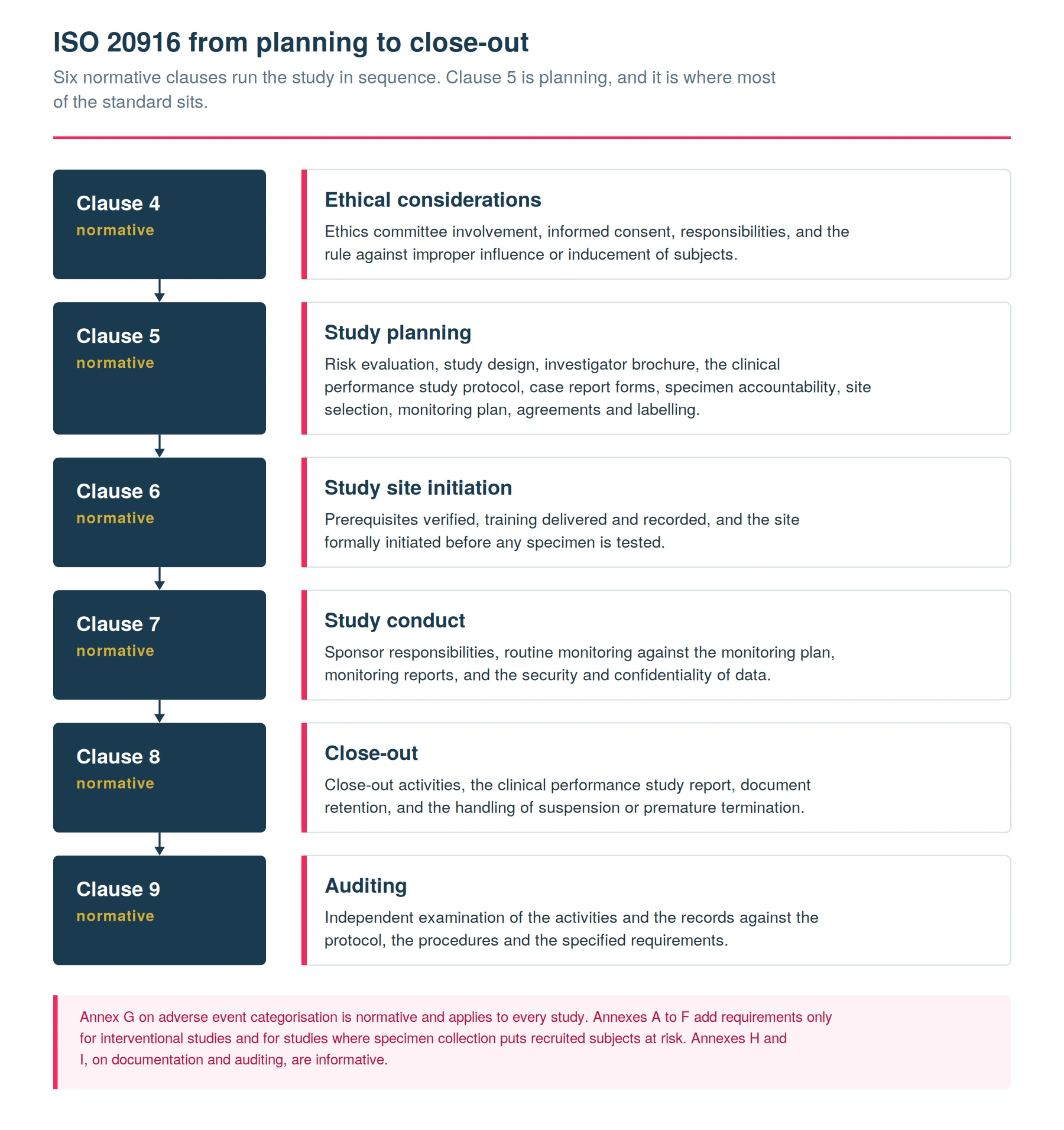
Clause 4 covers ethical considerations: general principles, improper influence or inducement, responsibilities, ethics committee involvement and informed consent. The framework is the familiar one, and the IVD-specific difficulty is in the last of those.
The standard's introduction states the problem directly. Because IVD studies rely on specimens taken from the body and the device never contacts the patient, the issues around obtaining informed consent differ from those of other medical devices, especially for studies using left-over or archived specimens. A specimen that would otherwise have been discarded, from a person with no remaining clinical need for it, raises a consent question with a different shape from that of a subject undergoing a procedure. The standard notes that the information provided can be broad, allowing the specimen to be used for future undetermined studies, or specific to a particular study — and national law, which the IVDR does not harmonise on ethics review, decides which is available to you.
Vulnerable subjects receive a similarly proportionate treatment: for the majority of IVD clinical performance studies the issue might not arise, but it is to be considered case by case. That phrasing is an instruction to record the consideration, not permission to skip it.
Planning is clause 5, and clause 5 is most of the standard
Clause 5 covers risk evaluation, the design of the study, the investigator brochure, the clinical performance study protocol, case report forms, the recording of specimen information, specimen accountability and integrity, study site selection, the monitoring plan, agreements and labelling. It is the longest clause in the document and it is where a study is won or lost, because every failure in the sections below is a planning decision that analysis cannot repair.
Risk evaluation comes before the design, not after it
Clause 5.2 places risk evaluation before the design of the study in clause 5.3, and the order is deliberate. For an IVD the risks in play are of two kinds and they arise from different places. Direct harm comes from the specimen collection procedure — the standard names lumbar puncture, tissue biopsy and blood collection from neonates or critically ill patients as examples where collection creates additional risk. Indirect harm comes from the information the device produces, where a false negative or false positive result leads to an inappropriate patient management decision.
Those two risks drive different mitigations and they drive the study tier. A study on left-over specimens has neither, which is why the standard adds nothing to the main body for it. A study recruiting subjects for a biopsy has the first. An interventional study has the second, and possibly both. Doing the risk evaluation properly is therefore not a documentation exercise appended to the protocol: it determines which annexes apply, which IVDR article the study falls under, and what the ethics committee will be asked to approve. The ISO 14971 risk management process the device already runs is the natural home for the indirect-harm chain, and the study risk evaluation should be traceable to it rather than parallel with it.
The protocol, and why you should only write one of them
Clause 5.5 covers the clinical performance study protocol — the CPSP — with subclauses on general requirements, the responsibilities of the principal investigator and the contents of the protocol, supported by normative Annex B. The standard defines the CPSP as the document stating the rationale, objectives, design, risk, proposed analysis, methodology, monitoring, conduct and record keeping of the study, and it notes that the CPSP need not be a single document: it can be a series of related and cross-referenced documents.
Here the standard and the Regulation converge on the same artefact under two names. IVDR Annex XIII section 2.3.2 sets out what the clinical performance study plan must contain, and it is the document a competent authority receives with an application under Article 66. ISO 20916 clause 5.5 and Annex B set out what the protocol must contain. They are not in conflict, and they are not the same list — which is exactly why writing both as separate documents produces two versions of the truth that drift apart at the first amendment.
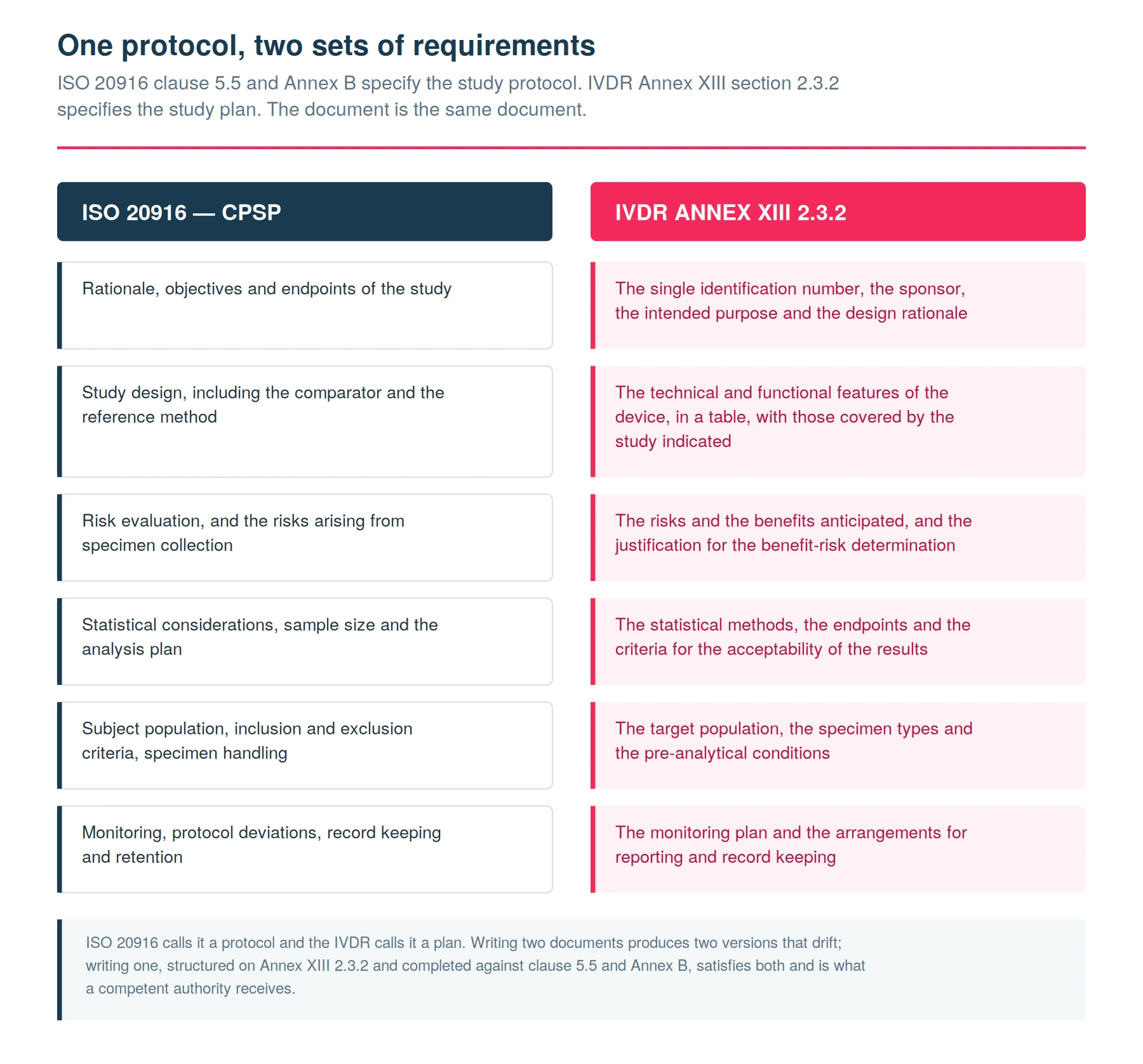
The workable approach is to structure the document on Annex XIII section 2.3.2, because that is the structure the assessor reads against, and then complete it against clause 5.5 and Annex B so that nothing the standard requires is missing. Where the standard asks for something the Regulation does not — the monitoring plan and the arrangements for protocol deviations are the clearest examples — it goes in as an additional section rather than into a separate file. One document, one version history, one set of amendments to notify.
Specimen accountability, sites, monitoring and labelling
The remaining subclauses of clause 5 are the ones sponsors treat as administrative and auditors treat as evidence. Clause 5.7 covers the recording of specimen information and clause 5.8 covers specimen accountability and integrity: what was collected, where it went, how it was stored, what condition it was in when tested. These are normative requirements, and their failure mode is specific — a chain-of-custody gap does not make a result wrong, it makes the claim that the result came from the specimen it is attributed to unverifiable, which for a diagnostic study is the same thing.
Clause 5.9 splits site selection into qualification, assessment and selection, which is a useful discipline for IVD studies where a site may be a collecting hospital, a testing laboratory, or both. Clause 5.10 requires a monitoring plan, clause 5.11 covers the agreements between the parties, and clause 5.12 covers labelling of the device for performance study. On labelling, the IVDR overlays its own requirement through Annex XIV, and the practical point from MDCG 2025-5 applies here too: comprehension of the instructions matters most at the sites handling specimens, and the pre-analytical sections are the ones that have to be understood locally.
✦ EU IVDR DOCUMENTATION KITOne study plan, structured the way an assessor reads it.
Clinical Performance Study Plan built on Annex XIII section 2.3.2 and completed against ISO 20916 clause 5.5, with the technical and functional features as a table, the monitoring plan and deviation handling inside it, and the Clinical Performance Report, Performance Evaluation Plan and Performance Evaluation Report the study data have to feed.- ✓ Word templates · Annex XIII Part A and Part B · ISO 20916 and MDCG 2025-5 integrated
- ✓ Compliance checklists against 1.1, 1.2, 1.3 and 2.3.2 in every document
Initiation, conduct and monitoring
Clause 6 governs study site initiation, and it is short because it is a gate rather than a process: prerequisites are verified, training is delivered, and the site is formally initiated. Nothing is tested before that. The training requirement is the one most frequently under-documented, because in an IVD study the people who need it are laboratory staff who already run assays competently — and the training that matters is not how to run an assay but how to run this protocol, including which specimens are eligible, how deviations are recorded, and what happens to a result that falls outside the expected range.
Clause 7 covers conduct: the responsibilities of the sponsor, study site monitoring split into general requirements, routine monitoring and monitoring reports, and the security and confidentiality of data. Monitoring is where a sponsor's own quality system usually needs extending, because it requires a person qualified by education, training or experience whose job is to review the progress of the study against the protocol and the written procedures. The standard requires written procedures for the study processes; a sponsor relying on general quality system documents without study-specific procedures for monitoring, deviations and specimen accountability has a gap that an audit finds before it finds anything else.
Data security and confidentiality sit inside the standard rather than beside it, which aligns with Article 57 IVDR requiring compliance with applicable data protection law across every performance study. For a study whose entire content is health data linked to identifiable specimens, this is not a footnote.
Close-out, the study report and what has to be retained
Clause 8 covers close-out activities, the clinical performance study report, document retention, and suspension or premature termination. The report — the CPSR — is defined as the document describing the objectives, design, execution, statistical analysis, results and conclusions of the study, and, like the protocol, it need not be a single document: elements can sit in stand-alone documents referenced from it, and normative Annex D sets out what it has to contain.
The report is where the study meets the performance evaluation. Under Annex XIII section 2.1, data obtained from a clinical performance study is used in the performance evaluation process and forms part of the clinical evidence for the device, which means the CPSR is an input to the clinical performance report rather than a substitute for it. A file that submits a study report where a clinical performance report is expected has conflated a study with the evaluation of its evidence.
Suspension and premature termination deserve a plan before they are needed. A study stopped early produces data that either supports a claim or does not, and the reasons for stopping become part of the record either way — as does the handling of subjects, specimens and sites at the point of termination. Under the IVDR this connects to the notification obligations around performance studies, and under Article 76 to safety reporting, which runs on its own track through MDCG 2024-4 regardless of the study's status.
Adverse events for an IVD, and the false result rule
Annex G on adverse event categorisation is normative and applies to every study, including the ones that need nothing else from the annexes. It is also the place where a team arriving from medical device or medicinal product studies is most likely to get the wrong answer, because the definition of an adverse event has been adapted for a device that never touches the patient.
An adverse event under ISO 20916 is any untoward medical occurrence, inappropriate patient management decision, unintended disease or injury, or untoward clinical sign in subjects, users or other persons with any connection to study-related activities, whether or not related to the device under investigation. The inclusion of an inappropriate patient management decision in that list is the IVD-specific element, and the note that follows completes it: false negative or false positive results are not considered adverse events unless, in an interventional study, inappropriate patient management decisions are made on the basis of those false results.
That rule does real work. In a study on left-over specimens, a discordant result is a data point about device performance. In an interventional study, the same discordant result that changes what happens to a patient is an adverse event, with everything that follows from that classification in the study records and in the safety reporting. The design of the study, not the behaviour of the device, decides which of the two you are looking at — and the classification has to be settled in the protocol, before the first discordance appears.
The banked specimen trap
Most IVD studies use left-over or archived specimens, and the standard says so plainly in its introduction. That route is legitimate, it is efficient, and it carries a design failure that is almost invisible in the study report and obvious in the market.
The failure is specimen selection. A repository lets you choose, and choosing well by intuition means choosing unambiguous cases: clear positives with high analyte concentrations and confirmed diagnoses, clear negatives from apparently healthy donors. A device evaluated against that set will report high diagnostic sensitivity and specificity, and both figures will be about a population that does not present in clinical practice — where the difficult cases are early disease, low concentrations, comorbidity, interfering conditions and the differential diagnoses the test is supposed to help resolve. The performance drops in the field, the complaint rate rises, and the post-market surveillance system has a signal that traces back to a decision made when the specimens were pulled.
Three practices in the standard bear directly on this and are easy to apply. The specimen set has to reflect the intended population and the clinical indications stated in the intended purpose, which is a design requirement in clause 5.3 rather than a statistical preference. Blinding, defined in clause 3.8 as a procedure keeping one or more parties unaware of the condition, prior test results or demographics behind a specimen, exists precisely to stop the known answer influencing the reading — and where interpretation is subjective, an unblinded study answers a different question from the one it claims to. And the recording of specimen information under clause 5.7 has to capture enough about each specimen's origin for anyone reviewing the study to see what population it actually represents.
The consequence reaches further than the study. The acceptance criteria in the performance evaluation plan are set against the state of the art and the risk management output for the intended population; if the specimen set does not represent that population, the criteria were met against the wrong denominator, and the performance evaluation report that reconciles them is reconciling nothing.
✦ RISK MANAGEMENT DOCUMENTATION KITThe risk evaluation clause 5.2 expects you to have already done.
Risk Management Plan, Risk Management Report, Hazard Analysis built on the ISO/TR 24971 Annex A questions, and Design and Use-related FMEA as active Excel worksheets with auto-calculated RPN — aligned with EN ISO 14971:2019/A11:2021, and the place the indirect-harm chain from a false result to a patient management decision is documented once and reused by every study.- ✓ 6 coordinated templates · Word and Excel · 90 working formulas per FMEA
- ✓ Buying the 6 templates individually costs €414
What ISO 20916 is used to raise
Now that the standard is harmonised, findings are increasingly written against its clause numbers rather than against general expectations of study quality — which makes them more specific and harder to argue with.
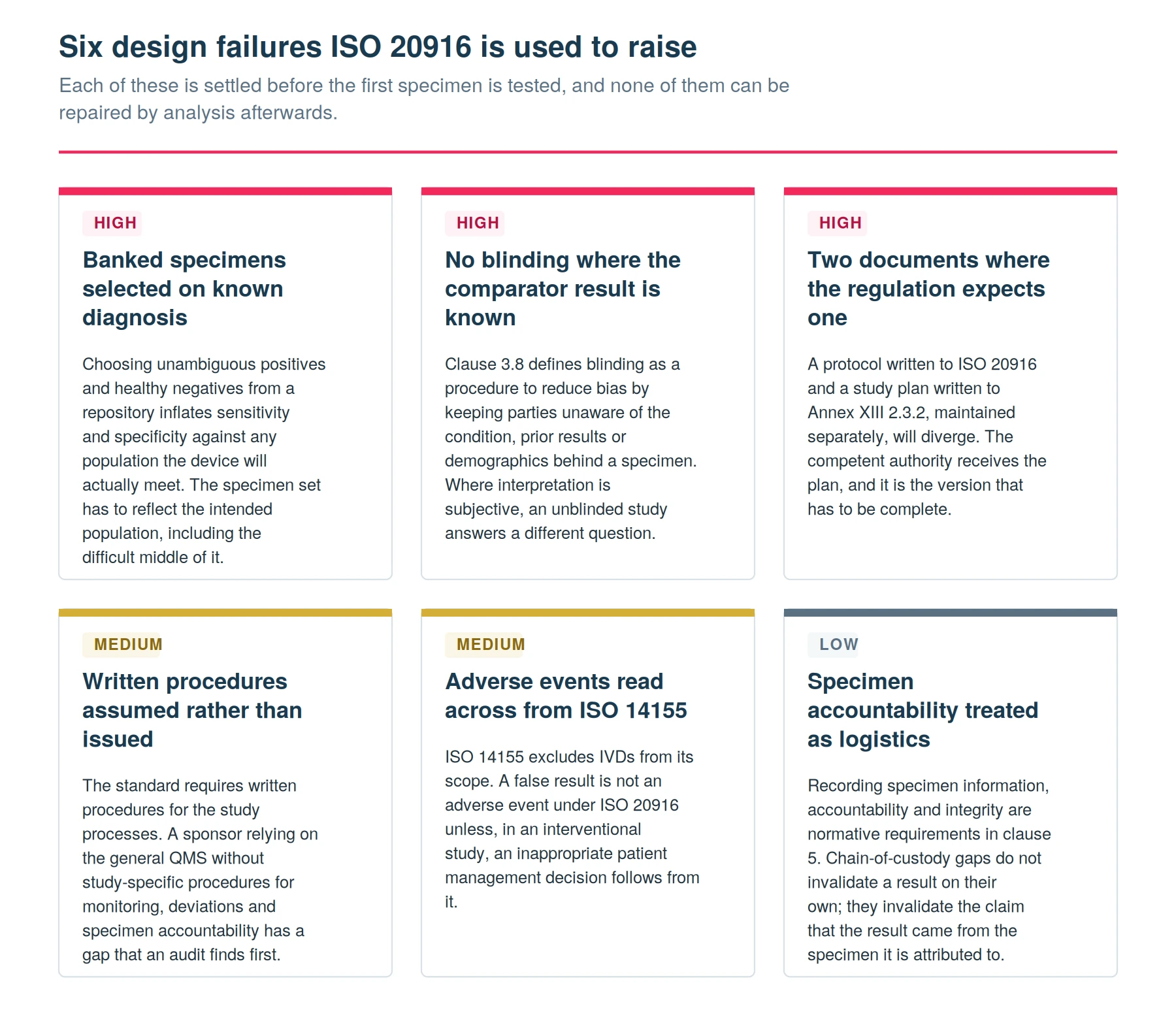
The specimen selection failure is the most expensive because it cannot be corrected without repeating the study, and it is the one most likely to be defended rather than fixed: the sponsor points to a high sensitivity figure, and the figure is real. It is simply a figure about a set of specimens rather than about a population. The blinding failure has the same character and a cheaper remedy, because blinding costs process rather than specimens.
The two-document failure is structural and entirely avoidable, and it produces a specific downstream problem: a substantial modification under Article 71 has to be notified within one week of the updated documents being issued, and a sponsor maintaining a protocol and a plan separately has two issue dates for one change. The written procedures failure is the classic quality system gap, made likelier by the fact that IVD sponsors usually do have procedures — for the laboratory, not for the study.
The adverse event failure and the specimen accountability failure sit at opposite ends of severity and share a cause: both come from applying a framework built for a different kind of device. ISO 14155 excludes IVDs deliberately, and every definition it contains that ISO 20916 restates has been modified in the restating.
Frequently asked questions
What is ISO 20916?
ISO 20916:2019 is the international standard defining good study practice for the planning, design, conduct, recording and reporting of clinical performance studies of in vitro diagnostic medical devices carried out for regulatory purposes. It was published in May 2019 by ISO/TC 212 and adopted by CEN without modification as EN ISO 20916:2024, which is harmonised and cited in the Official Journal in support of the IVDR.
Is ISO 20916 mandatory under the IVDR?
No standard is mandatory. But EN ISO 20916:2024 is harmonised, so complying with its normative clauses confers a presumption of conformity with the general safety and performance requirements they cover, within the limits of its scope. In practice that reverses the burden of argument: applying it is the default, and a study run outside it needs a justification in the file.
Does ISO 20916 cover analytical performance studies?
No. Analytical performance studies are explicitly outside its scope. The standard notes that where specimens are collected specifically for an analytical performance study and the collection creates additional risk for subjects, some of its elements — particularly the annexes — can be useful for ensuring subject safety, but the requirements of the standard do not apply to those studies.
Which annexes of ISO 20916 apply to my study?
The main body and Annex G apply to every study. Annexes A to F add requirements for interventional studies and for studies where the specimen collection procedures pose a risk to subjects recruited primarily for the study. Studies using left-over or archived specimens, and studies whose collection procedures pose no additional risk, need nothing beyond the main body and Annex G.
Is a false result an adverse event?
Not in itself. Under ISO 20916 a false negative or false positive result is not an adverse event unless, in an interventional study, an inappropriate patient management decision is made on the basis of that false result. The definition of an adverse event does include inappropriate patient management decisions, which is the IVD-specific element and the reason ISO 14155 definitions do not transfer.
Do I need both a study protocol and a study plan?
One document satisfies both. ISO 20916 calls it a clinical performance study protocol and specifies its contents in clause 5.5 and Annex B; the IVDR calls it a clinical performance study plan and specifies its contents in Annex XIII section 2.3.2. Structuring the document on the Annex XIII list and completing it against the standard produces one version to amend and one document for the competent authority.
Can ISO 14155 be used for an IVD study?
No. ISO 14155 excludes in vitro diagnostic medical devices from its scope, and ISO 20916 states that except in one situation the two should not be read together. The exception is an integrated system combining an IVD and a medical device — a lancet, a test strip and a meter, for example — where the classification in the relevant jurisdiction decides which regulation applies and aspects of both standards may need to be considered.
Conclusions
ISO 20916 is a short standard with a specific job: making a clinical performance study produce results that can be relied on, while protecting the people whose specimens made it possible. Harmonisation has not changed its content and has changed its weight, and a sponsor still running studies to an internal procedure now has a document to reconcile against rather than a reference to cite.
Three points carry most of the value. The flowchart decides how much of the standard applies, and the two questions behind it — collection risk and interventional design — are the same two questions that decide the IVDR submission route, so answer them once. Write one protocol, structured on Annex XIII section 2.3.2 and completed against clause 5.5, because two documents become two versions at the first amendment. And treat specimen selection as the design decision it is: a set of unambiguous cases from a repository will produce sensitivity and specificity figures that are true about the set and misleading about the population the device will meet.
The EU IVDR Documentation Kit on MD Regulatory includes the Clinical Performance Study Plan built on Annex XIII section 2.3.2 and completed against ISO 20916, the Clinical Performance Report the study data feed, and the Performance Evaluation Plan and Report that assemble the evidence — all aligned with Regulation (EU) 2017/746, MDCG 2022-2 and MDCG 2025-5, and immediately deployable in an existing ISO 13485 quality management system.
Related articles
- IVDR Explained: What Regulation (EU) 2017/746 Requires
- MDCG 2025-5: When an IVD Performance Study Needs Approval
- MDCG 2022-2 Explained: Clinical Evidence for IVDs
- MDCG 2025-10: Post-Market Surveillance Under the IVDR
- ISO 14971 Risk Management
- IVDR Technical Documentation: Annex II Section by Section