IVDR Explained: What Regulation (EU) 2017/746 Requires
Table of Contents
- Introduction
- What the IVDR changed, and why the change was structural
- Which products the IVDR captures, and which it leaves out
- Classification is the decision every other IVDR obligation follows from
- What the class actually costs you at conformity assessment
- The technical documentation the IVDR asks for
- Why the IVDR splits clinical evidence into three reports
- Post-market obligations with no equivalent under the MDR
- Roles, registration and the transition deadlines still running
- Where IVDR technical files most often lose a review cycle
- Frequently asked questions
- Conclusions
Introduction
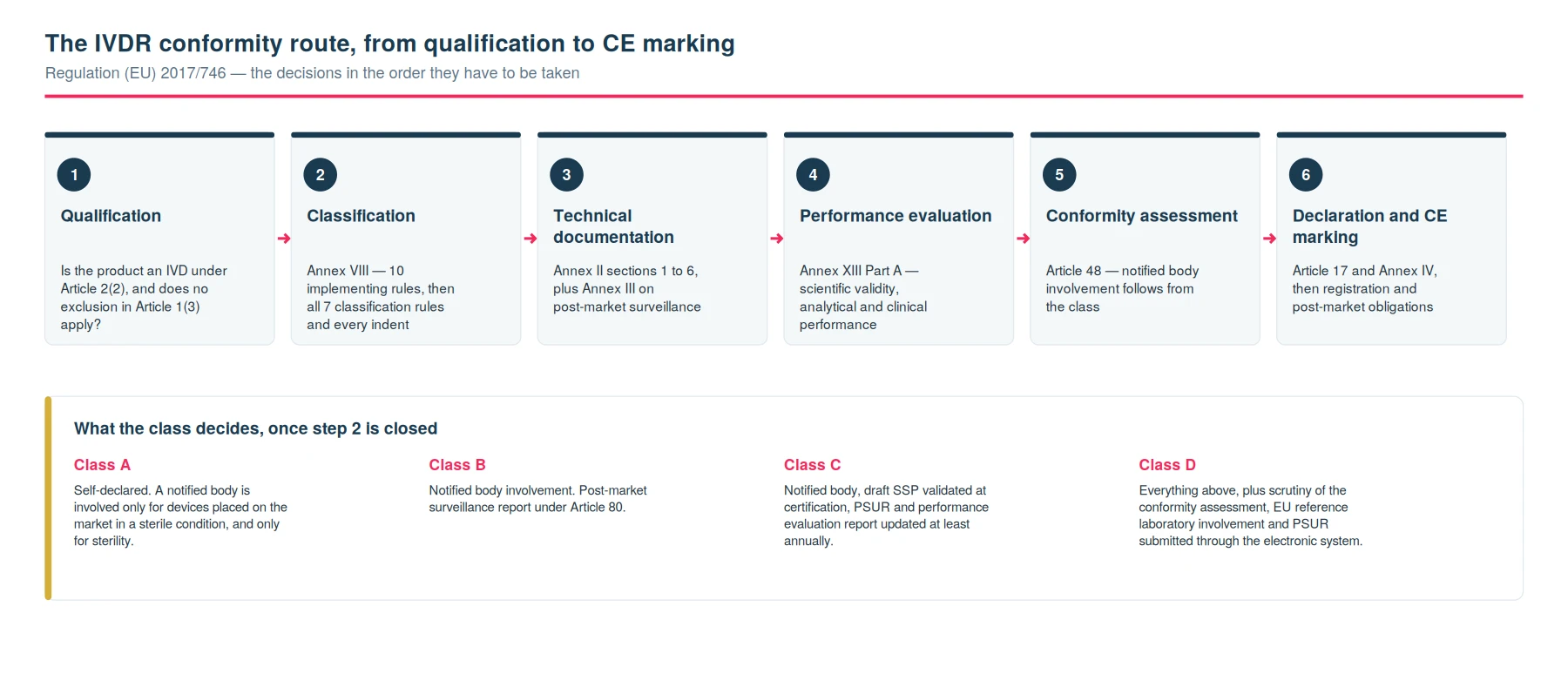
The IVDR is where diagnostic manufacturers discover that a product they self-certified for twenty years is now class C, and that nobody in the building has ever written a performance evaluation report. Regulation (EU) 2017/746 did not tighten the old Directive. It inverted it: under Directive 98/79/EC roughly eight products in ten reached the market on the manufacturer's own declaration, and under the Regulation roughly eight in ten need a notified body. The same product, the same laboratory, the same evidence — and a completely different route to the CE mark.
That inversion is why IVDR projects fail on scope rather than on science. The assay works. What is missing is a classification rationale that survives contact with Annex VIII, a technical file structured to Annex II, and clinical evidence assembled the way Annex XIII asks for it rather than the way the MDR asks for it. This guide walks the Regulation in the order the decisions have to be taken, from qualification to post-market. If you are coming from the medical device side, the EU MDR technical documentation guide covers the parallel structure under Regulation (EU) 2017/745, and the GSPR checklist guide covers the requirement-by-requirement demonstration that both regulations demand.
What the IVDR changed, and why the change was structural
Directive 98/79/EC classified in vitro diagnostics by exception. Two lists — Annex II List A and List B — named the higher-risk products, self-testing devices formed a third category, and everything not named fell into a residual group that the manufacturer certified itself. The list was written in 1998. It named HIV and hepatitis assays, blood grouping reagents, and a short set of infectious disease and tumour markers. It did not name companion diagnostics, next-generation sequencing panels, or software that interprets a result, because none of them existed in the form they exist now.
The Regulation replaced the lists with rules. Annex VIII sets out seven classification rules and ten implementing rules, and every device is worked through all of them. There is no residual category that escapes scrutiny: Rule 6 catches whatever the other six do not, and it places the device in class B, which still requires a notified body. The only devices that reach the market on a manufacturer's declaration alone are class A devices that are not supplied sterile — buffers, washing solutions, general culture media, instruments, specimen receptacles.
Two consequences follow, and they are the ones that reshape a company rather than a document. The first is capacity: a manufacturer that never dealt with a notified body now needs one, and the number of bodies designated under the Regulation is far smaller than the number of manufacturers seeking them. The second is evidence. The Directive asked for performance evaluation in general terms. The Regulation asks for scientific validity, analytical performance and clinical performance as three separately documented reports, assembled into a performance evaluation report under Annex XIII, and kept current for the life of the device.
Which products the IVDR captures, and which it leaves out
Before classification there is qualification, and it is skipped more often than any other step in the file. A manufacturer who has always sold a product as a reagent assumes the answer is obvious and writes nothing down. Annex II then asks for the rationale for qualification as a device, and there is nothing to point at.
Qualification runs through the six purposes of Article 2(2)
Article 2(2) defines an in vitro diagnostic medical device as a reagent, reagent product, calibrator, control material, kit, instrument, apparatus, piece of equipment, software or system, used in vitro for the examination of specimens derived from the human body, solely or principally to provide information on one or more of six purposes: a physiological or pathological process or state; congenital physical or mental impairments; predisposition to a medical condition or disease; safety and compatibility with potential recipients; prediction of treatment response or reactions; and the definition or monitoring of therapeutic measures. Specimen receptacles are deemed to be in vitro diagnostic medical devices in their own right.
Each of the six is assessed and the answer recorded, because the purpose the device serves determines which classification rules can apply to it. A device that predicts treatment response is a candidate for Rule 3(f) and the companion diagnostic route; a device that monitors therapeutic measures may be nothing of the kind. Therapeutic drug monitoring, keeping a medicinal product within its therapeutic window, is expressly not a companion diagnostic purpose, and neither is establishing the dose for a patient already eligible for the medicine. Treating either as a companion diagnostic puts the device in class C and triggers a consultation with a medicines authority that the Regulation never asked for.
| № | Purpose under Article 2(2) | Typical device | Classification rule it opens |
|---|---|---|---|
| a | Concerning a physiological or pathological process or state | Clinical chemistry analyte, infectious disease assay, tumour marker | Rules 1, 2, 3(a)–(e), 3(g)–(m), 6 |
| b | Concerning congenital physical or mental impairments | Newborn screening, pre-natal screening | Rule 3(l), 3(m) |
| c | Concerning the predisposition to a medical condition or a disease | Human genetic testing, hereditary risk panels | Rule 3(i) |
| d | To determine the safety and compatibility with potential recipients | Blood grouping, tissue typing, transmissible agent screening of donations | Rules 1 and 2 |
| e | To predict treatment response or reactions | Companion diagnostic, pharmacogenomic test | Rule 3(f) |
| f | To define or monitor therapeutic measures | Therapeutic drug monitoring, viral load monitoring | Rules 1 third indent, 3(j), 3(k) |
| — | Specimen receptacles, deemed to be devices in their own right | Vacuum blood collection tube, swab transport medium | Rule 5(c) |
Purposes (e) and (f) are the pair that decides most companion diagnostic disputes. Predicting treatment response opens Rule 3(f) and the companion diagnostic route. Defining or monitoring therapeutic measures does not: therapeutic drug monitoring within a therapeutic window, and dose-setting for a patient already eligible for the medicine, are expressly not companion diagnostic purposes.
The four exclusions are narrower than manufacturers expect
Article 1(3) excludes four categories: products for general laboratory use or research-use-only products, unless in view of their characteristics they are specifically intended by their manufacturer for in vitro diagnostic examination; invasive sampling products and products applied directly to the body to obtain a specimen; internationally certified reference materials; and materials used for external quality assessment schemes.
The first exclusion decides the status of most general laboratory products, and it turns entirely on intent. A buffer is outside the Regulation until the manufacturer specifically intends it for in vitro diagnostic examination. Once that intention appears — in the labelling, in the catalogue, in a sales presentation — the product is a device and falls under Rule 5(a). The decision is made by the marketing material, not by the chemistry, which is why research-use-only claims have to be policed as carefully as regulatory ones. Assign an in vitro diagnostic purpose to a research-use-only product and it stops being research-use-only, whoever assigned it.
Classification is the decision every other IVDR obligation follows from
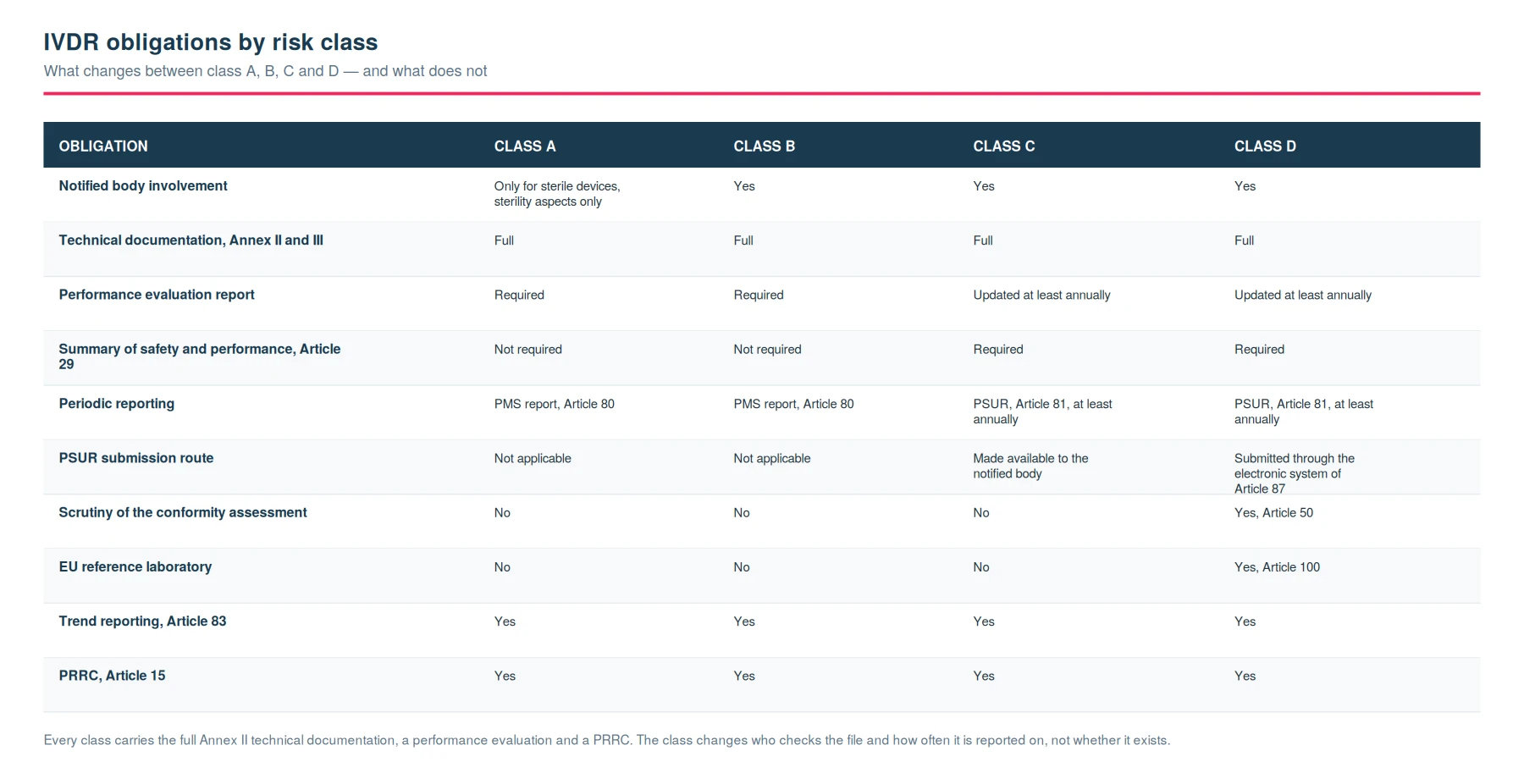
The class determines the conformity assessment route, whether a notified body is involved, whether an EU reference laboratory is involved, whether the conformity assessment is subject to scrutiny, whether a summary of safety and performance is published, and whether the periodic report is an annual PSUR or a lighter post-market surveillance report. Get it wrong and every downstream document is built on the wrong assumption.
The ten implementing rules come before the seven classification rules
Chapter I of Annex VIII contains ten implementing rules that govern how the classification rules are applied, and they are routinely ignored. Classification is governed by the intended purpose. Where a device is used in combination with another, the rules apply separately to each. Accessories are classified in their own right, separately from the device they are used with. Software driving a device or influencing its use takes that device's class; software independent of any other device is classified on its own intended purpose. Calibrators take the class of the device they are used with, and so do control materials with assigned values — a control without an assigned value is class B under Rule 7.
Three of the ten decide most disputes. Implementing rule 1.7 requires the manufacturer to take all classification and implementing rules into consideration, which is why a rationale that names only the rule relied upon is incomplete. Rule 1.8 places a device with multiple stated intended purposes in the higher class. Rule 1.9 applies the rule resulting in the higher classification where several rules apply. Between them they mean that a multiplex panel takes the class of its highest marker, and a self-test detecting a class C analyte alongside one of the class B exceptions is class C in its entirety.
| Ref. | What the implementing rule says | What it means in a real file |
|---|---|---|
| 1.1 | Application of the classification rules is governed by the intended purpose | Rewrite the intended purpose and you may have rewritten the class |
| 1.2 | Where a device is used in combination with another, the rules apply separately to each | An analyser and its assays are classified independently |
| 1.3 | Accessories are classified in their own right, separately from the device | An accessory does not inherit the class of the device it serves |
| 1.4 | Software driving a device or influencing its use takes that device's class; independent software is classified on its own | Interpretive software is assessed as a device, not as a feature |
| 1.5 | Calibrators take the class of the device they are used with | No separate classification exercise for the calibrator |
| 1.6 | Control materials with assigned values take the class of the device | A control without an assigned value is class B under Rule 7 |
| 1.7 | The manufacturer shall take all classification and implementing rules into consideration | A rationale naming only the rule relied upon is incomplete |
| 1.8 | Multiple stated intended purposes falling into more than one class means the higher class | A multiplex panel takes the class of its highest marker |
| 1.9 | Where several rules apply, the rule resulting in the higher classification applies | Competing rules are resolved upwards, never downwards |
| 1.10 | Each classification rule applies to first line, confirmatory and supplemental assays | Being a confirmatory assay is not a route to a lower class |
Rule 3 is where most devices land, and it has thirteen indents
Rule 3 places a device in class C and runs from indent (a) to indent (m): sexually transmitted agents; infectious agents in cerebrospinal fluid or blood without high risk of propagation; infectious agents where an erroneous result would cause death or severe disability; pre-natal screening for immune status; infective disease or immune status where an erroneous result would lead to a life-threatening patient management decision; companion diagnostics; disease staging with the same consequence; screening, diagnosis or staging of cancer; human genetic testing; therapeutic drug monitoring where an erroneous result would be life-threatening; management of patients with a life-threatening condition; screening for congenital disorders in the embryo or foetus; and screening for congenital disorders in newborns.
A device can fall under more than one indent. That does not change the outcome — the class is C either way — but the indents relied upon should still be identified, because they carry different evidence expectations forward into the performance evaluation. Cancer screening under indent (h) and human genetic testing under indent (i) are both class C, and they need very different clinical performance data.
The Commission's own guidance on Annex VIII, MDCG 2020-16, is now at revision 4 of March 2025, and the revisions have changed worked examples rather than the rules themselves. Citing an earlier revision in a classification rationale is a visible error, and it is the first thing a reviewer notices. The current text sits on the Commission's MDCG guidance page, which should be checked at the date the rationale is issued rather than at the date the template was bought.
What the class actually costs you at conformity assessment
Class A devices that are not sterile are self-declared. Class A devices placed on the market in a sterile condition involve a notified body, but only for the aspects relating to establishing, securing and maintaining sterile conditions. From class B upwards the notified body assesses the quality management system and samples the technical documentation. Class C adds a validated summary of safety and performance and an annual cycle on the periodic safety update report and the performance evaluation report. Class D adds two things that exist nowhere else in the framework: scrutiny of the conformity assessment under Article 50, and the involvement of an EU reference laboratory under Article 100 for batch verification and performance testing.
The practical consequence is scheduling. A class D device depends on a laboratory outside the manufacturer's control and outside the notified body's control, with its own capacity constraints. Building a project plan that assumes the notified body is the only external dependency is how class D timelines slip by quarters rather than weeks.
✦ EU IVDR TECHNICAL DOCUMENTATION KIT
The Annex II file for an in vitro diagnostic, structured to the Regulation's own order.
The complete IVDR technical documentation set: Device Description and Specifications, Labelling and Instructions for Use, Design and Manufacturing Information, General Safety and Performance Requirements, Benefit-Risk Analysis and Risk Management, Product Verification and Validation, Post-Market Surveillance and the Declaration of Conformity — each mapped to its Annex II section.
- ✓ 8 Word templates · full Annex II and Annex III coverage · Annex IV declaration included
- ✓ MDCG 2022-2, MDCG 2025-10 and MDCG 2020-16 rev. 4 integrated throughout
ONE-TIME
€429
Get the IVDR Technical Documentation Kit →The technical documentation the IVDR asks for
Annex II of the IVDR carries the same six-section architecture as its MDR counterpart, in the same order: device description and specification; information supplied by the manufacturer; design and manufacturing information; general safety and performance requirements; benefit-risk analysis and risk management; and product verification and validation. Annex III sits alongside it and holds the post-market surveillance documentation.
The divergence is inside Section 6, and it is deeper than the section headings suggest. Where the MDR asks for pre-clinical testing and a clinical evaluation, the IVDR splits Section 6 into five subsections: 6.1 information on analytical performance, 6.2 information on clinical performance and clinical evidence, 6.3 stability excluding specimen stability, 6.4 software verification and validation, and 6.5 additional information required in specific cases. Files that label the whole of Section 6 as "product verification and validation" and file everything under 6.1 are common, and they fail the completeness check for a reason that has nothing to do with the quality of the data.
| № | Annex II section | Sub-elements | Where the evidence lives |
|---|---|---|---|
| 1 | Device description and specification | 1.1 device description; 1.2 previous and similar generations | Classification rationale; intended purpose statement; UDI records |
| 2 | Information supplied by the manufacturer | — | Controlled label and IFU artwork; translation records |
| 3 | Design and manufacturing information | 3.1 design; 3.2 manufacturing, including all sites and suppliers | Design stage records; process validation; site and supplier list |
| 4 | General safety and performance requirements | — | The GSPR checklist against Annex I and every document it references |
| 5 | Benefit-risk analysis and risk management | — | Benefit-risk analysis; ISO 14971 risk management file |
| 6 | Product verification and validation | 6.1 analytical performance; 6.2 clinical performance and clinical evidence; 6.3 stability; 6.4 software V&V; 6.5 specific cases | Analytical and clinical performance reports; stability studies; performance evaluation report |
| Annex III — technical documentation on post-market surveillance | |||
| 1 | Post-market surveillance plan | 1(a) information sources; 1(b) plan content | PMS plan; PMPF plan or the justification for its non-applicability |
| 2 | Post-market surveillance reporting | — | PSUR for class C and D; post-market surveillance report for class A and B |
Section 6 is where the IVDR and the MDR part company. The MDR asks for pre-clinical testing and a clinical evaluation under a single heading. The IVDR splits the same section into five, and a file that labels the whole of Section 6 as product verification and validation and files everything under 6.1 fails the completeness check for a reason that has nothing to do with the quality of the data.
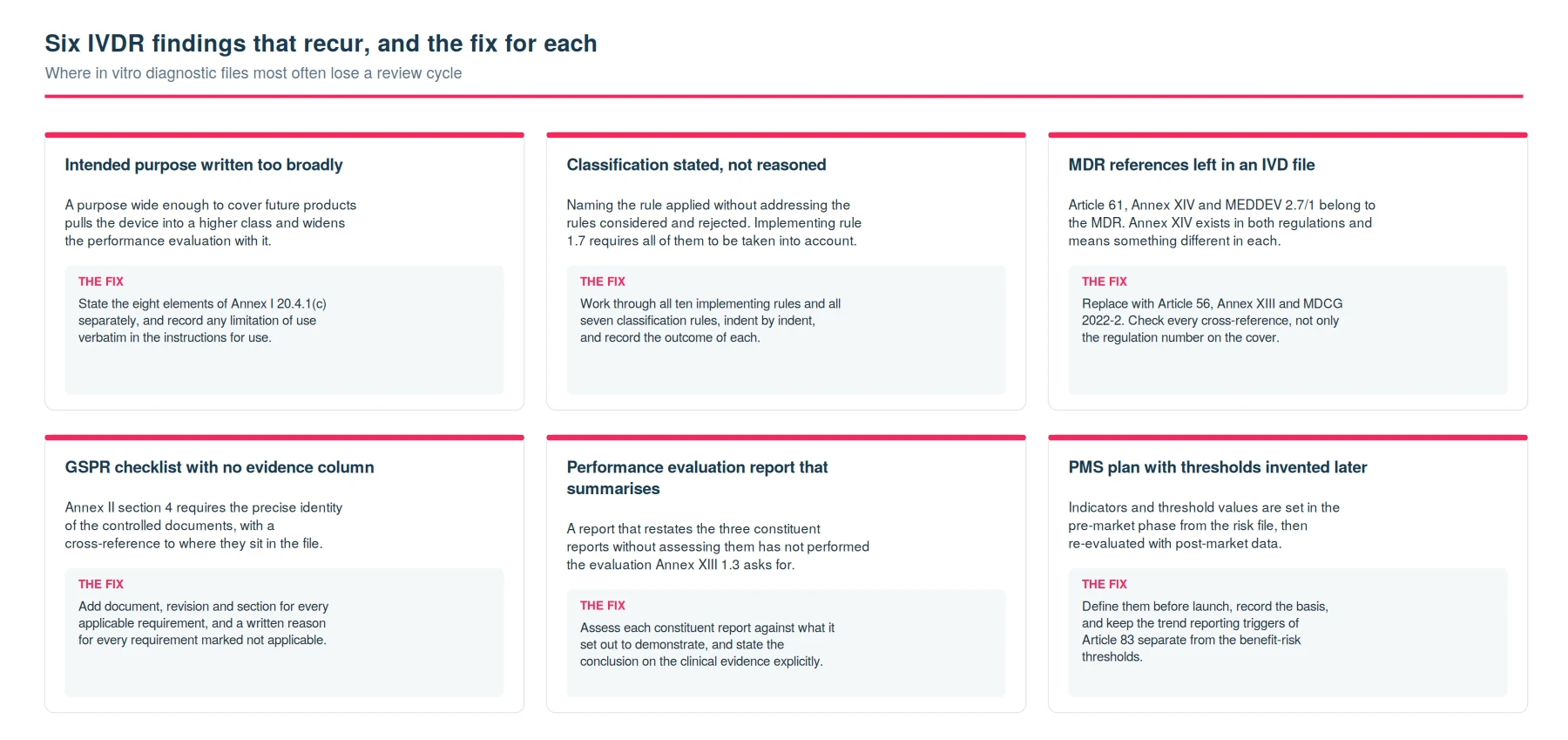
Section 4 deserves separate attention because it is where most review cycles are lost. It requires the requirements of Annex I that apply and those that do not with the reasons, the methods used to demonstrate conformity, the harmonised standards or common specifications applied, and — the part that is consistently underestimated — the precise identity of the controlled documents offering evidence of conformity, with a cross-reference to where they sit in the technical documentation. Naming the evidence satisfies half the requirement. A checklist without a document, revision and section column obliges the reviewer to search the file, and a reviewer who searches asks questions.
Section 5 draws on the same risk management discipline as any other device. ISO 14971 is regulation-agnostic and the process transfers unchanged. What does not transfer is the hazard library. For an in vitro diagnostic the harm is almost always indirect: it arises from a medical decision taken, or not taken, on the basis of an incorrect, delayed, absent or unclear result. A risk file built on a hazard list written for therapeutic devices — energy, biocompatibility, mechanical failure — will be visibly the wrong file, and the benefit-risk analysis built on top of it will weigh the wrong things.
Why the IVDR splits clinical evidence into three reports
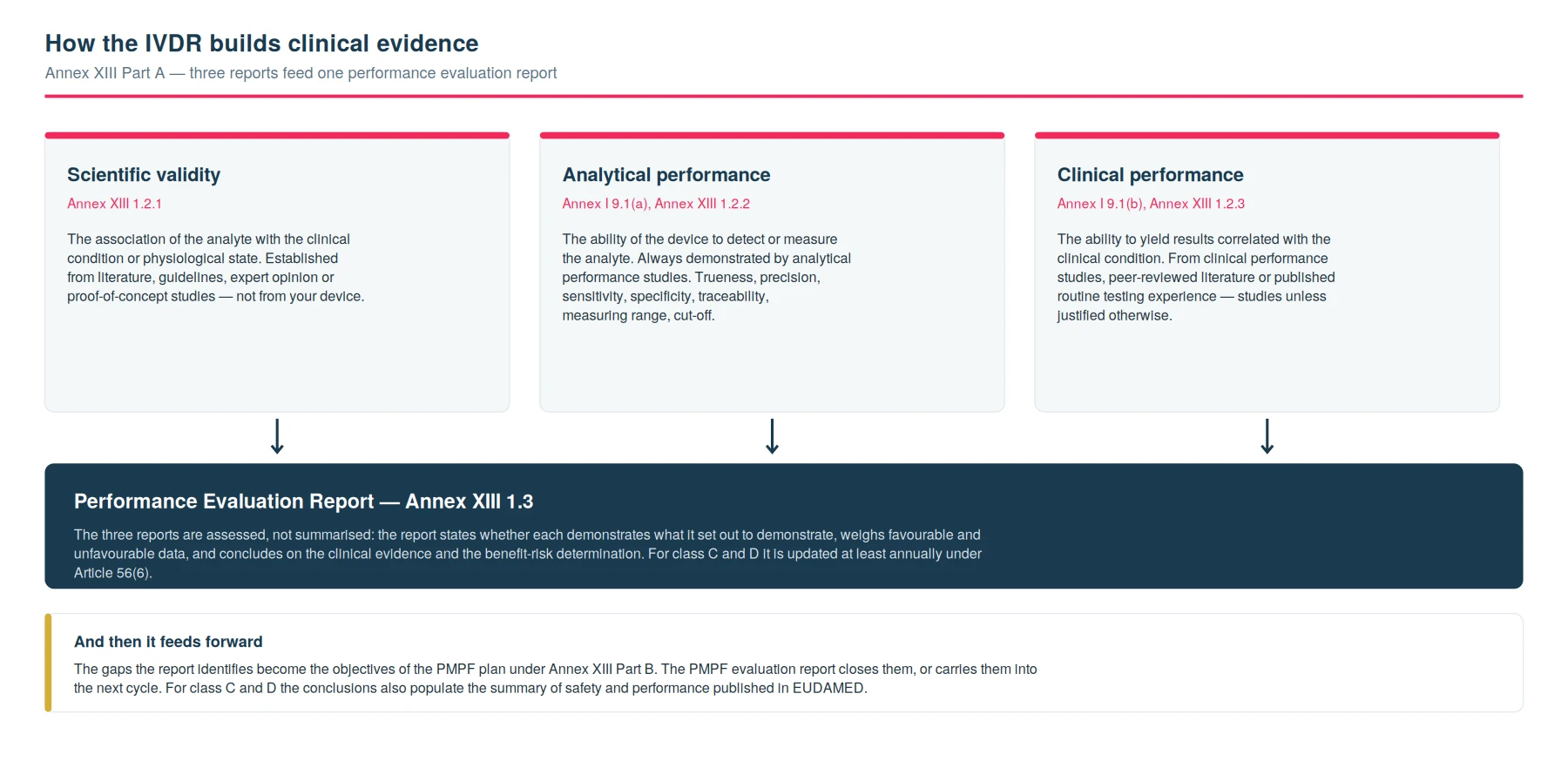
Article 56 requires performance evaluation to be planned, conducted and documented in accordance with Annex XIII. Annex XIII Part A then defines clinical evidence for an in vitro diagnostic as resting on three pillars, each with its own report: scientific validity, analytical performance and clinical performance. The general principles are set out in MDCG 2022-2, which is the single most useful document in the IVDR guidance set and the one most often cited in notified body questions.
Scientific validity is about the analyte, not about your device
Scientific validity is the association of the analyte with a clinical condition or physiological state. It says nothing about how well your device measures that analyte — it establishes that measuring it is clinically meaningful in the first place. It is demonstrated from literature, from consensus expert opinion, from proof-of-concept studies, or from clinical performance studies, and for a well-established analyte the report can be short. For a novel biomarker it is the hardest of the three to build, and a thin scientific validity report is the point at which a class C performance evaluation starts to unravel.
Analytical performance sits at the opposite end. It is always demonstrated by analytical performance studies — the Regulation admits no substitute — and covers trueness, precision, analytical sensitivity and specificity, metrological traceability of the values assigned to calibrators and controls, measuring range, linearity and the assay cut-off. Clinical performance, by contrast, may be established from clinical performance studies, from peer-reviewed literature, or from published experience gained by routine diagnostic testing. Studies are the default, and relying on the other two sources requires a justification recorded in the file.
The performance evaluation report assesses, it does not summarise
Annex XIII 1.3 asks the performance evaluation report to do something the three constituent reports cannot do for themselves: state whether each of them demonstrates what it set out to demonstrate. A report that restates the scientific validity report, then the analytical performance report, then the clinical performance report, and concludes that the device is safe, has summarised rather than evaluated. It must weigh favourable and unfavourable data — both are required to appear in the technical documentation — and it must reach an explicit conclusion on the clinical evidence and on the benefit-risk determination.
For class C and class D devices the report is updated when necessary and at least annually under Article 56(6). The gaps it identifies become the objectives of the post-market performance follow-up plan under Annex XIII Part B, and the PMPF evaluation report either closes them or carries them into the next cycle. That loop is the part reviewers test: a PMPF plan whose objectives cannot be traced back to a gap stated in the performance evaluation report has not been planned, it has been written.
✦ EU IVDR PERFORMANCE EVALUATION KIT
The three constituent reports, and the one that assesses them.
The Annex XIII set: performance evaluation plan and report, scientific validity report, analytical performance report, clinical performance report and the post-market performance follow-up documents — structured so that each Annex XIII requirement has a document that answers it.
- ✓ 11 templates across Annex XIII Part A and Part B
- ✓ Aligned with MDCG 2022-2 and MDCG 2025-5
Complete kit €399
Get the Performance Evaluation Kit →| Guidance | What it governs | Current revision |
|---|---|---|
| MDCG 2022-2 | General principles of clinical evidence for IVDs — the reference for Annex XIII Part A | January 2022 |
| MDCG 2020-16 | Classification rules under Annex VIII, with worked examples for each rule | Revision 4, March 2025 |
| MDCG 2025-5 | Performance studies — when an application or a notification is required, with a decision tree | June 2025 |
| MDCG 2024-4 | Safety reporting in performance studies under Article 76, with the reporting form | April 2024 |
| MDCG 2025-10 | Post-market surveillance for medical devices and IVDs, covering both regulations | December 2025 |
| MDCG 2022-9 | Summary of safety and performance template for class C and D devices | Revision 1, April 2024 |
| MDCG 2019-7 | The person responsible for regulatory compliance under Article 15 | Revision 1, December 2023 |
Revision numbers are part of the citation. MDCG 2020-16 has reached revision 4 and MDCG 2022-9 revision 1, and both changed content that files depend on. A technical file citing an earlier revision tells the reviewer when the document was last opened, which is rarely the impression the manufacturer intended to give.
Post-market obligations with no equivalent under the MDR
Articles 78 to 81 build the post-market surveillance system, and the architecture will be familiar to anyone who has run post-market surveillance under the MDR: a plan under Annex III, a periodic report, and a feedback loop into risk management and the performance evaluation. Two features are specific to diagnostics and neither has an MDR counterpart.
The first is the split between Article 80 and Article 81. Class A and class B devices produce a post-market surveillance report, updated when necessary, made available to the notified body and the competent authority on request. Class C and class D devices produce a periodic safety update report, updated at least annually, which must additionally set out the conclusions of the benefit-risk determination, the main findings of the post-market performance follow-up, and the volume of sales together with an estimate of the size and other characteristics of the population using the device and, where practicable, its usage frequency. For class D the report goes to the notified body through the electronic system.
Article 80 is short, and that is its trap. Two required elements do not make a two-paragraph document, because the report still has to satisfy Article 78(2) and (3): conclusions have to be drawn from the data, and those conclusions have to feed eight named processes, from the benefit-risk determination through to the post-market surveillance of other devices in the portfolio.
The second diagnostic-specific feature is in Article 83. Trend reporting covers any statistically significant increase in the frequency or severity of non-serious incidents, and of expected erroneous results. There is no such category under the MDR. A vigilance procedure inherited from a medical device portfolio will not have it, and a trend method that counts only incidents will never detect it. The distinction that has to survive into the plan is that the indicators and thresholds required by Annex III for reassessing the benefit-risk ratio are not the same thing as the triggers for a trend report under Article 83, and MDCG 2025-10 is explicit that both are established in the pre-market phase and re-evaluated later with field data.
Roles, registration and the transition deadlines still running
Article 15 requires every manufacturer to have available within its organisation at least one person responsible for regulatory compliance, qualified either by a relevant degree plus one year of experience in regulatory affairs or quality management systems relating to in vitro diagnostics, or by four years of that experience. Micro and small enterprises need not have the person inside the organisation but must have one permanently and continuously at their disposal. Two rules catch groups out: the person responsible for a non-EU manufacturer and the person responsible for its authorised representative cannot be the same individual, and every legal manufacturer in a group needs its own.
Registration runs through EUDAMED, which reached mandatory use of its first modules on 28 May 2026. Manufacturers need a single registration number before device registration, and the details of the person responsible for regulatory compliance are part of the registered information and must be updated within one week of any change. The EUDAMED registration guide covers the module sequence and the actor registration process.
The transition deadlines are the part of the IVDR most often quoted from an out-of-date source. The staggered dates introduced in 2022 were superseded by Regulation (EU) 2024/1860 of 13 June 2024, which extended the transitional periods for legacy devices — those covered by a certificate or a declaration of conformity issued under Directive 98/79/EC before 26 May 2022. Class D legacy devices may now be placed on the market until 31 December 2027, class C until 31 December 2028, and class B and class A sterile devices until 31 December 2029. Non-sterile class A devices never had an extended period; they have been under the Regulation since 26 May 2022.
Those extensions are conditional, not automatic. The device must continue to comply with the Directive, must not undergo significant changes in design or intended purpose, and must not present an unacceptable risk. The manufacturer must have a quality management system meeting Article 10(8) in place, must lodge a formal application for conformity assessment with a notified body by the applicable date, and must have concluded a written agreement with that notified body. Missing the application date collapses the extension for that device. The Commission maintains a transitional provisions page with the conditions in full, and it should be read rather than summarised at second hand.
Where IVDR technical files most often lose a review cycle
The failures are structural rather than scientific, which is what makes them cheap to prevent and expensive to discover late. An intended purpose written broadly enough to cover the next three products widens the classification and the performance evaluation with it, and there is no way to narrow it later without reopening both. A classification rationale that names the rule applied without addressing the rules considered and rejected does not satisfy implementing rule 1.7. A GSPR checklist without an evidence column does not satisfy Annex II Section 4.
The most damaging category is subtler: MDR references left inside an IVD file. Article 61, Annex XIV and MEDDEV 2.7/1 belong to Regulation (EU) 2017/745, and the IVDR equivalents are Article 56, Annex XIII and MDCG 2022-2. Annex XIV is the trap, because it exists in both regulations and means something entirely different in each — clinical evaluation under the MDR, interventional performance studies under the IVDR. A cross-reference copied across regulations produces no error message. It simply points somewhere else, and it will be found during assessment rather than during drafting.
The same applies to software. An in vitro diagnostic that includes interpretive software is subject to the same qualification questions as any other software as a medical device, and implementing rule 1.4 decides the rest: software driving a device or influencing its use takes that device's class, while independent software is classified on its own intended purpose.
✦ EU IVDR COMPLETE BUNDLE
Everything the IVDR asks for, in one deduplicated set.
Technical documentation, performance evaluation and risk management in a single structure, with the cross-references already resolved between them rather than three sets you have to reconcile yourself.
- ✓ 25 documents across the three kits
- ✓ Class B, C and D coverage · Word and Excel · fully editable
ONE-TIME
€999
Get the EU IVDR Complete Bundle →Frequently asked questions
What is the IVDR?
The IVDR is Regulation (EU) 2017/746 on in vitro diagnostic medical devices, applicable since 26 May 2022 and replacing Directive 98/79/EC. It sets out the requirements for placing an in vitro diagnostic on the EU market: qualification, classification into classes A to D under Annex VIII, technical documentation under Annexes II and III, performance evaluation under Annex XIII, conformity assessment under Article 48, and post-market surveillance under Articles 78 to 81.
What is the difference between the IVDR and the IVDD?
The Directive classified by exception, using two named lists, and left roughly eighty per cent of products to be self-certified by the manufacturer. The Regulation classifies by rule, using seven classification rules and ten implementing rules, and roughly eighty per cent of products now require a notified body. The Regulation also requires clinical evidence to be documented as three separate reports — scientific validity, analytical performance and clinical performance — and kept current for the life of the device.
How are IVDs classified under the IVDR?
Under Annex VIII, into four classes. Class D covers transmissible agents in blood and tissues intended for transfusion or transplantation and life-threatening agents with high risk of propagation. Class C covers thirteen categories under Rule 3, including cancer, human genetic testing, companion diagnostics and sexually transmitted agents, plus most self-tests under Rule 4. Class B is the residual class under Rule 6 and covers controls without assigned values under Rule 7. Class A covers general laboratory products, instruments and specimen receptacles under Rule 5.
What are the current IVDR transition deadlines?
Following Regulation (EU) 2024/1860, legacy devices may be placed on the market until 31 December 2027 for class D, 31 December 2028 for class C, and 31 December 2029 for class B and class A sterile devices. The extensions are conditional on the device continuing to comply with the Directive, no significant change in design or intended purpose, a compliant quality management system, a formal application lodged with a notified body by the applicable date, and a signed written agreement with that notified body.
Does every IVD need a notified body under the IVDR?
No. Class A devices that are not placed on the market in a sterile condition are self-declared. Class A sterile devices involve a notified body only for the aspects relating to sterility. Class B, C and D devices all require notified body involvement, and class D adds scrutiny of the conformity assessment under Article 50 and EU reference laboratory involvement under Article 100.
What is the difference between a PSUR and a post-market surveillance report under the IVDR?
The post-market surveillance report under Article 80 applies to class A and class B devices and requires a summary of the results and conclusions of the post-market surveillance data, together with a rationale and description of any preventive and corrective actions. The PSUR under Article 81 applies to class C and class D devices, is updated at least annually, and additionally requires the conclusions of the benefit-risk determination, the main findings of the post-market performance follow-up, and the volume of sales with an estimate of the exposed population.
Conclusions
The IVDR is not a stricter version of the Directive it replaced. It is a different architecture, and the two decisions taken at the start of the project — how the intended purpose is written and how the device is classified — determine everything that follows. Both are cheap to get right at the beginning and expensive to revisit once the technical file has been built on them.
Three points carry most of the value. Classification requires all ten implementing rules and all seven classification rules to be considered and the outcome recorded, not just the rule relied upon. Section 4 of Annex II requires the location of the evidence, not only its identity. And the performance evaluation report has to assess its three constituent reports rather than restate them, because that assessment is what sets the post-market performance follow-up objectives for the next cycle.
The EU IVDR Technical Documentation Kit on MD Regulatory covers the full Annex II technical file and the Annex III post-market surveillance documentation, and the EU IVDR Performance Evaluation Kit covers the Annex XIII set — Word templates and working Excel checklists, aligned with Regulation (EU) 2017/746 and the current MDCG guidance, and immediately deployable in a technical file. Both are included in the EU IVDR Complete Bundle.