IVDR Technical Documentation: Annex II Section by Section
Table of Contents
- Introduction
- IVDR Annex II at a glance — the six sections and Annex III
- Section 1 — Device description and specification
- Section 2 — Information supplied by the manufacturer
- Section 3 — Design and manufacturing information
- Section 4 — General safety and performance requirements
- Section 5 — Benefit-risk analysis and risk management
- Section 6 — Product verification and validation
- Annex III — the post-market documentation that sits alongside
- Why an MDR template does not survive the copy
- The structural mistakes that cost a review cycle
- Frequently asked questions
- Conclusions
Introduction
Most IVDR technical documentation fails on structure long before anyone reads the science. The assay is validated, the studies are sound, the stability data are real — and the file is organised the way the company has always organised files, which is to say not the way Annex II of Regulation (EU) 2017/746 sets out. A completeness check finds that in an afternoon, and every mismatch becomes a question that has to be answered before the substantive review can start.
Annex II is short. Six sections, a handful of pages, and the order it establishes is the order a notified body reviewer works through. This guide walks each section with its sub-elements set out individually, covers the Annex III post-market documentation that sits alongside it, and shows exactly where the IVDR diverges from the MDR — because the two annexes look identical at the section level and are not identical underneath. For the wider regulatory context, from qualification through to the transition deadlines, start with the IVDR guide; for the parallel structure under Regulation (EU) 2017/745, see the EU MDR technical documentation guide.
IVDR Annex II at a glance — the six sections and Annex III
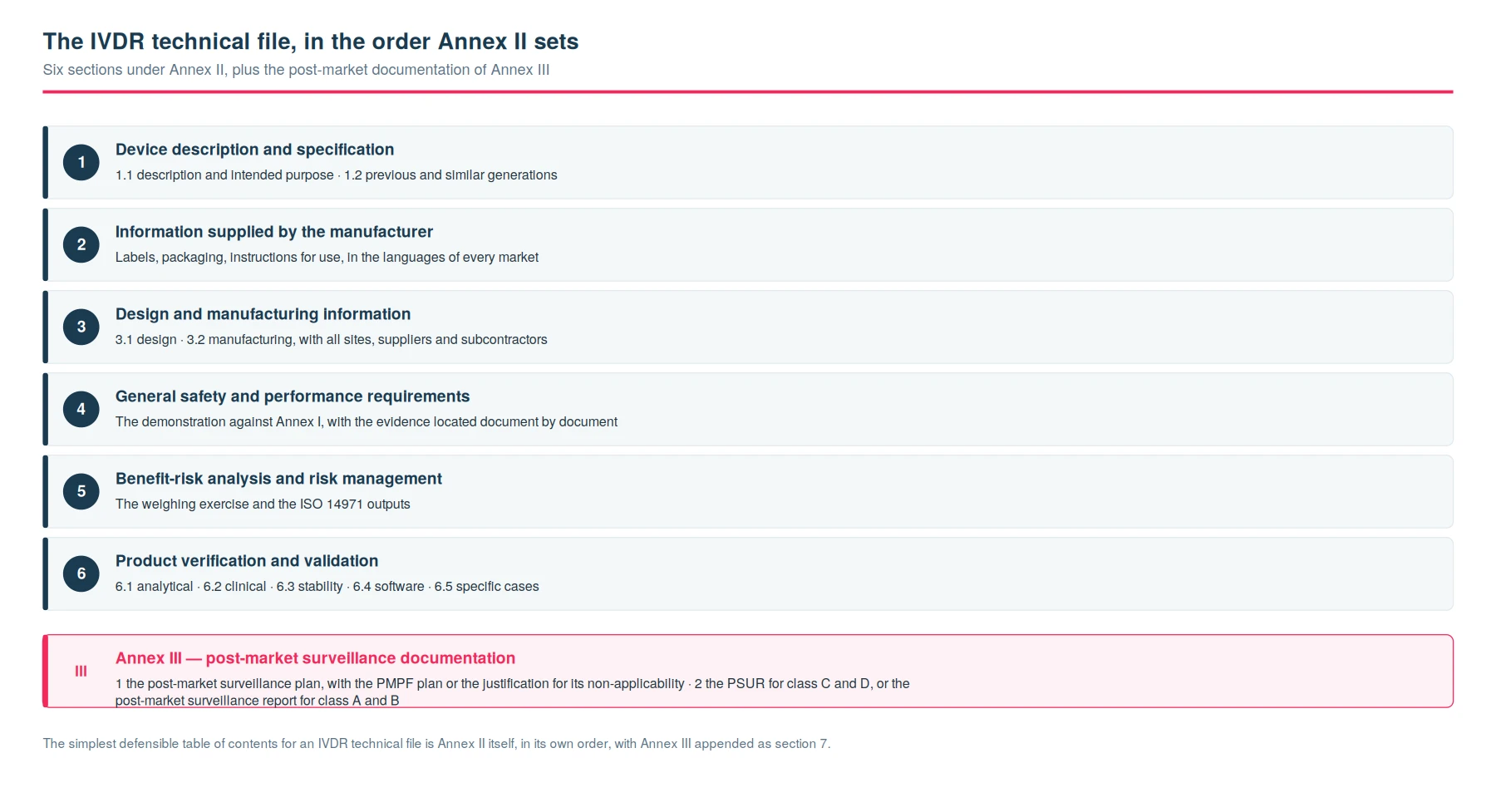
Annex II has six sections. Their order in the Regulation is the order a reviewer expects to find them in the file, and Annex III — the technical documentation on post-market surveillance — sits alongside rather than inside it.
| № | Section | What it contains | Sub-elements | Where the evidence lives |
|---|---|---|---|---|
| 1 | Device description and specification | What the device is, what it detects, who uses it, how it is classified | 1.1; 1.2 | Classification rationale; intended purpose statement; UDI assignment records |
| 2 | Information to be supplied by the manufacturer | Labels and instructions for use, in the languages of every Member State where the device is made available | — | Controlled label and IFU artwork; symbol list; translation records |
| 3 | Design and manufacturing information | How the device was designed, how it is made, and where | 3.1; 3.2 | Design stage records; process validation; site, supplier and subcontractor list |
| 4 | General safety and performance requirements | The demonstration of conformity against Annex I | — | The GSPR checklist and every controlled document it references |
| 5 | Benefit-risk analysis and risk management | The benefit-risk determination and the risk management outputs | — | Benefit-risk analysis; ISO 14971 risk management file |
| 6 | Product verification and validation | All the performance evidence, plus stability, software and the special cases | 6.1; 6.2; 6.3; 6.4; 6.5 | Analytical and clinical performance reports; stability studies; performance evaluation report |
| Annex III — technical documentation on post-market surveillance | ||||
| 1 | Post-market surveillance plan | The information collected, and how it is assessed and acted on | 1(a); 1(b) | PMS plan; PMPF plan, or the justification for its non-applicability |
| 2 | Post-market surveillance reporting | The periodic report the device class requires | — | PSUR for class C and D; post-market surveillance report for class A and B |
Two things this table settles. First, labelling and instructions for use are Section 2, immediately after the device description — not an appendix at the back. Second, the performance evaluation is not a section of its own: it sits inside Section 6.2, alongside the analytical performance data in 6.1. Files that promote it to a top-level section and push labelling to the end are following a habit inherited from the IVDD rather than the structure of the Regulation.
Section 1 — Device description and specification
Section 1 is the foundation of the whole file. The classification, the applicable general safety and performance requirements, the scope of the performance evaluation and the boundaries of the risk analysis all derive from what is written here. It has two parts, and the first carries most of the weight.
Section 1.1 — what has to be described, and how precisely
Annex II 1.1 asks for the product or trade name and a general description including the intended purpose and intended users; the Basic UDI-DI or an unambiguous identification allowing traceability; the intended purpose broken into its elements; the principle of the assay method or the operating principles of the instrument; the rationale for qualification as a device; the risk class with the justification of the classification rules applied; an explanation of any novel features; a description of the components and reactive ingredients; the specimen collection and transport materials; the instrumentation characteristics for automated assays; a description of any software; a description of the configurations and variants; and a description of the accessories and other products intended to be used in combination with the device.
The intended purpose is the element that decides most of the rest, and Annex I Chapter III Section 20.4.1(c) sets out what it must contain. Each of the eight elements is stated separately rather than folded into a marketing sentence.
| Ref. | Element of the intended purpose | What satisfies it | Frequent finding |
|---|---|---|---|
| i | What is detected and/or measured | The analyte named precisely, including the form measured where more than one exists | "Total" or "free" left unstated where both circulate |
| ii | Its function | Screening, monitoring, diagnosis or aid to diagnosis, prognosis, prediction, companion diagnostic | "Aid to diagnosis" claimed in the file and "diagnosis" claimed in the IFU |
| iii | The specific information intended to be provided | The physiological or pathological state, the predisposition, the treatment response — matched to one of the six purposes of Article 2(2) | Stated so broadly that a higher classification rule becomes arguable |
| iv | Whether it is automated or not | The instrument or platform named, or manual use stated | Omitted for kits that are used both ways |
| v | Whether it is qualitative, semi-quantitative or quantitative | Stated explicitly, with the reportable result described | Semi-quantitative devices described as quantitative in promotional material |
| vi | The type of specimen or specimens required | Each matrix listed, with the collection tube and additive where it matters | A matrix validated but never declared, or declared but never validated |
| vii | Where applicable, the testing population | Age range, clinical status, care setting, assumed prevalence | Population in the clinical performance report narrower than the one claimed |
| viii | For companion diagnostics, the associated medicinal product | The target population and the medicinal product named by its International Non-proprietary Name | The INN omitted, or a class of medicines named instead of the product |
Write the limitation of use, verbatim. Where there is a foreseeable risk that the device could be used for a purpose that a higher classification rule would capture — a marker validated for monitoring being used to screen, for instance — the limitation belongs in the instructions for use and in Section 1.1, in the exact words used. That limitation is often the only thing separating the device from the higher class, and a reviewer will want to read it rather than be told it exists.
Section 1.2 — previous and similar generations
Section 1.2 asks for two distinct overviews, and they are routinely merged into one paragraph. The first is previous generations of the device produced by the manufacturer, where they exist. This is the manufacturer's own history, and it is where a reviewer looks for a pattern of design changes that should have triggered risk management or performance evaluation updates.
The second is similar devices already available on the market. This is the state-of-the-art anchor and it feeds the performance evaluation directly. A Section 1.2 that names no similar devices at all invites the question of how the state of the art was established — and for an analyte measured by a dozen CE-marked assays, that question is hard to answer well. What this section does not do is transfer performance: information about a similar device supports the scientific validity of the analyte, it does not demonstrate that your device measures it.
Section 2 — Information supplied by the manufacturer
Section 2 requires a complete set of the labels — on the device and on every level of packaging, including transport packaging where specific handling conditions apply — and the instructions for use, in the languages accepted by every Member State where the device is to be made available.
Its position in the Regulation is deliberate. Labelling and instructions for use come immediately after the device description because together they are the manufacturer's declaration of what the device is and how it is to be used. Everything downstream is a demonstration that the declaration is true.
Three elements generate most of the findings. The intended purpose printed in the instructions for use must match the one in Section 1.1 element by element, not approximately. The analytical and clinical performance characteristics printed in the instructions for use must be traceable to a figure in the analytical or clinical performance report — every number, including the ones nobody rereads. And the metrological traceability of the values assigned to calibrators and control materials, together with the maximum batch-to-batch variation, must be stated, because Annex I requires it and because it is the first thing a laboratory customer checks.
The language obligation carries a version control consequence that is easy to underestimate. A device marketed across the Union may need instructions for use in more than twenty languages, each a controlled document, each requiring a revision path when the source changes. A superseded translation circulating in one market is a non-conformity in that market even when the source version is current.
Section 3 — Design and manufacturing information
Section 3 has two parts. Section 3.1 asks for design information: a description of the critical ingredients such as antibodies, antigens, enzymes and nucleic acid primers; for instruments, a description of the major subsystems, the analytical technology, the operating principles, the control mechanisms and the dedicated hardware and software; for instruments and software, an overview of the entire system; for software, a description of the data interpretation methodology, meaning the algorithm; and for devices intended for self-testing or near-patient testing, a description of the design aspects that make them suitable for that use.
Section 3.2 asks for information allowing the manufacturing processes to be understood — production, assembly, final product testing and packaging of the finished device — and, critically, the identification of all sites where manufacturing activities are performed, including suppliers and subcontractors. The Regulation notes that more detailed information is provided for the audit of the quality management system, so this section is an overview with references rather than a copy of the batch records.
The site list is the part most often incomplete. A manufacturer that outsources the filling of a reagent, the value assignment of a calibrator, or the sterilisation of a collection device, and lists only its own premises, has an incomplete Section 3.2. The suppliers named here must also match the critical suppliers identified in Section 4, and an inconsistency between the two is a question that is trivially easy for a reviewer to raise.
Section 4 — General safety and performance requirements
Section 4 is where the technical documentation meets Annex I, and it is where most review cycles are lost. It requires four things: the general safety and performance requirements that apply to the device and those that do not with the reasons for non-applicability; the methods used to demonstrate conformity with each applicable requirement; the harmonised standards, common specifications or other solutions applied; and the precise identity of the controlled documents offering evidence of conformity, including a cross-reference to the location of that evidence within the technical documentation.
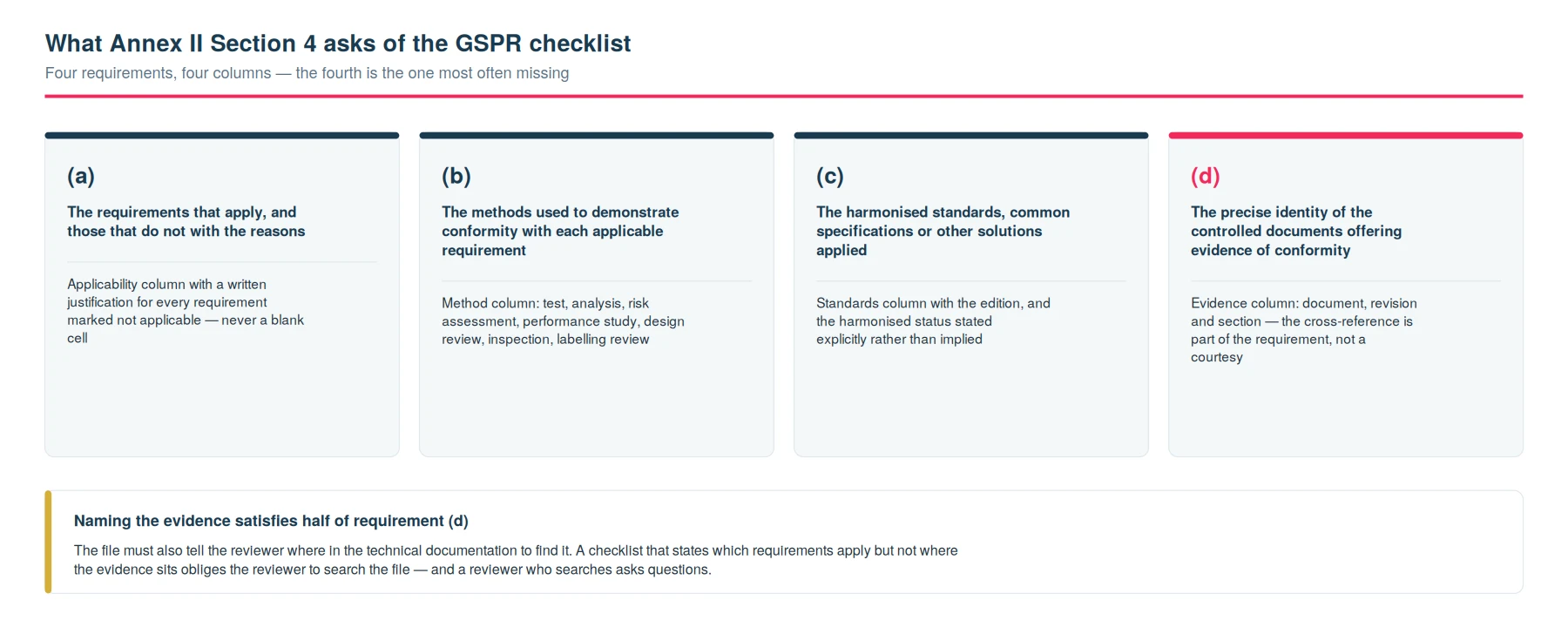
Those four requirements are the reason a GSPR checklist has the columns it has, and the fourth is the one most often reduced by half. Naming the evidence is not enough — the file has to tell the reviewer where in the documentation to find it, which in practice means the document, its revision, and the section or page. A checklist that lists "Analytical Performance Report" against a requirement has satisfied requirement (c) at best and left (d) open.
The applicability decision matters as much as the evidence. Annex II is explicit that the demonstration covers the requirements that do not apply, together with the reasons. An entry left blank is not the same as an entry marked not applicable with a justification, and only the second satisfies the Regulation. For an in vitro diagnostic the requirements that genuinely do not apply are usually those on sterility for a non-sterile device, on radiation, on materials of animal or human origin, and on measuring function — and each of those exclusions is a one-line justification tied to a stated characteristic of the device, not a dash.
The requirement-by-requirement structure of Annex I, and the checklist format that survives review, are covered in detail in the GSPR checklist guide. The chapter architecture is common to both regulations; the numbering is not, which is the subject of a later section here.
✦ EU IVDR TECHNICAL DOCUMENTATION KIT
The Annex II file, already structured to the Regulation's own order.
The complete IVDR technical documentation set: Device Description and Specifications, Labelling and Instructions for Use, Design and Manufacturing Information, General Safety and Performance Requirements, Benefit-Risk Analysis and Risk Management, Product Verification and Validation, Post-Market Surveillance and the Declaration of Conformity — one document per Annex II section, cross-referenced.
- ✓ 8 Word templates · full Annex II and Annex III coverage · Annex IV declaration included
- ✓ GSPR checklist in Word and Excel, with the evidence column Section 4 requires
ONE-TIME
€429
Get the IVDR Technical Documentation Kit →Section 5 — Benefit-risk analysis and risk management
Section 5 asks for two things that are frequently treated as one: the benefit-risk analysis referred to in Sections 1 and 8 of Annex I, and the solutions adopted together with the results of the risk management referred to in Section 3 of Annex I. They are separate deliverables. The risk management file records what could go wrong and what was done about it; the benefit-risk analysis weighs what remains against what the device is for.
The process comes from ISO 14971, which is regulation-agnostic and transfers unchanged from the medical device world. What does not transfer is the hazard library. For an in vitro diagnostic the harm is almost always indirect: it arises from a medical decision taken, or not taken, on the basis of a result. The chain runs from an event — a degraded reagent, a cross-reacting substance, an instrument fault — through a hazard expressed as an incorrect, delayed, absent or unclear result, to a hazardous situation in which a user acts on that result, to the harm that follows.
| Hazard | Typical cause | Hazardous situation | Harm |
|---|---|---|---|
| False negative | Degraded reagent, poor sampling, out-of-specification lot | The user receives an incorrect result and acts on it | Missed or delayed treatment; deterioration; death |
| False positive | Cross-reactivity, contamination, excess sample volume | The user receives an incorrect result and acts on it | Unnecessary treatment, or harm arising from that treatment |
| Delayed result | Control failure, instrument fault, invalid run | The result is not available when the decision is taken | Delay of a medical intervention |
| No result | Missing component, barcode error, insufficient specimen | The user receives no result at all | Delay of a medical intervention |
| Unclear result | Faint test line, ambiguous growth, borderline value | The user misinterprets the result | Inappropriate patient management |
| Direct hazard | Leakage, sharps, hazardous reagent, electrical fault | The operator is exposed while running the test | Infection, chemical exposure or injury to the user |
A risk file built on a hazard list written for therapeutic devices — energy, biocompatibility, mechanical failure — is visibly the wrong file for an in vitro diagnostic, and the benefit-risk analysis built on top of it weighs the wrong things. The benefit for an IVD is the provision of accurate medical information; the clinical outcome depends on what is done with it, which is why the analysis has to state which risk controls are inside the manufacturer's organisation and which depend on the user behaving as assumed.
Section 6 — Product verification and validation
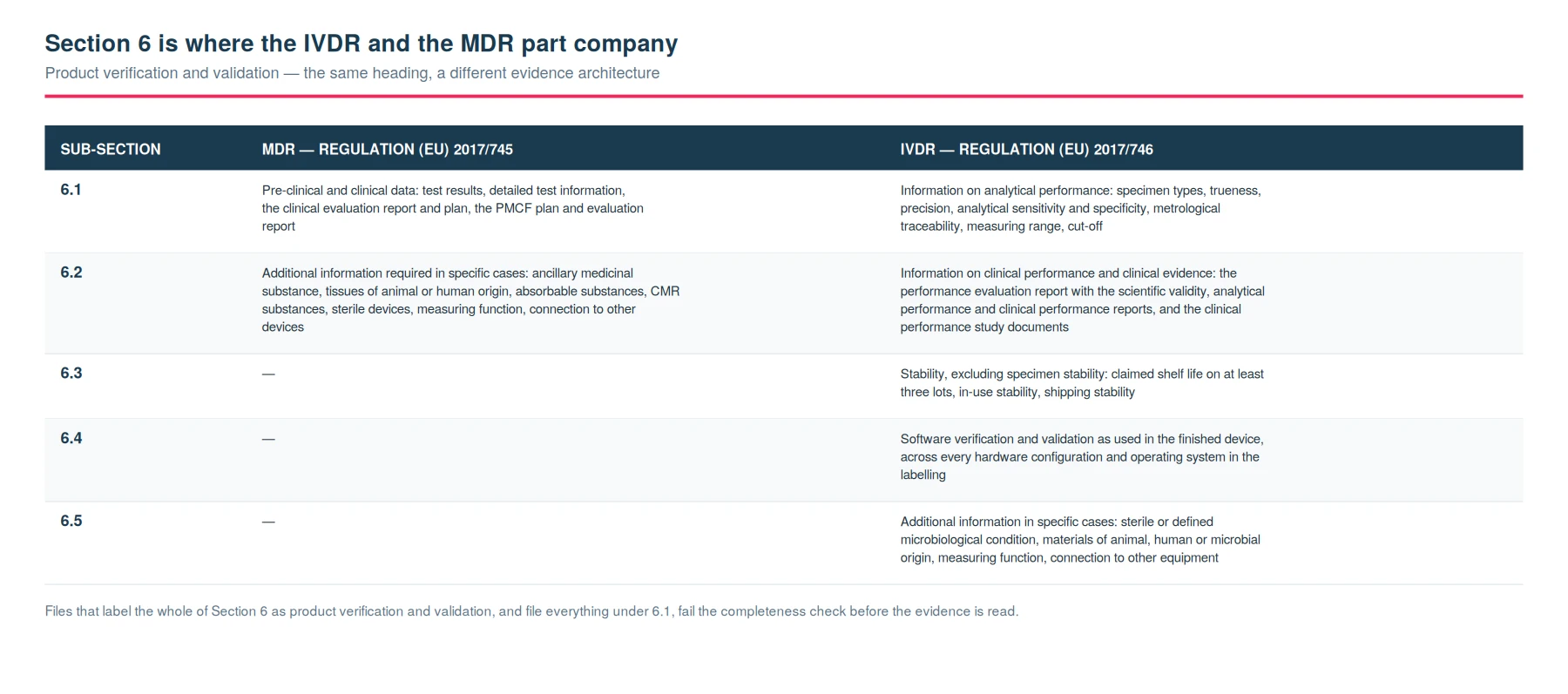
Section 6 is the largest section and the one where the IVDR structure differs most sharply from its MDR counterpart. It divides into five subsections, and the division is not decorative — each subsection carries different evidence and different acceptance criteria.
Sections 6.1 and 6.2 — analytical and clinical performance
Section 6.1 covers information on analytical performance: the specimen types that can be analysed with their stability and, for time-critical methods, the timeframe between collection and analysis; trueness and precision; analytical sensitivity with the study design, the specimen preparation, the number of replicates and the calculation used; analytical specificity with the interference and cross-reactivity studies, naming the substances tested and their concentrations; metrological traceability of the values assigned to calibrators and control materials; the measuring range and the limit of detection with the basis on which each was established; and the definition of the assay cut-off with the population studied, the characterisation method and the statistical approach.
Section 6.2 covers clinical performance and clinical evidence, and its content is the performance evaluation report with the three constituent reports it assembles — scientific validity, analytical performance and clinical performance — together with the clinical performance study documents, either included in the technical documentation or fully referenced from it. This is where the performance evaluation lives in the structure of Annex II: inside Section 6, not as a section of its own.
The division between the two is a common source of confusion because analytical performance appears in both. The distinction is one of purpose: 6.1 holds the analytical performance data as verification evidence for the device, while 6.2 holds the analytical performance report as one of the three pillars of clinical evidence under Annex XIII. The same studies, read for two different questions.
Sections 6.3 to 6.5 — stability, software and the specific cases
Section 6.3 covers stability excluding specimen stability, and it is the most quantitatively prescriptive part of Annex II. The claimed shelf life must be supported by testing on at least three different lots manufactured under conditions essentially equivalent to routine production — they need not be consecutive. Accelerated studies or extrapolation from real-time data are acceptable for an initial claim but must be followed up with real-time stability studies. In-use stability is studied on one lot reflecting actual routine use, real or simulated, and where calibration stability is claimed for an instrument, the supporting data belong here. Shipping stability is studied on one lot to evaluate tolerance to the anticipated shipping conditions, including extremes of heat and cold.
Section 6.4 covers software verification and validation: evidence of the validation of the software as used in the finished device, a summary of the verification, validation and testing performed in-house and, where applicable, in an actual user environment prior to final release, across all the hardware configurations and operating systems identified in the labelling. Where the software is itself the device, the qualification and classification questions that apply to any software as a medical device apply here too.
Section 6.5 covers the additional information required in specific cases: the environmental conditions for the relevant manufacturing steps where the device is placed on the market in a sterile or defined microbiological condition; the methods, validation reports, bioburden and pyrogen testing where it is placed on the market sterile; the origin and collection conditions where it contains tissues, cells or substances of animal, human or microbial origin; the methods used to ensure accuracy where it has a measuring function; and a description of the resulting combination with proof of conformity where it must be connected to other equipment to operate as intended.
Section 6.5 is a screening exercise, not a writing exercise. Review all five triggers at the start and record the outcome of each — applicable with a pointer to the evidence, or not applicable with a one-line reason. A file that simply omits the ones that do not apply gives the reviewer nothing to confirm against, and the omission is indistinguishable from an oversight.
✦ RISK MANAGEMENT DOCUMENTATION KIT
The ISO 14971 file that Section 5 points back to.
Risk Management Plan, Risk Management Report, Hazard Analysis built on the ISO/TR 24971 Annex A questions, and Design and Use-related FMEA as active Excel worksheets with auto-calculated RPN — the process that carries across from the MDR to the IVDR unchanged, while the hazard library does not.
- ✓ 6 coordinated templates · Word and Excel · 90 working formulas per FMEA
- ✓ Buying the 6 templates individually costs €414
Complete kit €349
Get the Risk Kit →Annex III — the post-market documentation that sits alongside
Annex III is not part of Annex II and it is not optional. Section 1 requires the post-market surveillance plan drawn up under Article 79, covering the information to be collected — serious incidents and field safety corrective actions, non-serious incidents and undesirable side-effects, trend reporting, specialist literature and databases, feedback and complaints from users, distributors and importers, and publicly available information on similar devices — together with the processes for assessing it, the indicators and threshold values for reassessing the benefit-risk ratio, the methods for investigating complaints, the protocols for managing trend reporting under Article 83, and the communication routes to authorities and users.
The plan must also include the post-market performance follow-up plan under Annex XIII Part B, or a justification as to why post-market performance follow-up is not applicable. The justification route exists and is narrow; a generic justification is a reliable way to generate a finding.
Section 2 is the periodic report, and which one applies is decided by the class. Class A and class B devices produce a post-market surveillance report under Article 80. Class C and class D devices produce a periodic safety update report under Article 81, updated at least annually, which additionally sets out the conclusions of the benefit-risk determination, the main findings of the post-market performance follow-up, and the volume of sales with an estimate of the size and characteristics of the population using the device. The mechanics of both, and the eight processes that post-market data must feed under Article 78(3), are covered in the post-market surveillance guide — the architecture is shared, the article numbers are not.
Two obligations that sit outside Annex II are checked at the same time and are worth filing with it: the EU declaration of conformity under Article 17 and Annex IV, and the written mandate with the authorised representative where the manufacturer is established outside the Union. Neither belongs to Annex II. Both are missed at the worst possible moment when they are not held with the file. Registration of the manufacturer and the device runs through EUDAMED, and the EUDAMED registration guide covers the actor registration sequence.
Why an MDR template does not survive the copy
Manufacturers with both device and diagnostic portfolios reasonably want one template. The skeleton does carry across: both regulations use a six-section Annex II in the same order, and both place the post-market documentation in Annex III. Reuse the template. Do not reuse the row content, and above all do not reuse the cross-references.
| Concept | MDR — Regulation (EU) 2017/745 | IVDR — Regulation (EU) 2017/746 |
|---|---|---|
| Clinical evidence obligation | Article 61 — clinical evaluation | Article 56 — performance evaluation |
| Annex governing that evidence | Annex XIV — clinical evaluation and PMCF | Annex XIII — performance evaluation and PMPF |
| What Annex XIV contains | Clinical evaluation and post-market clinical follow-up | Interventional clinical performance studies and other studies involving risk |
| General guidance on clinical evidence | MEDDEV 2.7/1 rev. 4 and MDCG 2020-13 | MDCG 2022-2 |
| Public summary | Article 32 — SSCP, class III and implantables | Article 29 — SSP, class C and class D |
| Declaration of conformity | Article 19 | Article 17 |
| Post-market surveillance articles | Articles 83 to 86 | Articles 78 to 81 |
| Vigilance articles | Articles 87 to 92 | Articles 82 to 87 |
| Risk classes | I, IIa, IIb, III | A, B, C, D |
Annex XIV is the trap. It exists in both regulations and means something entirely different in each — clinical evaluation and PMCF under the MDR, interventional performance studies under the IVDR. A cross-reference copied from one regulation to the other produces no error message. It simply points somewhere else, and it will be found during assessment rather than during drafting.
The structural mistakes that cost a review cycle
The failures that delay an IVDR certification are structural far more often than scientific, which makes them cheap to prevent and expensive to find late.
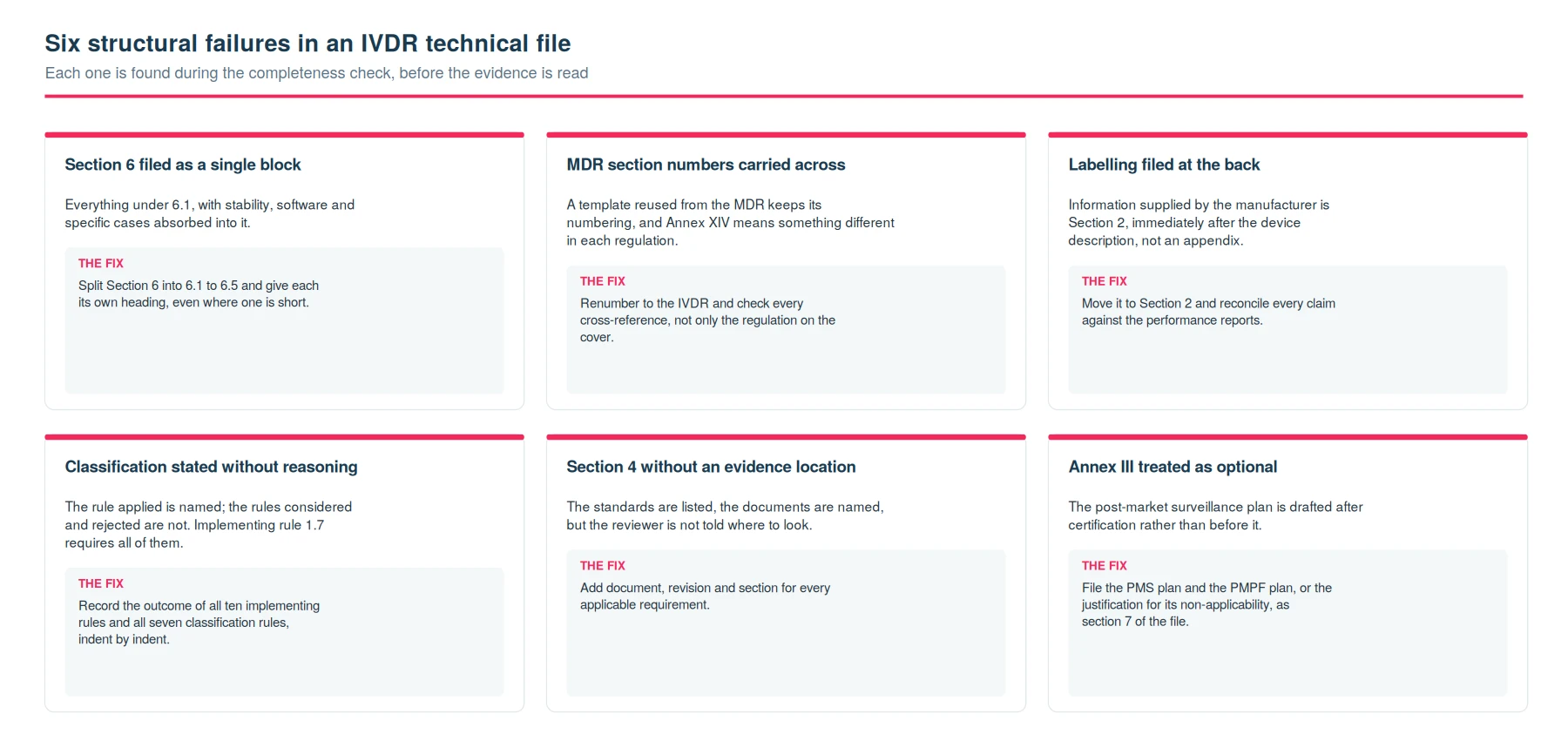
The first is filing Section 6 as a single block. A file that labels the whole section "product verification and validation" and puts everything under 6.1 has hidden the stability data, the software validation and the specific cases somewhere inside it. The fix is to split the section into 6.1 to 6.5 with a heading each, even where one of them is two lines long and says the case does not apply.
The second is carrying MDR section numbers across. A template reused without renumbering keeps its MDR structure, and the cross-references inside it keep pointing at MDR annexes. The fix is to renumber and then read every cross-reference, not only the regulation number on the cover page.
The third is filing labelling at the back. Information supplied by the manufacturer is Section 2, immediately after the device description. Files that place it after the verification evidence are following an IVDD habit, and while the content may all be present, the completeness check runs against the Regulation's order.
The fourth is stating the classification without reasoning it. Implementing rule 1.7 of Annex VIII requires the manufacturer to take all classification and implementing rules into consideration, which means a rationale that names only the rule relied upon is incomplete by construction. The fix is to record the outcome of all ten implementing rules and all seven classification rules, indent by indent, including the ones considered and rejected.
The fifth is a Section 4 with no evidence location, which is requirement (d) satisfied by half. The sixth is treating Annex III as something to be written after certification. The post-market surveillance plan is part of the technical documentation submitted for assessment, and the indicators and threshold values it contains are established in the pre-market phase from the risk file — not invented after a year of complaints.
Frequently asked questions
How many sections does IVDR Annex II have?
Six. Section 1 device description and specification; Section 2 information supplied by the manufacturer, meaning labels and instructions for use; Section 3 design and manufacturing information; Section 4 general safety and performance requirements; Section 5 benefit-risk analysis and risk management; Section 6 product verification and validation. Annex III, covering the post-market surveillance documentation, sits alongside Annex II rather than inside it.
What are the five subsections of IVDR Annex II Section 6?
Section 6.1 information on analytical performance; 6.2 information on clinical performance and clinical evidence; 6.3 stability excluding specimen stability; 6.4 software verification and validation; and 6.5 additional information required in specific cases. This is the structure most often collapsed into a single block in practice, and the collapse is one of the easiest structural findings for a reviewer to raise.
Where does the performance evaluation report sit in the IVDR technical documentation?
In Section 6.2, together with the scientific validity report, the analytical performance report, the clinical performance report and the clinical performance study documents. It is not a top-level section of Annex II, although many technical files treat it as one.
Does IVDR Annex II apply to class A devices?
Yes. Every device placed on the EU market requires technical documentation meeting Annex II and Annex III, regardless of class. For class A devices that are not placed on the market in a sterile condition, no notified body reviews the file — but a competent authority can request it at any time during market surveillance, and the manufacturer signs a declaration of conformity that rests on it.
How many lots are needed for the shelf life claim under Section 6.3?
At least three different lots, manufactured under conditions essentially equivalent to routine production conditions. The three lots need not be consecutive. Accelerated studies or extrapolation from real-time data may support an initial claim but must be followed up with real-time stability studies, and the study report must include the protocol, the number of lots, the acceptance criteria and the testing intervals.
Can I use the same technical documentation template for MDR and IVDR devices?
The template structure carries across because both regulations use a six-section Annex II in the same order. The content does not. Section 6 has a different architecture, the article and annex references differ throughout, and Annex XIV means clinical evaluation under the MDR and interventional performance studies under the IVDR. Reuse the skeleton and rebuild the cross-references rather than translating them.
What has to be in Section 3.2 about manufacturing sites?
All sites where manufacturing activities are performed, including suppliers and subcontractors. A manufacturer that outsources reagent filling, calibrator value assignment or sterilisation and lists only its own premises has an incomplete Section 3.2. The sites named here must also be consistent with the critical suppliers identified under Section 4.
Conclusions
Annex II is six sections long and it is the cheapest part of the IVDR technical documentation to get right. The content takes months to produce; the structure takes an afternoon to align, and misaligning it costs a review cycle before anyone has read the performance data.
Three points carry most of the value. Section 6 has five subsections and each needs its own heading, because the IVDR splits what the MDR keeps together. Section 4 requires not only the identity of the evidence but a cross-reference to where it sits in the file. And Annex III is part of the submission, not a post-certification exercise — the post-market surveillance plan, with its indicators and threshold values, is written before the device is placed on the market.
The EU IVDR Technical Documentation Kit on MD Regulatory includes one Word template per Annex II section, the Annex III post-market surveillance documentation, the GSPR checklist in Word and Excel with the evidence column Section 4 requires, and the Annex IV declaration of conformity — all aligned with Regulation (EU) 2017/746 and the current MDCG guidance, and immediately deployable in an existing ISO 13485 quality management system.