Table of Contents
- Introduction
- What MDCG 2025-5 settles that the Regulation left open
- Article 57 catches every performance study, and that is where most files go wrong
- The four criteria that turn a study into an application
- The two routes that require only a notification
- Three definitions decide more cases than the decision tree does
- CE marked devices, including the ones marked under the Directive
- Which Member State receives the submission
- What goes into the application, and what stays out of it
- Substantial modifications: one week to notify, thirty-eight days to wait
- Where sponsors get this wrong
- Frequently asked questions
- Conclusions
Introduction
MDCG 2025-5 exists because the IVDR describes four different kinds of regulated performance study in three separate articles and never explains how they interact — and sponsors have been guessing. Published in June 2025 as fifty-four questions and answers with a decision tree in Appendix I, it settles which studies need an authorisation from a competent authority, which need only a notification, and which need neither while remaining fully regulated. The distinction is not academic: an application under Article 66 requires an explicit authorisation before the study may start, and a study that proceeded on a notification when it needed an authorisation has generated data a notified body may decline to accept.
This guide walks the routes in the order a sponsor has to decide them, and stops on the three definitions that determine the outcome more often than the flowchart does. For the regulatory framework the studies sit inside — classification, conformity assessment, the transition deadlines — start with the IVDR guide, and for what the resulting data have to demonstrate, the MDCG 2022-2 guide covers clinical evidence and the three constituent reports.
What MDCG 2025-5 settles that the Regulation left open
MDCG 2025-5 is titled Questions & Answers regarding performance studies of in vitro diagnostic medical devices under regulation (EU) 2017/746, endorsed by the Medical Device Coordination Group in June 2025. It addresses Articles 57 to 77 and it is aimed at sponsors, at manufacturers supplying devices into studies sponsored by someone else, and at sponsors of combined studies running alongside a medicinal product trial. Like every MDCG document it is not binding, and like every MDCG document it is what competent authorities and notified bodies use.
What makes this one unusually valuable is that it answers questions that had no defensible answer in the text. The Regulation says an application is required where surgically invasive sample-taking is done only for the purpose of the study, without defining surgically invasive sample-taking for an IVD. It creates a category of interventional clinical performance study using a term that already means something else in medicines legislation. It refers to CE marked devices without saying whether devices marked under the old Directive are included. Each of those gaps produced divergent national practice for three years. The guidance closes them, and in several cases the answer is the more demanding one.
Two structural points are worth having in mind before the detail. The first is that the IVDR, unlike the MDR, draws no distinction between studies run for conformity assessment and studies run for any other reason; Article 62(1) of the MDR refers to conformity assessment, and the IVDR has no equivalent wording. An academic study, a hospital study, a study run by a sponsor who is not the manufacturer — all of them are regulated the same way, and the guidance says so directly in answer to the question about academia. The second is that these provisions are not mutually exclusive. A study can satisfy the criteria of Article 58(1) and Article 58(2) at once, and the routes overlap rather than partition.
Article 57 catches every performance study, and that is where most files go wrong
The single most consequential structural fact in the guidance is that Article 57 governs every performance study that meets the definition, regardless of who the sponsor is, regardless of the design, and regardless of whether anything has to be submitted to anyone. Articles 58 and 70 sit inside that scope and add requirements for particular study types. They do not create the regulated space; they subdivide it.
Article 57 requires that the device for performance study complies with the general safety and performance requirements of Annex I apart from the aspects the study is investigating, and that every precaution has been taken to protect health and safety in respect of those aspects. It governs the circumstances in which studies may be performed, the protection of subjects, the data generated and data protection. None of that is waived because no submission is due.
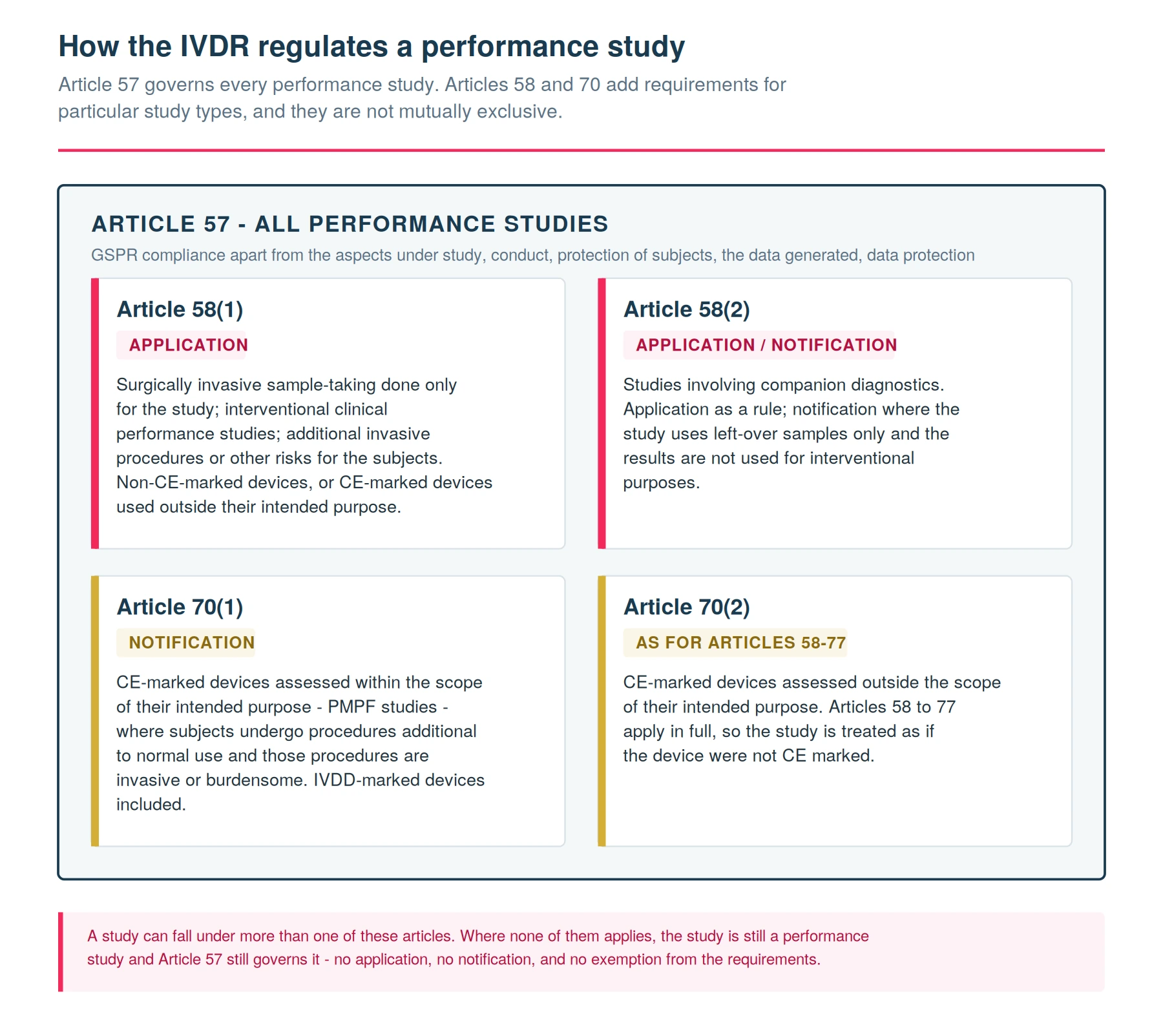
This is where a recognisable category of file fails. A sponsor establishes that the study needs neither an application nor a notification, concludes that the study is therefore unregulated, and runs it as internal validation work with no statement of conformity, no protection-of-subjects documentation and no data protection assessment. The study was regulated the whole time. What was absent was a submission, not an obligation, and the missing Article 57 records are found later, when the data reach a notified body inside a performance evaluation.
What counts as a performance study, and what stops short of one
A performance study is defined in Article 2(42) as a study undertaken to establish or confirm the analytical or clinical performance of a device, and MDCG 2025-5 adds the operative test: every performance study should have endpoints that establish or confirm that performance. The IVDR does not regulate clinical or laboratory methods — workflows, operating procedures, how a laboratory organises itself around an instrument. The object of a performance study is device performance, and if the endpoints are about the laboratory rather than the device, the study is something else.
Fresh specimens from human subjects are not required. A curated database, a registry, previously collected patient data or material, and contrived artificial samples can all be the source of data for a performance study. That is worth stating explicitly, because sponsors sometimes reason that a study on banked material cannot be a performance study. It can, and frequently is.
The development-stage boundary is drawn where design validation begins. Early-stage design studies that seek to establish product specifications before design verification, where neither analytical nor clinical performance is being investigated, are not performance studies. Studies for validation of the design are performance studies where they seek to establish or confirm analytical or clinical performance. The line is what the study is trying to demonstrate, not what the project plan calls the phase.
Research use only, and the moment a reagent becomes a device
Research use only products can be used in performance studies, and the guidance sets out three distinct configurations that a sponsor should be able to tell apart. An RUO product used purely for research purposes alongside a performance study of a different product sits outside the IVDR entirely. An RUO product that is assigned an in vitro diagnostic intended purpose and is itself the object of the study becomes an IVD and a device for performance study. And an RUO product that is assigned an IVD intended purpose but is not the object of the study is still no longer an RUO product: it is in scope, and the requirements for conformity assessment and CE marking or in-house manufacture apply to it.
The consequence that catches sponsors is the change of role. Where a sponsor assigns a medical purpose to a product in a way that fulfils the definition in Article 2(2), the sponsor may assume the role of manufacturer under the IVDR — with the obligations of Article 10 and Article 57(1), or as the person responsible for the manufacture of the device for performance study under section 4.1 of Chapter I of Annex XIV. A research group that writes an intended purpose into its own protocol has done more than describe a study. It has taken on a manufacturer's obligations.
The four criteria that turn a study into an application
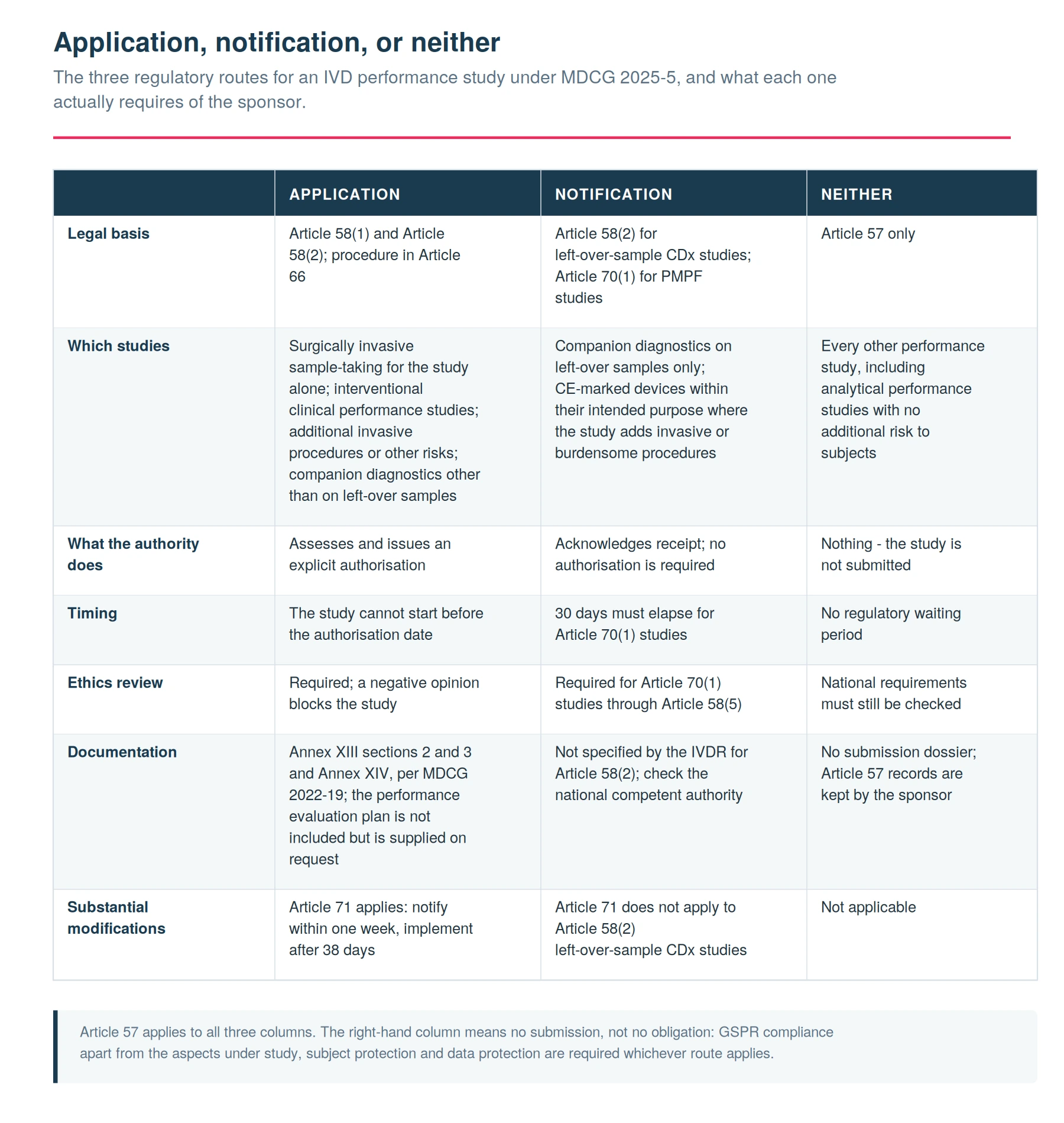
An application to the competent authority, with the explicit authorisation that follows it, is required in four situations. Three of them are in Article 58(1) and one is in Article 58(2).
The first is a study in which surgically invasive sample-taking is done only for the purpose of the performance study. The second is an interventional clinical performance study, which the IVDR defines as one where the test results may influence patient management decisions or may be used to guide treatment. The third is a study involving additional invasive procedures or other risks for the subjects, even where those risks have nothing to do with sample collection. The fourth is a study involving a companion diagnostic other than one using left-over samples only.
Two of these criteria have wide edges that the guidance deliberately leaves open, and in both cases it tells sponsors to document their reasoning rather than to look for a threshold. On other risks for the subjects, the guidance gives the example of assessing the volume of blood to be collected against an individual subject's sensitivity to a reduction in blood volume, and encourages sponsors to record why a study does not meet any of the Article 58(1) criteria. On major clinical risk under Article 66(7), it lists the study population, the clinical status of the subjects and the number, volume and type of samples as the factors to weigh, and again asks for the assessment to be documented in the application. A sponsor who concluded that a criterion did not apply and wrote nothing down has an undocumented decision at the exact point an assessor will probe.
The two routes that require only a notification
Two situations attract a notification rather than an application. The first is a performance study involving a companion diagnostic that uses left-over samples only and where the results are not used for interventional purposes — Article 58(2). The second is a study with a CE marked IVD used within the scope of its intended purpose, where the study submits subjects to procedures additional to those performed under normal conditions of use and those additional procedures are invasive or burdensome — Article 70(1). That second route is the post-market performance follow-up route, and it is the one most manufacturers will meet.
The procedural difference between the two mechanisms matters more than the paperwork difference. A notification under Article 58(2) or Article 70(1) does not have to be authorised by the Member State before the study starts; acknowledgement of receipt is sufficient but not necessary, provided that for Article 70(1) studies the thirty-day timeline is respected. An application under Article 66, by contrast, requires an explicit authorisation from the Member State, and the study cannot start before the authorisation date. Sponsors who read the notification route as a formality should note that Article 70(1) studies still attract points (b) to (l) and point (p) of Article 58(5), which include ethical review by an ethics committee.
A comparison of CE marked devices is not automatically outside the rules. If a head-to-head comparison meets the definition of a performance study, a notification may be required depending on the study characteristics. The test under Article 70(1) is whether subjects undergo additional procedures beyond normal use, and whether those procedures are invasive or burdensome — not whether the devices already carry a CE mark.
Three definitions decide more cases than the decision tree does
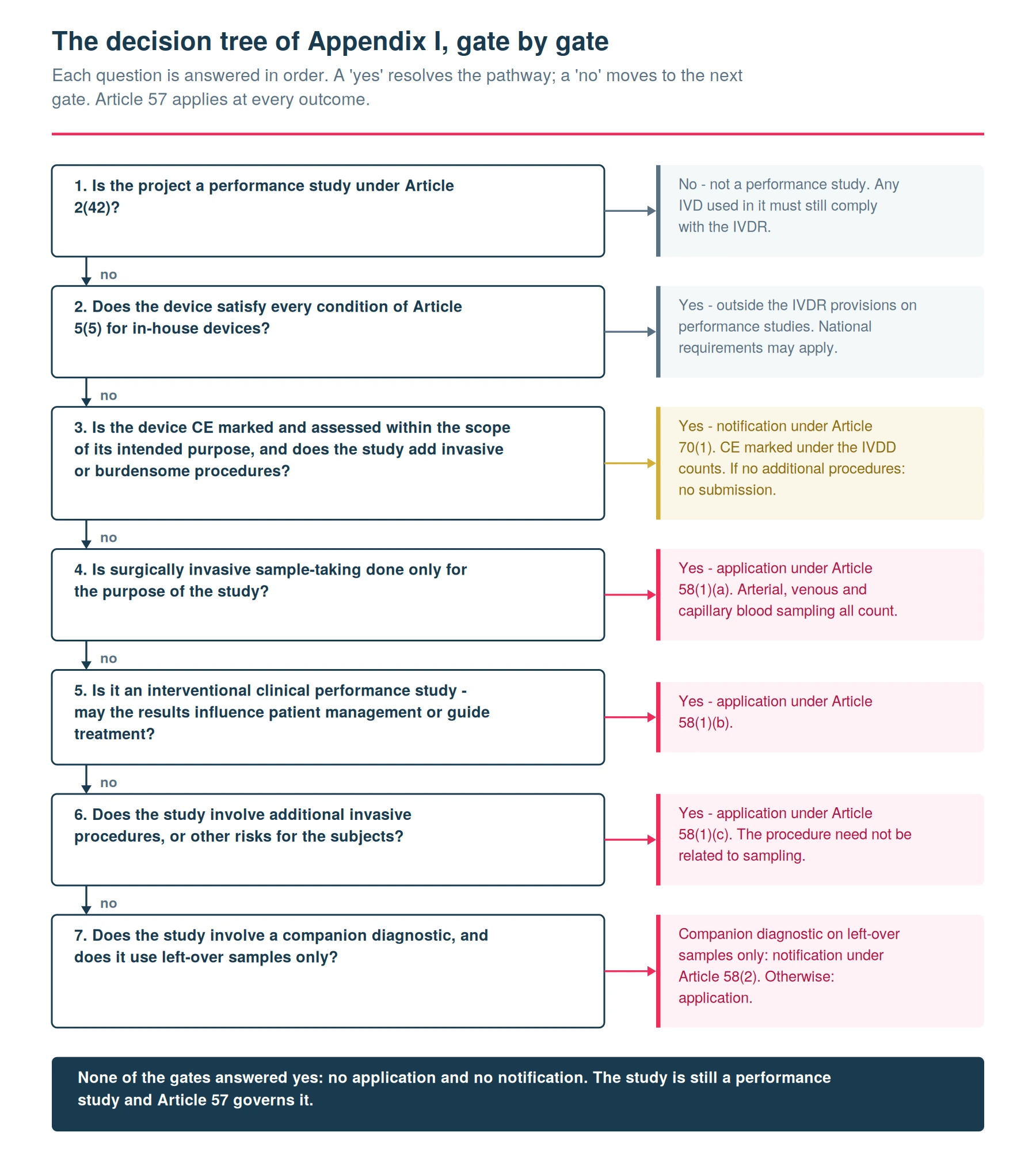
The decision tree in Appendix I is clean, and it is easy to work through to the wrong answer, because three of its gates turn on definitions that are not intuitive. Sponsors who misread any one of them will follow the flowchart faithfully and arrive at a route the competent authority disagrees with.
Surgically invasive sample-taking includes an ordinary blood draw
This is the correction with the widest reach. Surgically invasive sample-taking means sample-taking with a surgically invasive device, and the guidance borrows the MDR definition: an invasive device that penetrates inside the body through the surface of the body, including through the mucous membranes of body orifices, or a device that produces penetration other than through a body orifice. The examples the guidance gives are blood sampling — arterial, venous or capillary — puncture including cerebrospinal fluid or abscess, and collection of a fresh tissue biopsy.
Capillary blood sampling is on that list. A finger-prick taken solely to supply specimens for a performance study is surgically invasive sample-taking done only for the purpose of the study, and Article 58(1)(a) applies. Any protocol that recruits subjects to give blood for the study and nothing else is on the application route, whatever the risk assessment says about the magnitude of the risk.
The qualifier that saves most studies is "only for the purpose of the performance study", and MDCG 2025-5 is precise about it. Sampling done as part of routine care or under a clinical trial protocol, where part of the sample is then used for the study, is not done only for the study. Nor is an additional volume drawn into a separate container without an additional invasive procedure — an extra tube taken through an indwelling catheter already in place for another reason. But two scenarios are captured: the sampling procedure performed as a separate procedure for the study alone, and an additional invasive sub-procedure during a surgical operation, such as a biopsy taken during surgery only for study purposes. And even where the sampling escapes Article 58(1)(a), the extent of the extra collection or the use of the result in treatment decisions may still bring the study under point (b) or point (c).
Interventional means something different here than in medicines law
An interventional clinical performance study, under Article 2(46), is a clinical performance study where the test results may influence patient management decisions or may be used to guide treatment. The guidance flags explicitly that the term means something different in the context of clinical trial legislation for medicinal products, where interventional describes an intervention allocated by the protocol. Teams staffed from pharmaceutical clinical operations import the wrong definition, and they import it in the direction that under-classifies: a study with no allocated intervention looks observational to them, while under the IVDR the question is only whether the result reaches a clinical decision.
The reason for the definition is the harm model. In an interventional study there is a risk of indirect harm to the subject from a false negative or false positive result produced by an unvalidated device, leading to inappropriate patient management. That is the same indirect-harm chain that governs an IVD risk file, and it is why the acceptance criteria in a performance evaluation have to be set against the severity of the clinical consequence rather than against a generic analytical target. The mechanics of that chain are covered in the ISO 14971 risk management guide.
One corollary is easy to miss: specimens used in an interventional study cannot be left-over samples, because they have clinical relevance for the subjects from whom they came. And not every companion diagnostic study is interventional — analytical performance studies are not, and clinical performance studies where the results are not used to influence patient management or guide treatment during the study are not either.
Left-over samples, and the condition that disqualifies them
Left-over samples are unadulterated remnants of human-derived specimens collected as part of routine clinical practice, for research, or for other purposes unconnected to the study in question, after all standard or intended analyses have been performed — specimens that would otherwise be discarded because there is no remaining clinical need for the individual they came from. Specimens obtained in the past from repositories such as tissue banks or commercial vendor collections can qualify.
The disqualifying condition is clinical need. Where there is a clinical need for the samples, as there is in an interventional performance study, they are not left-over samples, and the notification route under Article 58(2) closes. Sponsors of companion diagnostic studies should test that condition before designing around the notification route, because the whole route depends on it.
Left-over samples also do not carry a general exemption outside the companion diagnostic case. Where they are used in a non-companion-diagnostic study, Article 58(1)(c) may still apply if subjects are exposed to other risks through additional examinations, and an application is then required. And where they are used to further assess a CE marked device within its intended purpose in a study that adds burdensome or invasive procedures, Article 70(1) still requires a notification.
✦ EU IVDR DOCUMENTATION KIT
The performance evaluation set the study data have to land in.
Performance Evaluation Plan with the thirteen elements of Annex XIII 1.1, Scientific Validity, Analytical Performance and Clinical Performance Reports, a Performance Evaluation Report that assesses its three inputs, and the PMPF plan whose studies fall under Article 70(1) — with the regulatory pathway determination built into the plan rather than argued afterwards.
- ✓ Word templates · Annex XIII Part A and Part B · MDCG 2022-2, 2025-5 and 2024-4 integrated
- ✓ Compliance checklists against 1.1, 1.2 and 1.3 in every document
ONE-TIME
€399
Get the EU IVDR Kit →CE marked devices, including the ones marked under the Directive
Article 70 deals with studies on devices that already carry a CE mark, and it splits on intended purpose. Article 70(1) covers a device assessed within the scope of its intended purpose — a post-market performance follow-up study — and requires a notification where subjects undergo additional procedures that are invasive or burdensome. Article 70(2) covers a device assessed outside the scope of its intended purpose, and its effect is to apply Articles 58 to 77 in full, which means the study is handled as though the device were not CE marked at all.
MDCG 2025-5 confirms that both provisions apply to devices CE marked under the IVD Directive as well as under the Regulation, provided those legacy devices are lawfully placed on the market under the transitional provisions. That answer removes an argument that had been used to keep IVDD-marked devices out of the performance study regime entirely, and it lands on a large population: most of the IVD portfolio still on the market in 2026 carries a Directive mark.
The guidance also closes the reverse question. Articles 58(1) and 58(2) do not apply to CE marked IVDs used within the scope of their intended purpose; those studies are regulated by Article 70(1), can attract a notification, and do not carry the additional obligations of Article 58 such as authorisation. They remain subject to Article 57 in every case.
Burdensome is the term that decides most Article 70(1) cases, and the guidance defines it broadly and from the subject's point of view. Burdensome procedures may cause pain, discomfort, fear, potential risks or complications and side effects, disturbance of lives and personal activities, or otherwise unpleasant experiences, and the assessment is mostly determined from the perspective of the person bearing the burden. The guidance acknowledges that the understanding of the term will develop over time, encourages sponsors to document their assessment of whether the additional procedures imposed by the clinical performance study plan are burdensome, and invites contact with the competent authority or ethics committee in uncertain cases. An extra clinic visit, a questionnaire that takes an hour, a dietary restriction — none of these is a risk in the safety sense, and all of them are plausibly burdensome. The benefit-risk analysis that supports the study is the natural place to record that reasoning.
✦ RISK MANAGEMENT DOCUMENTATION KIT
The risk file the 'other risks for the subjects' assessment comes from.
Risk Management Plan, Risk Management Report, Hazard Analysis built on the ISO/TR 24971 Annex A questions, and Design and Use-related FMEA as active Excel worksheets with auto-calculated RPN — aligned with EN ISO 14971:2019/A11:2021, and the place a documented judgement on sample volume, additional procedures and indirect harm actually belongs.
- ✓ 6 coordinated templates · Word and Excel · 90 working formulas per FMEA
- ✓ Buying the 6 templates individually costs €414
Complete kit €349
Get the Risk Kit →Which Member State receives the submission
IVD performance studies routinely collect specimens in one country and analyse them in another, and Article 66 says only that an application goes to the Member States in which the study is to be conducted. MDCG 2025-5 resolves the ambiguity in a way that is both narrower and more demanding than most sponsors assume.
Both specimen collection sites and specimen analysis sites are investigational sites, and the study is conducted at both. Article 57 therefore applies to all of them. But the criteria in Article 58(1) all relate to the study subjects, so Article 66 applies only where specimen collection is performed. An application is submitted for every Member State where subjects are included, and is not necessary for Member States that host only analysis sites. The same reasoning applies to notifications under Article 70(1). The one broader case is a companion diagnostic study on left-over samples only: there, a notification under Article 58(2) is required in every Member State involved, whether the samples came from an EU Member State or from outside the Union.
Two operational consequences follow. A study can only start in a Member State once at least one collection site in that Member State has the relevant authorisations, including an ethical review that has not produced a negative opinion — and the sponsor must additionally ensure that the analysis site is ready, so that subjects are not exposed to sampling risk for specimens nobody can analyse. And the start date is the first act of recruitment in that Member State, specified by the sponsor and described in the performance study plan; for studies on left-over samples only, it can be the date the first sample is analysed.
Instructions for use translation is governed by national law rather than by the IVDR, but the guidance is direct about the practical requirement: comprehension of the manufacturer's instructions is one of the important aspects of a performance study, and the sections describing how to obtain, prepare and store specimens matter most at collection sites even when analysis happens elsewhere. A partial translation of the relevant sections is a viable option. For self-testing and near-patient testing devices, the information supplied to the user must be in the official language or languages determined by the Member State where the device is made available.
What goes into the application, and what stays out of it
An application under Article 66(1) is accompanied by the documentation referred to in Sections 2 and 3 of Annex XIII — the clinical performance study plan of section 2.3.2 — and in Annex XIV, with the application forms supplied by MDCG 2022-19. National requirements published by the competent authority have to be checked on top of that. Two questions about the content come up constantly, and the guidance answers both against the instinct to over-submit.
The performance evaluation plan is not required in the application. The IVDR does not ask for it, and the guidance says so plainly — while adding that it gives a useful overview of product development and of how the study contributes to the collection of evidence, and that it must be provided to the competent authority on request. So it is not filed, and it has to exist and be current, which is a distinction some sponsors resolve in the wrong direction by having no plan at all.
The full technical documentation is not required either. Compliance with the GSPR must be documented to a level appropriate to the planned use in the study, with the underlying reports available on request. The guidance gives a clean example: where an IVD is only used, stored and shipped within certain temperature limits during the study, data supporting stability outside those limits is not needed. What the documentation must do is show which GSPR are applicable, which have already been met by objective evidence, and which the proposed study will address — the same structural exercise as the IVDR technical documentation file, scoped down to the study. Those reports are the basis on which the manufacturer signs the statement of conformity for the device for performance study under section 4.1 of Chapter I of Annex XIV.
| Question | What MDCG 2025-5 answers | Where it bites |
|---|---|---|
| Is the performance evaluation plan filed? | No. It is not part of the application, but it is provided to the competent authority on request | A sponsor with no current plan cannot respond to the request |
| Is the full technical documentation filed? | No. GSPR compliance is documented to the level appropriate to the use in the study | Over-submission invites questions on evidence the study does not need |
| How are technical and functional features presented? | As a table of the relevant product characteristics with the associated specifications and the expected clinical outcome | Element (aa) of the CPSP is a narrative in most drafts |
| Does each feature have to be labelled? | Yes. It must be stated whether each characteristic relates to the safety or to the performance of the device | Rarely done, and visible immediately |
| Can one study cover several devices? | Yes, within one performance study plan, duplicating the device section of the application form | The investigator's brochure and the statement of conformity must cover all of them |
| What is the study identifier before EUDAMED? | The CIV-ID generated by a competent authority in Eudamed2; national numbers may also be used | Cross-references between documents drift when the identifier changes |
Element (aa) is the one to rewrite. Section 2.3.2(aa) of Annex XIII asks for the technical and functional features of the device with those covered by the study indicated, and MDCG 2025-5 expects a tabular presentation: characteristic, associated specification, expected clinical outcome, and whether it relates to safety or to performance. Expected clinical performance outcomes are specified according to the study endpoints. A paragraph of prose does not satisfy it.
Where several devices for performance study are assessed together, the documentation accompanying the application under Chapter I of Annex XIV has to cover all of them — although the guidance allows a combined investigator's brochure with sufficient detail on each device, while the statement of conformity is more naturally issued separately, one per device, signed by whoever assumes responsibility for that device. If the devices cannot sensibly share one performance study plan, they are split across separate studies. On the identification number, the CIV-ID stands in until the EUDAMED performance study module is functional; the broader picture of what is live and what is not is covered in the EUDAMED registration guide.
Substantial modifications: one week to notify, thirty-eight days to wait
A substantial modification is a change to the performance study likely to have a substantial impact on the safety, health or rights of the subject, or on the robustness or reliability of the data generated. Whether a change to the plan, the investigator's brochure, the subject information sheet or the device meets that test is the sponsor's determination, and the national competent authority may be consulted where the sponsor is uncertain. Appendix II lists twenty-nine modifications that may be deemed substantial, grouped into changes to the plan or subject information, changes affecting benefit-risk, changes to the device or its use, changes to other information, and changes to the manufacturing process.
The list repays reading in full, because several entries are not obvious. Amending the number of subjects to maintain a previously defined sample size calculation, after an unanticipated dropout rate, is on it. So is deletion of an interim analysis, not only its addition. So is a change in the compensation paid to subjects or investigators, a new insurance policy with new conditions — a renewal of the same certificate is not substantial — and, on the manufacturing side, a change in the supply chain for antibodies or for materials of human or animal origin, a change in reagent formulation, or a change in the material and coating of storage containers.
The timing has two clocks and sponsors regularly run only the first. The one-week notification period of Article 71(1) starts from the date the relevant documents are issued in an updated version, not from the date the decision was taken; where a change to the study plan forces later changes to subject information, the changes can be collected and submitted together when the last affected document is issued. Implementation is the second clock: if the sponsor has not heard from the Member State after thirty-eight calendar days from the submission of the complete documentation with clearly identifiable changes, the modification may be implemented, provided no ethics committee has issued a negative opinion. The Member State may extend that period by seven further days to consult experts, and a request for information may stop the clock depending on national provisions. Authorisation can also come sooner, and once a modification is authorised in one Member State it can be implemented there even if others have not yet responded.
Two limits are worth holding on to. A change to the device for performance study is generally a substantial modification — particularly one that alters the risk profile or adds new risks — but some device changes are extensive enough that the study should be terminated and a new application submitted; a modification that alters whether the study design can still provide evidence for the device may be refused for that reason. And Article 71 does not apply at all to performance studies involving companion diagnostics on left-over samples only, because Article 58(2) disapplies Article 58(1) and with it Articles 59 to 77.
Safety reporting runs on a separate track. It is governed by MDCG 2024-4, which carries the reporting form in its appendix, and it applies to studies that started under the Directive as well. Studies approved or started before 26 May 2022 are not resubmitted under the IVDR, but any serious adverse event or device deficiency that could lead to one, occurring after that date, is reported under Article 76 regardless of when the study began.
Where sponsors get this wrong
The errors are consistent, and most of them are decisions taken early — at protocol design, when the regulatory pathway is assumed rather than determined — which is why they are expensive to correct once recruitment has started.
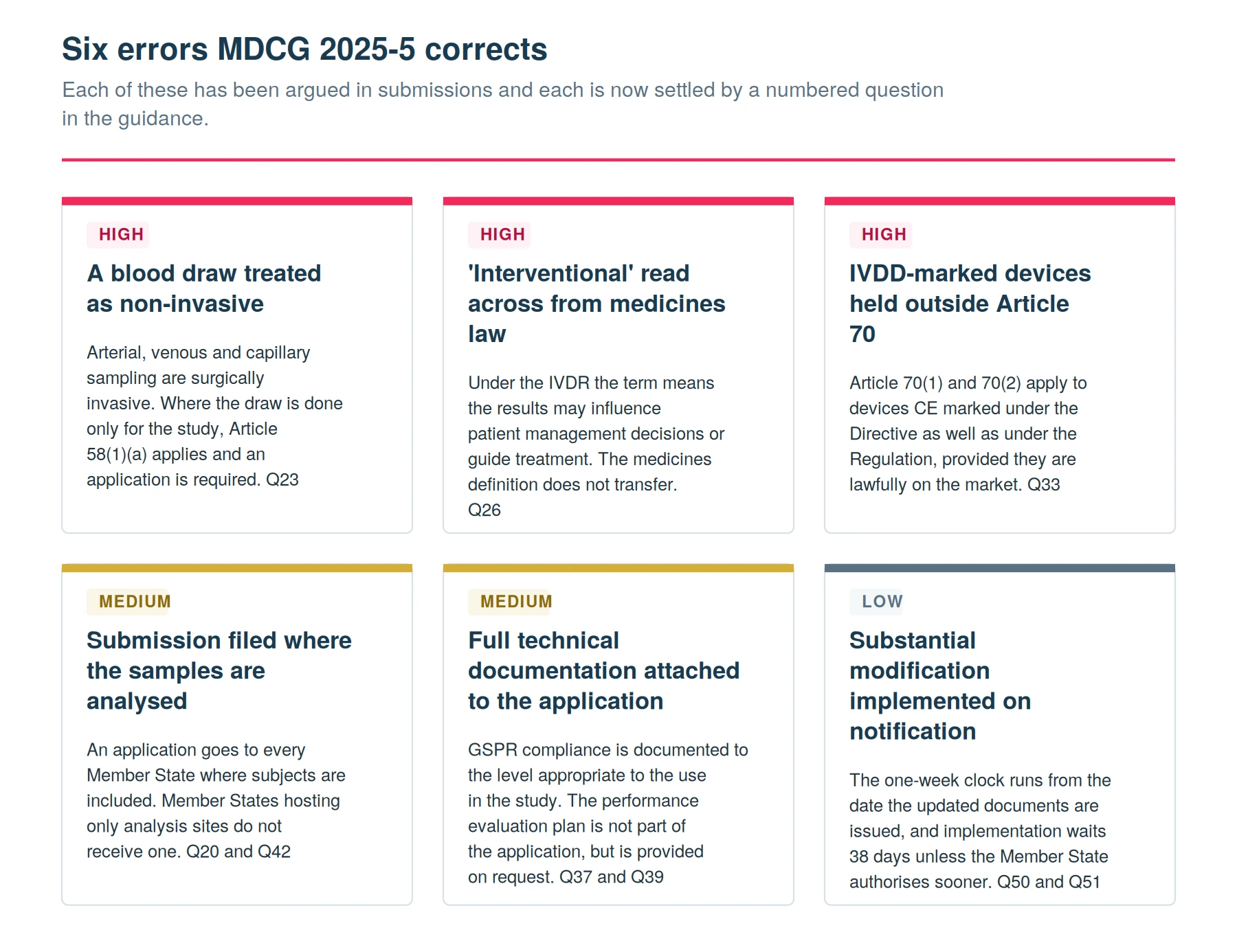
The blood sampling error is the most common and the most consequential, because it converts a study the sponsor planned to notify, or not to submit at all, into a study requiring an authorisation that has to be obtained before recruitment. Discovering it after enrolment has begun means stopping. The interventional misreading runs the same direction and produces the same outcome, and it is most likely in organisations that staff IVD studies from a medicinal product clinical operations function.
The Member State error is procedural but it delays study start by weeks: an application filed in the country where the laboratory sits, rather than in the countries where subjects are recruited, is filed with an authority that does not need it and not filed with the ones that do. The over-submission error is the opposite of a compliance failure and still costs time, because assessors ask questions about every document they receive, including the ones the Regulation never asked for.
The two remaining errors are documentation habits. Element (aa) written as prose rather than as a table, with no indication of whether each characteristic relates to safety or to performance, is close to universal in first drafts. And the substantial modification implemented as soon as the notification is sent, rather than after the thirty-eight-day period has run, is the kind of finding that surfaces during a competent authority inspection rather than at submission — long after the data have been generated under a protocol that was not yet cleared.
Frequently asked questions
What is MDCG 2025-5?
MDCG 2025-5 is the Medical Device Coordination Group guidance published in June 2025 as a set of fifty-four questions and answers on performance studies of in vitro diagnostic medical devices under Regulation (EU) 2017/746. It covers Articles 57 to 77, and includes a decision tree in Appendix I for determining the regulatory pathway and a non-exhaustive list of substantial modifications in Appendix II. It is not legally binding, but competent authorities and notified bodies work from it.
Does an IVD performance study always need approval from a competent authority?
No. Only studies in scope of Article 58(1), Article 58(2) or Article 70 are submitted. Article 58(1) and companion diagnostic studies other than on left-over samples require an application and an explicit authorisation; companion diagnostic studies on left-over samples only and Article 70(1) post-market performance follow-up studies with additional invasive or burdensome procedures require a notification. All other performance studies require no submission — but Article 57 still applies to them in full.
Is drawing blood for a performance study surgically invasive?
Yes. MDCG 2025-5 lists arterial, venous and capillary blood sampling as examples of surgically invasive sample-taking, along with puncture for body fluids and collection of a fresh tissue biopsy. Where that sampling is done only for the purpose of the study, Article 58(1)(a) applies and an application is required. Sampling performed as part of routine care, or an extra tube drawn through a catheter already in place, is not done only for the study.
What does interventional mean under the IVDR?
An interventional clinical performance study is one where the test results may influence patient management decisions or may be used to guide treatment. The term carries a different meaning in clinical trial legislation for medicinal products, and the medicines definition must not be applied to an IVD study. Specimens used in an interventional study cannot be treated as left-over samples, because they have clinical relevance for the subjects concerned.
Do Articles 70(1) and 70(2) apply to devices CE marked under the IVD Directive?
Yes. MDCG 2025-5 confirms that both provisions apply to IVDs CE marked under Directive 98/79/EC as well as under the Regulation, provided the legacy devices are duly placed on the market in compliance with the transitional provisions. A study on a Directive-marked device is therefore inside the performance study regime, not outside it.
Does the performance evaluation plan go into the performance study application?
No. The IVDR does not require the performance evaluation plan to be included in the application. It has to be provided to the competent authority on request, which means it must exist and be current even though it is not filed. The documentation that is filed is set out in Sections 2 and 3 of Annex XIII and in Annex XIV, using the forms in MDCG 2022-19.
When can a substantial modification be implemented?
The sponsor notifies the Member State within one week of the date the updated documents are issued, and may implement the modification thirty-eight calendar days after submitting the complete documentation with clearly identifiable changes, provided the Member State has not responded and no ethics committee has issued a negative opinion. The Member State may extend the period by seven days to consult experts, and may authorise the modification sooner.
Which Member States receive the application when samples are collected and analysed in different countries?
An application is submitted for every Member State where subjects are included. Member States hosting only analysis sites do not receive one, because the Article 58(1) criteria all relate to study subjects. The exception is a companion diagnostic study on left-over samples only, where a notification under Article 58(2) is required for all Member States involved, regardless of where the samples were sourced.
Conclusions
The regulatory pathway for an IVD performance study is a determination, not an assumption, and MDCG 2025-5 has removed most of the room to get it wrong by accident. The determination belongs in the protocol design phase, documented with the reasoning that led to it, because every one of the expensive errors in this article is a pathway decided late or decided by analogy with something else.
Three things carry most of the practical value. Article 57 governs every performance study, so a conclusion that nothing needs submitting is not a conclusion that nothing is required. Blood sampling — arterial, venous or capillary — is surgically invasive, and a study that draws blood only for its own purposes is on the application route with an authorisation to obtain before it starts. And interventional under the IVDR means the result may reach a clinical decision, which has nothing to do with what the word means in medicines legislation and catches studies that look observational on paper.
The guidance is available in full from the European Commission, and it is worth reading Appendix II end to end rather than sampling it, because the modifications that are deemed substantial are not the ones most sponsors would predict.
The EU IVDR Documentation Kit on MD Regulatory includes the Performance Evaluation Plan with the thirteen elements of Annex XIII 1.1, the Scientific Validity, Analytical Performance and Clinical Performance Reports, the Performance Evaluation Report with its compliance checklist against 1.3.2, and the PMPF plan whose studies fall under Article 70(1) — all aligned with Regulation (EU) 2017/746, MDCG 2022-2 and MDCG 2025-5, and immediately deployable in an existing ISO 13485 quality management system.
Related articles