ANVISA Registration: The Complete Guide for Medical Devices
Table of Contents
- Introduction
- Why ANVISA registration defeats companies that already hold a CE certificate
- The regulations that govern ANVISA registration
- Classification: four classes, twenty-two rules
- The Brazilian Registration Holder (BRH)
- Notification or marketing authorisation
- BGMP certification: the gate on Class III and IV
- Building the technical dossier for ANVISA registration
- Frequently asked questions about ANVISA registration
- Conclusions
Introduction
ANVISA registration is where confident manufacturers discover that a CE certificate is not a passport. The file that satisfied your Notified Body — the same risk management report, the same clinical evaluation, the same design history — will be read again in Brasília against a different framework, by a reviewer who owes your Notified Body nothing. Most of the work transfers. Almost none of it transfers unchanged. And the two things that most often stop a Brazilian submission dead are not technical at all: the legal entity you appointed to hold the registration, and a manufacturing certificate you did not know you needed until the review was already running.
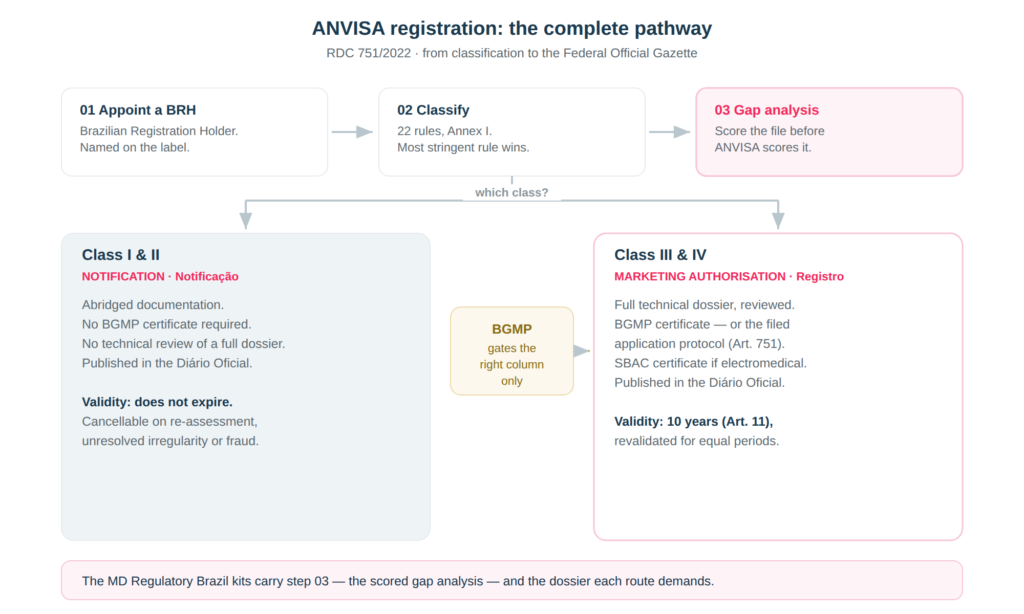
This guide covers the whole path: the regulatory architecture under RDC 751/2022 and RDC 848/2024, the twenty-two classification rules, the Brazilian Registration Holder decision, the split between Notification and marketing authorisation, BGMP certification, the technical dossier, and the deficiencies that come back. It assumes you already know how to build a technical file — if you do not, start with our EU MDR technical documentation guide and our ISO 14971 risk management guide, because both are the raw material for everything below.
Why ANVISA registration defeats companies that already hold a CE certificate
The failure is rarely technical competence. It is a category error about what kind of system Brazil is.
Manufacturers arriving from Europe carry an unexamined assumption: that regulatory approval is a conformity assessment, in which an independent body reviews evidence against harmonised standards and issues a certificate. That is the European model. Brazil is not that model. ANVISA is a state health authority exercising sanitary police power, and the thing it grants is an administrative act published in the Diário Oficial da União — the Federal Official Gazette. It is not a certificate of conformity. It is a government permission, granted to a Brazilian legal entity, to place a specific product on the Brazilian market.
That distinction has consequences that surprise people. The permission belongs to the holder, not to you. It has a number, a publication date and, for higher-risk devices, an expiry. It can be cancelled by administrative decision. And it is granted on the basis of a dossier that ANVISA itself reads — there is no intermediary, no Notified Body, no negotiated technical dialogue of the kind European manufacturers are used to. What you file is what gets assessed.
The second surprise is sequencing. In Europe, quality system certification and technical documentation review run in parallel under the same Notified Body, on the same timeline, often in the same audit week. In Brazil they are separate proceedings with separate clocks, and one of them gates the other. A Class III device cannot receive marketing authorisation without Brazilian Good Manufacturing Practices certification of the manufacturing site — and BGMP certification, when it requires an inspection, can take longer than the registration review itself. Companies that discover this at submission have already lost a year.
The third is that Brazil moved. RDC 185/2001 governed medical devices for more than two decades, and an entire generation of Brazilian regulatory practice grew up around it. It is gone. RDC 751/2022 replaced it with effect from 1 March 2023, and the replacement was not cosmetic — the classification rules were rewritten to align with IMDRF and, in substance, with the logic of EU MDR Annex VIII. If your Brazilian classification predates March 2023, it was determined under rules that no longer exist. ANVISA will not write to tell you. That reconciliation is your job, and the deficiency letters prove that a lot of companies have not done it.
The regulations that govern ANVISA registration
Brazil does not have a single medical device regulation. It has a stack, and the stack is the first thing to get straight, because half the errors in Brazilian submissions are citations to instruments that have been superseded.
RDC 751/2022 — the framework
Resolution RDC No. 751/2022, published 15 September 2022 and effective from 1 March 2023, is the backbone. It defines what a medical device is, classifies devices into four risk classes, sets the rules for labelling and instructions for use, establishes the two regularisation regimes (Notification and marketing authorisation), and governs alterations, revalidation and cancellation. The official English translation is published by ANVISA and it is worth reading in the original rather than in a consultant’s summary, because the operative details live in the paragraphs — Article 11 for the ten-year validity, Article 10 for the documents and the language rule, Annex I for the classification rules, Annex II Chapter 3 for the link to essential requirements.
Note what RDC 751/2022 excludes. In vitro diagnostics are governed separately by RDC 830/2023, in force since June 2024, which classifies IVDs into Classes A to D under eight rules of its own. Custom-made and patient-matched devices fall under RDC 925/2024. Used and refurbished devices fall under RDC 579/2021, which prohibits the import, sale or donation of used or refurbished implantable devices outright. Software as a medical device is classified under RDC 751/2022 but carries additional obligations under RDC 657/2022 — if that is your product, read our software as a medical device guide alongside this one, because the Brazilian SaMD rules add labelling and cybersecurity requirements that have no clean European equivalent.
RDC 848/2024 — the essential requirements
RDC 751/2022, at Annex II Chapter 3, requires every device to comply with the Essential Safety and Performance Requirements. When RDC 751/2022 was published, that pointed at RDC 546/2021. It no longer does. RDC 848/2024, published 6 March 2024 and mandatory 180 days later — from September 2024 — replaced RDC 546/2021 entirely.
This matters more than a renumbering exercise. RDC 848/2024 extended the essential requirements to IVDs for the first time, aligned further with IMDRF guidance, and made explicit a set of expectations that RDC 546/2021 handled loosely or not at all: risk management across the full lifecycle rather than at design freeze, clinical evaluation maintained as living evidence, cybersecurity for devices incorporating software, and conformity with the state of the art rather than with a frozen standards list. Protocols filed before the effective date could rely on the prior requirements. New submissions cannot.
The practical consequence is blunt: an essential requirements checklist built against RDC 546/2021 is now a deficiency waiting to be written. It is also one of the most common findings we see, because the checklist is the kind of artefact that gets built once, blessed, and copied forward across submissions for years without anyone re-reading its header.
Around this core sit the instruments that catch specific device types. RDC 665/2022 sets the Good Manufacturing Practice requirements. RDC 591/2021 implements Brazilian UDI, with Device Identifier and Production Identifier issued through accredited agencies and phased in by risk class. RDC 549/2021 requires conformity assessment within the Brazilian Conformity Assessment System (SBAC) for electromedical equipment, certified by a body accredited by INMETRO against a standards list that ANVISA updates by Normative Instruction — currently IN 283/2024. IN 320/2024 governs the grouping of products. And IN 290/2024 created a reliance-based review pathway, under which ANVISA may take account of assessments already performed by recognised foreign authorities where sameness of product can be demonstrated. That last one is new, under-used, and worth investigating before you assume a full independent review is your only option.
✦ BRAZIL · ESSENTIAL REQUIREMENTS CHECKLIST
Built against RDC 848/2024 — not the RDC 546/2021 checklist you already have.
All 119 essential requirements of RDC 848/2024, each one cross-referenced to the matching EU MDR GSPR so your CE evidence can be reused instead of rewritten. Built from the ANVISA resolution itself, not from a third-party summary.
- ✓ 119 requirements · each mapped to its EU MDR GSPR
- ✓ Current from September 2024 · RDC 546/2021 fully superseded
One-time €89
Get the Checklist →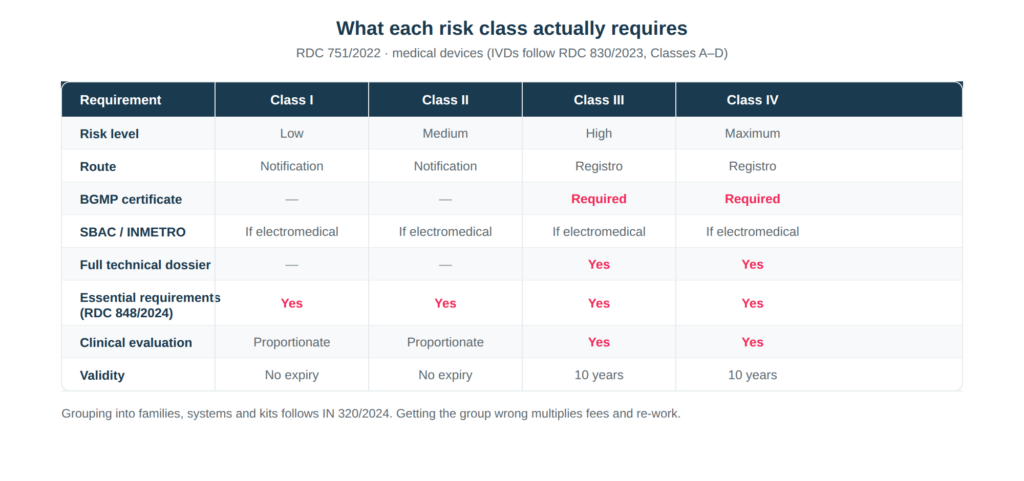
Classification: four classes, twenty-two rules
Everything downstream — route, dossier, BGMP, fees, timeline — is decided by class. Get it wrong and you do not get a deficiency; you get a rejected filing and a new fee.
How the rules in Annex I actually work
RDC 751/2022 classifies devices into Class I (low risk), Class II (medium), Class III (high) and Class IV (maximum), using twenty-two rules set out in Annex I. Classification runs on intended purpose, not on what the device physically is. The same catheter, described for two different purposes, classifies differently — and ANVISA reads the intended purpose you declare, not the one you meant.
Three mechanics drive the outcome. The first is duration of contact, and Brazil uses the familiar three bands: transient for less than sixty minutes, short-term from sixty minutes to thirty days, long-term beyond thirty days. The second is the principle that where more than one rule applies, the most stringent applicable rule prevails — you do not get to select the convenient one. The third is that where genuine doubt remains, ANVISA determines the class. That is not a threat; it is a route. A classification query resolved before filing costs a delay. A classification dispute discovered during review costs the filing.
The rules follow a structure European regulatory staff will find familiar: non-invasive devices in the early rules, invasive and surgically invasive devices next, active devices after that, then the special rules. Because RDC 751/2022 was written to align with IMDRF and, in practice, tracks the logic of EU MDR Annex VIII closely, a device CE-marked under the MDR will usually land in the equivalent Brazilian class. Usually is not always, and the exceptions are expensive. Treat your MDR class as a strong hypothesis to be tested rule by rule against Annex I, never as an answer to be transcribed.
Software deserves specific attention. ANVISA’s own guidance identifies a dedicated classification rule for software as a medical device within Annex I, and RDC 657/2022 layers additional requirements on top. Standalone software classifies on its own account, not as an accessory to the hardware it happens to run beside.
Grouping: families, systems and kits
Article 3 of RDC 751/2022 allows notification or marketing authorisation to be granted to families, systems and kits, with the grouping rules set out in specific regulation — currently IN 320/2024. This is not an administrative nicety. Grouping decides how many filings you make, how many fees you pay, and how much of your dossier you write once instead of five times.
It also decides how much you re-do when something changes. A family that is drawn too broadly invites ANVISA to challenge the commonality of intended use and split it. A family drawn too narrowly multiplies the filings and, worse, multiplies the alteration submissions for the rest of the product’s commercial life. Accessories are a particular trap: some can ride inside the parent grouping and some require their own regularisation, and a separate accessory registration can carry its own class and therefore its own BGMP exposure.
Draw the grouping before you write a single dossier page, and draw it against IN 320/2024 rather than against how your product catalogue happens to be organised internally.
The Brazilian Registration Holder (BRH)
This is the decision that outlives the product, and it is routinely made in a hurry by people who think they are choosing a distributor.
What the BRH actually carries
A foreign manufacturer cannot hold an ANVISA registration. The registration is granted to a Brazilian legal entity — the Brazil Registration Holder — which acts as the applicant before ANVISA and, once the device is regularised, assumes responsibility for its commercialisation in Brazil. The BRH’s identity appears on the device labelling. The BRH manages the BGMP certification process, handles reportable events and field actions, and files the alterations, revalidations and cancellations across the product’s life.
The BRH can be the manufacturer’s own Brazilian subsidiary, an importer, a distributor, or an independent third party existing for no other purpose. All four are lawful. They are not equivalent.
Why an independent BRH is worth the extra cost
Here is the mechanism that catches people. The registration belongs to the holder. If your distributor is your BRH and the commercial relationship ends — they underperform, they get acquired, they simply refuse to release the registration during a dispute — you do not walk away with your registration. You start again: new applicant, new filing, new fee, new review clock, and a gap in supply while a product that is demonstrably safe sits outside the Brazilian market for administrative reasons.
ANVISA permits a registration holder to authorise multiple companies to import the product. That is the structural answer. An independent BRH holds the registration; importers and distributors are authorised beneath it and can be added, changed or removed without touching the registration itself. You pay an annual fee for the privilege, and the fee is trivial against the cost of re-registering a Class III device because a commercial partnership soured.
Decide this before classification, not after the dossier is written. Changing BRH later is a filing, not an amendment.
Notification or marketing authorisation
RDC 751/2022 establishes two regimes, and which one applies is determined entirely by class.
Notification — Class I and Class II
Class I and Class II devices follow Notificação. The documentation is abridged. There is no full technical dossier review. There is no BGMP certificate requirement. The regularisation is published and the product may be marketed.
The critical property is that a Notification does not expire. There is no ten-year clock, no revalidation filing, no renewal fee. It can be cancelled — on request, on re-assessment, where irregularities cannot be resolved, or where fraud is detected — but it does not lapse through the passage of time.
Do not read “abridged documentation” as “no obligations”. The device must still comply with the essential safety and performance requirements of RDC 848/2024. The technical dossier must still exist, be maintained by the manufacturer, and be produceable — ANVISA verifies it at regularisation and at inspection. What changes is what you file up front, not what you must hold. A Class II Notification with no underlying technical file is not a light-touch registration; it is an unregistered device with a number.
Marketing authorisation — Class III and Class IV
Class III and Class IV devices require Registro: a full technical dossier, reviewed. Under Article 11 of RDC 751/2022 the marketing authorisation is valid for ten years from publication in the Federal Official Gazette, and may be revalidated for equal and successive periods.
The filing must carry the application forms, the manufacturer’s authorisation for the BRH where the device is imported, the technical dossier, proof of compliance, the BGMP certificate, and — for electromedical equipment — the SBAC conformity certificate. Under RDC 549/2021, devices within the SBAC scope may only be imported and marketed if they were manufactured while the conformity certificate was valid, which is a supply-chain constraint dressed as a paperwork requirement and one that catches manufacturers who let a certificate lapse between production runs.
BGMP certification: the gate on Class III and IV
For Class III and Class IV, the manufacturing site must hold a valid Brazilian Good Manufacturing Practices certificate issued by ANVISA. This is the single most common reason a Brazilian project misses its date, and the reason is almost always that it was treated as a parallel workstream rather than as a gate.
There is one significant mitigation, and it is written into RDC 751/2022 itself: ANVISA accepts the application protocol for BGMP certification in support of a marketing authorisation application. You do not have to hold the certificate before you file. You do have to have filed for it. That single fact, understood early, can compress a Brazilian project by many months — and not knowing it is why so many companies sequence the two proceedings end to end when they could have overlapped them.
The MDSAP route
Brazil is a founding member of the Medical Device Single Audit Program, and ANVISA accepts MDSAP audit reports in the BGMP certification process. For a manufacturer already carrying MDSAP, this is the difference between a documentary proceeding and an ANVISA inspection team travelling to your site. If Brazil is on your roadmap and you are weighing whether MDSAP earns its cost, this is the calculation that usually settles it — our MDSAP audits guide sets out what the audit actually covers and how it maps onto the ISO 13485 quality system you already run.
The ANVISA inspection route
Without MDSAP, ANVISA may inspect the manufacturing site. For an overseas manufacturer this means scheduling an international inspection into ANVISA’s programme, and the queue is the constraint — not your readiness. This is the path where a Brazilian project quietly becomes an eighteen-month project.
The strategic point is that this decision is not really about Brazil. MDSAP delivers Canada, Australia, Japan, the United States and Brazil off one audit. Assessed against Brazil alone it looks expensive. Assessed against a market access roadmap it usually pays for itself on the second market.
Building the technical dossier for ANVISA registration
The dossier is where the CE file earns its keep — if you rebuild it correctly.
Mapping EU MDR GSPR onto RDC 848/2024
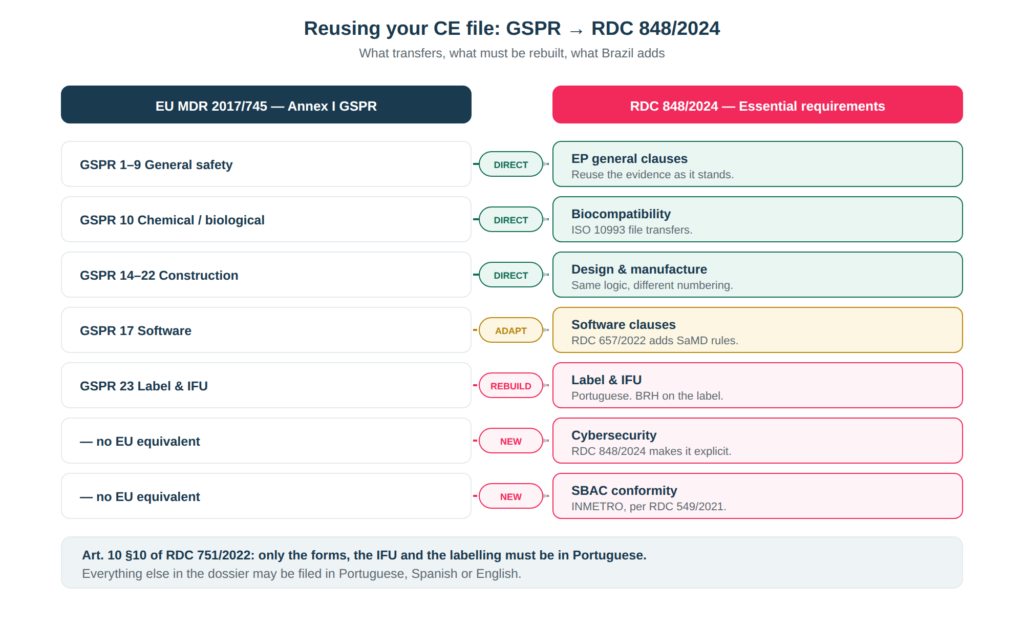
Do not translate your GSPR checklist. Map it.
Most of the evidence transfers as it stands. General safety principles, biocompatibility, design and manufacturing construction requirements — the substance is the same, the numbering is not, and a well-built ISO 10993 biocompatibility file satisfies the Brazilian requirement without new testing. The work is in building a defensible cross-reference: each RDC 848/2024 requirement, the evidence that addresses it, and the GSPR it corresponds to. That cross-reference is itself the deliverable ANVISA wants to see, and it is what turns a European file into a Brazilian one without duplicating a single test.
Some evidence must be adapted. Software requirements carry additional RDC 657/2022 obligations. Some must be rebuilt from scratch: labelling and instructions for use are not a translation exercise, because the BRH identity has to appear and the Brazilian content requirements are not a superset of the European ones.
And some has no European counterpart at all. RDC 848/2024 makes cybersecurity expectations explicit for software-bearing devices in a way that RDC 546/2021 did not. SBAC conformity assessment under RDC 549/2021 has no EU analogue whatsoever — INMETRO certification is a Brazilian construct, and it must be complete before you file, not alongside.
The language rule everyone gets wrong
Almost every manufacturer entering Brazil budgets for a full Portuguese translation of the technical dossier. Almost every one of them is wasting the money.
Article 10 of RDC 751/2022 splits the requirement. The application forms, the instructions for use or user and operator manuals, and the labelling must be in Portuguese — those are the documents the Brazilian user and the Brazilian patient rely on, and Brazil is unambiguous about them. But Article 10, paragraph 10 provides that the other documents composing the application may be presented in Portuguese, Spanish or English, subject to the rules in specific regulation.
Read that again if you have ever paid for a technical dossier translation into Portuguese. The design documentation, the verification and validation reports, the risk management file, the clinical evaluation — the bulk of the file by page count — do not require Portuguese. Translate the IFU and the labelling properly, with a competent technical translator, because those are read by clinicians and scrutinised by reviewers. Leave the rest in English.
✦ BRAZIL · TECHNICAL DOSSIER PACK
The dossier ANVISA expects, on the table of contents it expects.
8 fill-in Word templates structured on the IMDRF table of contents, with a master index — the file a Class III or IV registration actually needs, ready to carry the CE evidence you already hold.
- ✓ 8 Word templates · IMDRF ToC · master index
- ✓ Deployable inside an existing ISO 13485 quality system
ONE-TIME
€249
Get the Dossier Pack →The deficiencies that come back
Patterns repeat. These are the six that account for most of the re-work we see on Brazilian files, and every one of them is cheaper to prevent than to answer.
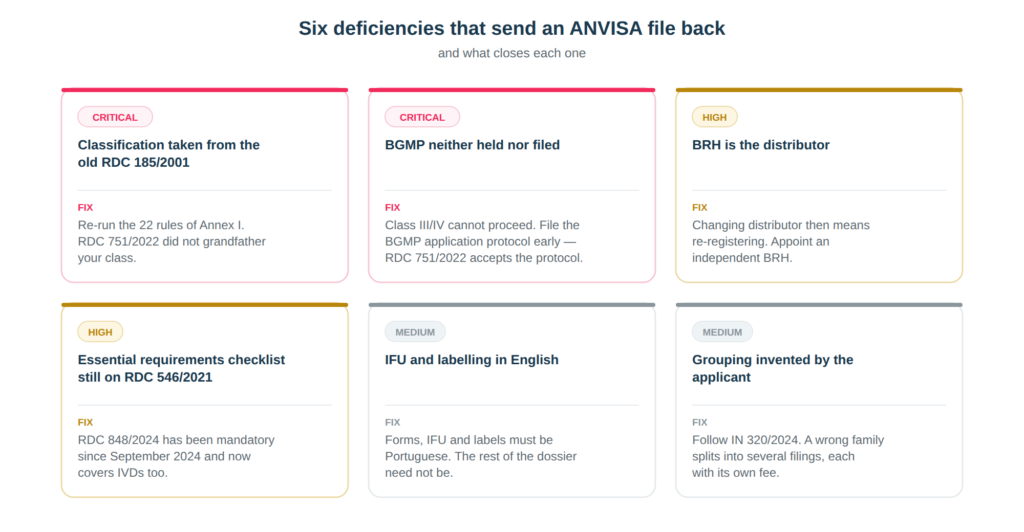
The first two are project-killers. A classification carried over from RDC 185/2001 is not a minor citation error — it means the entire regulatory strategy may be built on the wrong class, and the fix may be a different route, a different dossier and a BGMP obligation you had not planned for. A missing BGMP certificate on a Class III or IV file, with no application protocol on record, stops the proceeding.
The next two are structural. A BRH that is also your distributor is a commercial risk written into a regulatory instrument, and it only reveals itself at the worst possible moment. An essential requirements checklist still built on RDC 546/2021 signals to a reviewer that your regulatory intelligence is at least two years stale — and reviewers who see one stale citation start looking for others.
The last two are avoidable in an afternoon. Filing English IFU and labelling fails a requirement that is plainly written. Inventing your own grouping instead of following IN 320/2024 splits your filing and multiplies your fees.
None of these are subtle. All of them are common. That is the whole argument for scoring a Brazilian file against the regulations before ANVISA scores it for you.
✦ COMPLETE BRAZIL BUNDLE
Score the file before ANVISA scores it for you.
The ANVISA Gap Analysis workbook — 359 scored items across 18 sheets with a DO-NOT-FILE gate that flags the killer items — plus the RDC 848/2024 Essential Requirements Checklist and the Technical Dossier Pack. Everything needed to prepare an ANVISA submission, built from the resolutions themselves.
- ✓ Gap analysis + checklist + dossier pack
- ✓ Save €88 vs buying the three kits separately
FROM
€399
Get the Complete Brazil Bundle →Frequently asked questions about ANVISA registration
How long does ANVISA registration take?
There is no single honest number, because the review is only one of the clocks. For Class I and II, Notification is comparatively quick. For Class III and IV, the marketing authorisation review runs for months and the BGMP proceeding runs in parallel — and where BGMP requires an ANVISA inspection of an overseas site, the inspection queue, not the technical review, sets your date. A manufacturer with MDSAP and a clean file plans in months. A manufacturer awaiting a first ANVISA inspection plans in years.
Do I need a Brazilian Registration Holder if I have a distributor in Brazil?
Yes, and you should think hard before making them the same company. A foreign manufacturer cannot hold the registration; a Brazilian legal entity must. Your distributor may lawfully be that entity, but then the registration is theirs, and ending the relationship means re-registering. An independent BRH holding the registration, with importers authorised beneath it, keeps the registration yours and the distribution chain flexible.
Does my CE certificate reduce the ANVISA registration requirements?
Not directly — Brazil does not accept a CE certificate in place of its own assessment. But it reduces the work enormously, because the underlying evidence transfers. Your risk management file, biocompatibility testing, verification and validation, and clinical evaluation are all reusable. Separately, IN 290/2024 created a reliance-based pathway under which ANVISA may take account of assessments by recognised foreign authorities where sameness is demonstrated; whether it fits your device is worth establishing early rather than assuming it does not.
Is BGMP required for all classes?
No. BGMP certification applies to Class III and Class IV. Class I and Class II devices following the Notification route do not require it. This is the single biggest structural difference between the two regimes and the reason class determination has to be right before anything else starts.
Does my ANVISA registration expire?
It depends on the regime. A Notification for Class I or II does not expire, though it can be cancelled. A marketing authorisation for Class III or IV is valid for ten years from publication in the Federal Official Gazette under Article 11 of RDC 751/2022, and must be revalidated for successive equal periods to keep the product on the market.
Does the whole technical dossier need to be in Portuguese?
No — and this is where a great deal of money is wasted. Under Article 10 of RDC 751/2022, the application forms, the instructions for use and the labelling must be in Portuguese. The remaining documents composing the application may be filed in Portuguese, Spanish or English.
My device was registered before March 2023. Do I need to do anything?
Probably, and nobody will tell you. RDC 751/2022 rewrote the classification rules with effect from 1 March 2023 and did not grandfather existing classifications. You are responsible for confirming that your device’s class is still correct under the current Annex I rules. If it moved, your obligations moved with it.
Conclusions
ANVISA registration rewards preparation and punishes assumption. The technical evidence you already hold is largely sufficient; what defeats manufacturers is the architecture around it — a class determined under a regulation that no longer exists, a registration holder chosen for commercial convenience, a BGMP proceeding started too late to overlap with the review, an essential requirements checklist that quietly aged out in September 2024.
Four decisions carry the project. Confirm the class against the twenty-two rules in Annex I of RDC 751/2022 rather than transcribing your MDR class. Appoint a Brazilian Registration Holder independent of your distribution chain, and do it before the dossier is written. File the BGMP application protocol early and use the fact that RDC 751/2022 accepts the protocol rather than the certificate. And map — do not translate — your GSPR evidence onto RDC 848/2024, translating only the forms, the IFU and the labelling, because that is all Article 10 actually requires.
Do those four things and Brazil becomes an administrative exercise on a known timeline. Skip any of them and it becomes an eighteen-month lesson.
The Brazil Market Access kits on MD Regulatory carry exactly this work: a scored ANVISA gap analysis workbook covering the file across 18 sheets with a do-not-file gate that flags the killer items before ANVISA does; an essential requirements checklist built against RDC 848/2024 with every requirement cross-referenced to the matching EU MDR GSPR so your CE evidence can be reused rather than rewritten; and a technical dossier pack of fill-in templates on the IMDRF table of contents with a master index — all built from the ANVISA resolutions themselves rather than from third-party summaries, and immediately deployable inside an existing ISO 13485 quality management system. The ANVISA regulatory framework page is the authority’s own starting point and should be your reference of record.
Related articles