Biocompatibility Testing for Medical Devices: ISO 10993 Complete Guide
Biocompatibility Testing for Medical Devices: ISO 10993 Complete Guide
Table of Contents
- Introduction
- Does My Device Need Biocompatibility Testing?
- What Is the ISO 10993 Series?
- How Is a Device Categorized Under ISO 10993-1?
- Which Biocompatibility Tests Do I Need?
- The Biological Evaluation Process — Step by Step
- The Three Most Important Biocompatibility Tests
- What Notified Bodies Reject — Six Recurring Findings
- ISO 10993-1:2025 — What Changed
- Biocompatibility Testing and EU MDR Requirements
- Biocompatibility Testing and FDA Requirements
- Practical Guidance — Building Your Biocompatibility Strategy
- Frequently Asked Questions
- Conclusions
Introduction
Biocompatibility testing is one of the most fundamental requirements in medical device development. Any device that comes into contact with the human body — whether it touches intact skin, penetrates mucosal membranes, contacts blood, or is implanted permanently in tissue — must demonstrate that its materials do not cause unacceptable biological harm to patients or users.
For the purpose of the ISO 10993 family of standards, biocompatibility is defined as the ability of a medical device or material to perform with an appropriate host response in a specific application. This definition captures something fundamental: biocompatibility is not a material property in isolation — it depends on the specific context of clinical use, the contact type, the duration of exposure, and the patient population.
ISO 10993-1 defines the principles and requirements for assessing a device’s biological safety within the broader risk management framework established by ISO 14971. The standard guides manufacturers and evaluators through the process of identifying, assessing, and managing biological risks associated with materials, design choices, and tissue contact during a device’s intended use.
This guide covers the complete biocompatibility testing framework — device categorization, biological evaluation planning, chemical characterization, test selection, and the documentation a Notified Body will actually ask to see. For context on how biocompatibility integrates into the broader ISO 14971 risk management process, refer to our complete risk management guide.
Does My Device Need Biocompatibility Testing?
Every medical device that contacts the human body — directly or indirectly — requires a documented biological evaluation. But a biological evaluation does not always require laboratory testing.
This distinction is the single most misunderstood point in the whole subject, and it is worth stating plainly: the obligation is to evaluate biological safety and document the conclusion. Testing is one way of generating the evidence, not the requirement itself. For many devices built from well-characterized materials with established safety histories, chemical characterization combined with a documented toxicological risk assessment is sufficient to close several biological effects without a single animal or cell-culture study.
Direct contact means the device or a component physically touches body tissue. Indirect contact means a fluid or gas passes through the device before reaching body tissue — which is why an infusion set, a filter, or a tubing set is in scope even though the plastic never touches the patient.
Three sources of existing evidence can reduce or eliminate testing, provided each is properly documented:
- Prior data on the same materials — from earlier submissions or from your own device family, provided the material, manufacturing process, sterilization method and contact conditions are genuinely unchanged. Any change in sterilization method or process aid invalidates the read-across until reassessed.
- Supplier data — usable only if you can actually access the underlying data, not just a certificate of conformity. A supplier statement that a material is “biocompatible” is not evidence; the test reports behind it are.
- Published literature and clinical history — for materials with long documented use in the same contact type and duration.
The decision to rely on any of these must be made and justified in the Biological Evaluation Plan, before testing decisions are taken — not retrofitted afterwards.
✦ RISK MANAGEMENT DOCUMENTATION KIT
Where your biological evaluation has to land: the ISO 14971 risk management file.
A Biological Evaluation Report that sits outside the risk management file is a finding waiting to happen. This kit covers the file it has to integrate into — Risk Management Plan, Risk Management Report, Hazard Analysis with all 46 ISO/TR 24971 Annex A questions, Design and Use-related FMEAs with auto-calculated RPN, and a GSPR Checklist covering all 159 requirements of MDR Annex I.
- ✓ 6 coordinated templates + Master Index and README
- ✓ EN ISO 14971:2019/A11:2021 · ISO/TR 24971:2020 · IEC 62366-1
- ✓ Save 16% vs buying the templates individually
One-time payment, lifetime access — €349
What Is the ISO 10993 Series?
The ISO 10993 series is a family of international standards developed by ISO Technical Committee 194 (ISO/TC 194) that provides the globally recognized framework for biological evaluation of medical devices. The ISO 10993 series provides guidelines for assessing the potential risks associated with the use of medical devices, with each part covering a specific aspect of biocompatibility.
ISO 10993-1 is the only normative framework standard in the series. The other parts define specific testing methodologies, referenced by ISO 10993-1 when a particular biological effect requires evaluation. The parts you will encounter most often:
| Part | Subject | When you need it |
|---|---|---|
| ISO 10993-1:2025 | Evaluation within a risk management process | Always — it is the framework standard |
| ISO 10993-3:2014 | Genotoxicity, carcinogenicity, reproductive toxicity | Prolonged and long-term contact |
| ISO 10993-4:2017 | Interactions with blood | Any blood-contacting device |
| ISO 10993-5:2009 | In vitro cytotoxicity | Effectively all devices |
| ISO 10993-6:2016 | Local effects after implantation | Implants and prolonged tissue contact |
| ISO 10993-7:2008 | Ethylene oxide sterilization residuals | EO-sterilized devices only |
| ISO 10993-9:2019 | Framework for degradation products | Degradable or resorbable materials |
| ISO 10993-10:2021 | Skin sensitization | Effectively all devices |
| ISO 10993-11:2017 | Systemic toxicity | Where chemical data cannot close the effect |
| ISO 10993-12:2021 | Sample preparation and reference materials | Whenever testing is performed |
| ISO 10993-13:2010 | Degradation products — polymers | Degradable polymeric devices |
| ISO 10993-15:2019 | Degradation products — metals and alloys | Metallic implants |
| ISO 10993-17:2023 | Toxicological risk assessment | Whenever chemical characterization is performed |
| ISO 10993-18:2020 | Chemical characterization | Effectively all devices — the first step |
| ISO 10993-22:2017 | Guidance on nanomaterials | Devices containing nanomaterials |
| ISO 10993-23:2021 | Irritation | Effectively all devices |
Note that ISO 10993-6 retains “local effects after implantation” in its own title. The biological effect evaluated under ISO 10993-1 was renamed to “local effects after tissue contact” in the 2025 edition, to acknowledge that non-implanted devices in prolonged tissue contact may also need this evaluation. The part title and the effect name are not the same thing, and confusing them is a common citation error in Biological Evaluation Plans.
How Is a Device Categorized Under ISO 10993-1?
Every device is categorized on two dimensions before any test is selected: contact type and contact duration. Together these determine which biological effects must be evaluated. Getting the categorization wrong is the most consequential error in the whole process, because every downstream decision inherits it — and it is one of the most frequent Notified Body findings.
Contact Type (ISO 10993-1:2025, Tables 1–4)
The 2025 edition categorizes devices by the type of body contact alone. The earlier scheme — surface, externally communicating, implant — has been removed, along with the ambiguity it created for devices that sat across two categories.
| Table | Contact type | Typical devices |
|---|---|---|
| Table 1 | Intact skin | Adhesive bandages, ECG electrodes, blood pressure cuffs, external prostheses, compression garments |
| Table 2 | Intact mucosal membranes | Dental impression materials, urinary catheters, GI endoscopes, contact lenses, endotracheal tubes |
| Table 3 | Breached or compromised surfaces, or internal tissues other than circulating blood | Wound dressings, surgical instruments, orthopaedic implants in bone or soft tissue, tissue grafts |
| Table 4 | Circulating blood | Cardiac catheters, vascular grafts, heart valves, dialysis membranes, blood oxygenators |
The practical consequence of the split is that a device is now evaluated on what it actually touches, not on what family it belongs to. Two devices previously both classed as “surface devices” — one contacting intact skin, one contacting a burn — now fall under different tables with different expectations.
Contact Duration and Total Exposure
Three duration categories apply regardless of contact type:
| Category | Total contact duration |
|---|---|
| Limited | 24 hours or less |
| Prolonged | More than 24 hours, up to 30 days |
| Long-term | More than 30 days |
The important change in the 2025 edition is not the categories but how the total is calculated. Duration is now assessed on the total exposure period accumulated across all uses on the same patient, not on a single application. For a reusable device, or for a single-use device applied repeatedly during a course of treatment, the cumulative figure is what counts.
This re-categorizes a significant number of devices upward. A wound contact layer applied at each dressing change over three weeks was frequently treated as limited contact under the previous approach, because no single application exceeded 24 hours. Assessed on total exposure, it is prolonged contact — which brings additional biological effects into scope, genotoxicity in particular.
Where bioaccumulation of device constituents is expected, the duration should be treated as long-term unless a documented justification supports otherwise.
What to do about it: take your existing device list, recalculate contact duration on total accumulated exposure, and flag every device that moves category. Those are the devices whose biological evaluations now have gaps. This is the core of the gap analysis described in our ISO 10993-1:2025 guide.
Which Biocompatibility Tests Do I Need?
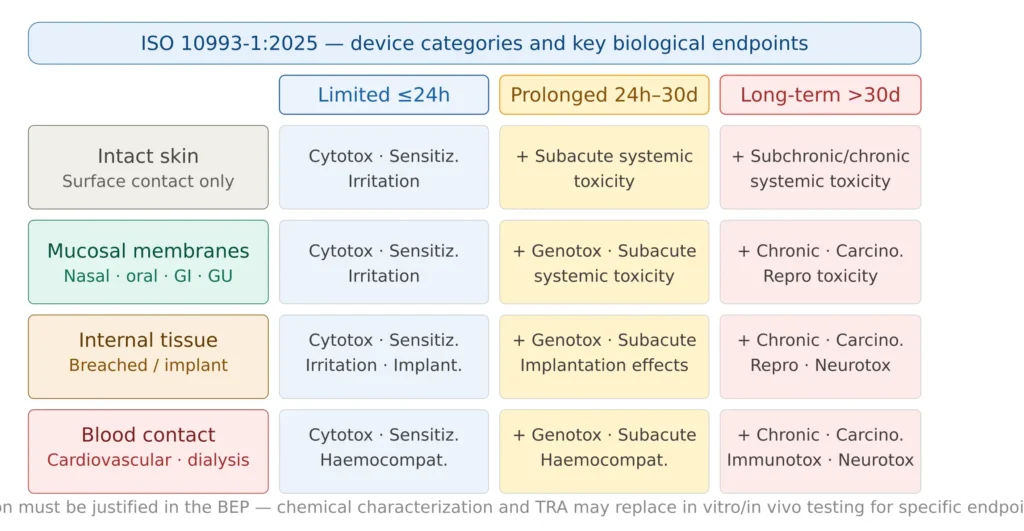
Once the device is categorized, the biological effects requiring evaluation follow from the applicable table in ISO 10993-1:2025. Three effects apply to effectively every device regardless of category — cytotoxicity, sensitization and irritation. Beyond those, the scope expands with contact invasiveness and duration.
Two points that are routinely missed:
An effect in scope does not mean a test is required. Each biological effect must be addressed, and chemical characterization plus toxicological risk assessment is a legitimate and often preferable way of addressing it. What is not legitimate is silence: an effect that is in scope and neither tested nor justified is a gap, and it will be found.
Genotoxicity now reaches much further than it used to. Under the 2025 edition, genotoxicity evaluation applies to all devices in prolonged or long-term contact with any tissue except intact skin. Wound care products, mucosal-contacting devices and prolonged-use topical devices that previously sat outside this requirement are now inside it. If your device is in prolonged contact and your file has no genotoxicity position, that is the first gap to close.
The Biological Evaluation Process — Step by Step
Step 1 — Device Characterization
The process begins with a comprehensive characterization of the device — not the materials in isolation, but the final finished device as it will be used clinically. This includes: all materials and components in contact with the body or potentially in contact through indirect pathways; all manufacturing processes and process aids (lubricants, mould release agents, cleaning agents); the sterilization method and any sterilization residuals; the intended use environment; and the patient population including any vulnerable groups.
Process aids are the most commonly forgotten input. A mould release agent that never appears on the bill of materials still ends up on the device surface, and it will appear in the extractables profile whether or not it appeared in the characterization.
Reasonably foreseeable misuse must now be explicitly considered in the exposure assessment — consistent with the ISO 14971 approach to hazard identification covered in our ISO 14971 risk management guide. In practice this means asking whether the device could plausibly be used for longer than intended, on a different tissue than intended, or reprocessed when it was not designed to be.
Step 2 — Biological Evaluation Plan (BEP)
The Biological Evaluation Plan is the strategic document that defines how the biological evaluation will be conducted for a specific device. It is the biocompatibility equivalent of the risk management plan under ISO 14971 — device-specific, documented before testing begins, and subject to review and update throughout the device lifecycle.
The BEP must include: the device categorization (contact type and duration, with the calculation shown); a review of all existing biological safety data for the device materials; a gap analysis identifying what additional data is needed; the proposed strategy for addressing each gap — through chemical characterization, toxicological risk assessment, biological equivalence, or testing; and the biological effects to be evaluated with a justification for each inclusion and each exclusion.
The word “before” carries weight here. A BEP written after the test results are in is a formality, and it reads like one.
Step 3 — Chemical Characterization (ISO 10993-18)
Chemical characterization is the expected first step after the BEP — before any biological testing is considered. It identifies the chemical hazards, biologically hazardous situations, and biological risks associated with the final finished device, its materials, and its manufacturing processes.
Chemical characterization under ISO 10993-18 includes: identification of the chemical constituents of the device and its materials; extractables and leachables testing; assessment of CMR substances and endocrine disruptors; and characterization of degradation products using the appropriate parts of the series (10993-9, -13, -15).
The output feeds directly into the toxicological risk assessment — and may be sufficient to conclude on biological safety for several effects without in vivo testing.
Step 4 — Toxicological Risk Assessment (ISO 10993-17)
The toxicological risk assessment evaluates whether the compounds identified through characterization pose an unacceptable biological risk at the expected patient exposure. It compares actual or estimated patient exposure for each compound against established toxicological thresholds — tolerable intake values derived under ISO 10993-17, or values from recognized regulatory sources.
One caution worth stating, because it is a recurring source of Notified Body questions: thresholds derived from food or pharmaceutical contexts are not automatically transferable to a medical device exposure scenario. Where such a value is used, the transferability must be argued explicitly, not assumed.
Where chemical characterization and TRA together demonstrate acceptable biological risk, additional testing may not be required for specific effects. This is the core of the risk-based approach: test where the science requires it, not where a table suggests it.
✦ COMPLETE CATALOG
Find the documentation you need — instantly.
Whether you need a complete kit or just one specific SOP, our catalog has it. 45 process packages and 3 complete bundles, all instantly downloadable and fully editable.
- ✓ Complete bundles or individual packages
- ✓ 45 process packages from €69 each
- ✓ ISO 13485 · MDSAP · Combined Kit
Step 5 — Biological Testing (When Required)
Biological testing is conducted when chemical characterization and TRA are insufficient to conclude on specific biological effects. Test selection must be justified based on the device category, contact duration, and the effects that cannot be addressed through chemical data alone.
Cytotoxicity, sensitization and irritation are the three assessments performed for almost all devices reaching the market. Depending on contact type and duration, additional effects come into scope: systemic toxicity (ISO 10993-11), genotoxicity (ISO 10993-3), haemocompatibility (ISO 10993-4), local effects after tissue contact (ISO 10993-6), chronic toxicity, carcinogenicity, and reproductive and developmental toxicity.
Step 6 — Biological Evaluation Report (BER)
The Biological Evaluation Report is the final output — a document summarizing all data reviewed, all testing conducted, the conclusions reached, and the overall biological risk determination. The BER integrates with the ISO 14971 risk management file and forms part of the EU MDR technical documentation under Annex II.
Every conclusion in the BER must be traceable to data, and every data element traceable back to the BEP and to the risk management file. The BER is a living document: it must be updated whenever device materials, manufacturing processes, sterilization method or intended use change, and whenever a post-market signal relates to biological safety.
The Three Most Important Biocompatibility Tests
While a full programme can involve a dozen or more biological effects for a long-term implant, three tests apply to virtually every device regardless of contact type and duration.
Cytotoxicity Testing (ISO 10993-5)
Cytotoxicity testing evaluates whether device materials or their extracts are toxic to living cells. It is the most fundamental screen — the first test performed and the one most likely to detect gross material toxicity early in development.
ISO 10993-5 defines three principal methods: direct contact, indirect contact, and the extract (elution) method with extracts prepared per ISO 10993-12. The L929 mouse fibroblast cell line is the most widely used.
Cytotoxicity testing is fast and inexpensive relative to the rest of the programme, and can be run early in the design process — making it the natural first screen before more expensive studies are commissioned.
Sensitization Testing (ISO 10993-10)
Sensitization testing evaluates whether device materials can cause delayed hypersensitivity following repeated or prolonged exposure. It matters particularly for devices containing latex, certain metals (nickel, chromium, cobalt), and adhesives.
ISO 10993-10 defines in vivo sensitization tests — the guinea pig maximization test and the Buehler test. In vitro alternatives exist and are developing quickly, but the FDA does not currently accept them as equivalent for sensitization, which means in vivo testing is generally still required for US submissions even where in vitro data is available.
Irritation Testing (ISO 10993-23)
ISO 10993-23 covers tests for irritation — the local tissue response to device contact that does not involve immune sensitization. It replaced the earlier irritation provisions of ISO 10993-10 and aligns more strongly with a risk-based approach, encouraging the use of validated in vitro methods and chemical data before in vivo testing is considered.
What Notified Bodies Reject — Six Recurring Findings
The technical requirements are documented in the standard. What is not documented anywhere is which parts of a biological evaluation actually fail review. These six account for the large majority of biocompatibility findings raised during conformity assessment and surveillance audits.
| Finding | What it looks like in the file | What closes it |
|---|---|---|
| No Biological Evaluation Plan | Test reports are present, but no document states what was planned or why. The strategy is inferred backwards from the results. | A BEP that predates the testing, with the effects in scope, the approach for each, and the justification for every exclusion. |
| Wrong device category | Contact type or duration is stated without the reasoning. Repeated use is assessed per application rather than on total accumulated exposure. | The categorization shown as a calculation, not an assertion — worst-case clinical use, total exposure, and the resulting table. |
| Missing chemical characterization | Biological testing has been performed but the material composition, process aids and extractables are not characterized. | An ISO 10993-18 characterization of the final finished, sterilized device — including process aids and sterilization residuals. |
| No toxicological risk assessment | Analytical results are reported as a compound list with no exposure comparison, or thresholds are used without justifying their transferability. | An ISO 10993-17 assessment comparing patient exposure to a justified tolerable intake for each identified compound. |
| Outdated BER | The report predates a change of supplier, resin grade, process or sterilization method, with no impact assessment on file. | A BER review triggered by every relevant change, documented even where the conclusion is that no new data is needed. |
| BER not integrated into the risk management file | The biological evaluation exists as a standalone document. Biological hazards do not appear in the risk management file and residual biological risk is not carried into the overall evaluation. | Biological hazards in the risk analysis, controls traced to the BER, and residual biological risk in the ISO 14971 Clause 8 overall evaluation. |
The pattern behind all six is the same: the evaluation was treated as a testing exercise rather than a documented reasoning process. Notified Bodies do not primarily assess whether the tests were done — they assess whether the decisions were justified and traceable.
ISO 10993-1:2025 — What Changed
The sixth edition of ISO 10993-1, published in November 2025, reorganizes the standard around ISO 14971 risk management, replaces the single evaluation matrix with four contact-specific tables, assesses exposure duration on total accumulated contact, and extends genotoxicity evaluation to all prolonged-contact devices except those contacting intact skin only. It also formalizes biological equivalence and raises the evidence expected to support an equivalence claim.
Manufacturers with evaluations built on the 2018 edition need a documented gap analysis before their next Notified Body review — particularly in the EU, where the revision is expected to be treated as state of the art quickly.
Our dedicated guide covers every change with a 2018-to-2025 re-categorization worksheet: ISO 10993-1:2025 — what changed and what to update.
Biocompatibility Testing and EU MDR Requirements
EU MDR 2017/745 does not specify biocompatibility tests directly. It requires, through the General Safety and Performance Requirements of Annex I, that devices are designed and manufactured to be safe for their intended use and that biological risks are eliminated or reduced as far as possible. Annex I Section 10 addresses substances leaking from the device, and the CMR and endocrine-disruptor provisions sit there.
EN ISO 10993-1 is recognized as the state of the art for biological evaluation under EU MDR. As part of the EU MDR technical documentation under Annex II, the biological evaluation documentation must include the BEP, all testing and characterization reports, and the BER — all integrated into the ISO 14971 risk management file. The mapping of each biological evaluation output to the relevant GSPR belongs in the GSPR checklist.
For Class III implantable devices, Notified Bodies apply particularly close scrutiny — especially where novel materials are used, where chemical characterization is incomplete, or where the TRA relies on tolerances derived from food or pharmaceutical contexts without justifying the transfer.
The connection to ISO 13485 is direct: Clause 7.3 requires biological safety to be addressed in design inputs and design verification. The BEP should be initiated at the design input stage, and the BER serves as design verification evidence.
Biocompatibility Testing and FDA Requirements
The FDA’s approach is defined in its guidance “Use of International Standard ISO 10993-1” and in the FDA-modified matrix, which adjusts the ISO test selection expectations for certain device categories and effects.
Recognition status. The FDA recognized ISO 10993-1:2025 in June 2026, with specific provisions excluded from the recognition. Declarations of conformity based on ISO 10993-1:2018 remain acceptable for premarket submissions until 1 July 2029; after that date only declarations referencing the 2025 edition will be accepted. Confirm the current status and the full list of excluded provisions in the FDA Recognized Consensus Standards database before citing the standard in a submission.
Chemical characterization. The FDA expects chemical characterization as the first step, consistent with ISO 10993-18, and expects a risk-based argument using chemical data to determine whether in vivo testing is necessary.
Sensitization. The FDA does not currently accept in vitro sensitization alternatives as equivalent to the guinea pig tests, so in vivo sensitization testing is generally required for US submissions even where in vitro data exists.
Extractables and leachables. Analytical chemistry reports with identified compounds quantified against toxicological thresholds are standard submission content for devices in prolonged or long-term contact.
Practical Guidance — Building Your Biocompatibility Strategy
Start at design input, not at design verification. The most costly biocompatibility mistakes happen when materials are selected without biological evaluation input, an issue surfaces at verification, and a redesign follows. Choosing materials with established biological safety profiles, and avoiding novel compounds without characterization data, dramatically reduces downstream testing burden.
Use chemical characterization strategically. A thorough characterization report coupled with a well-executed TRA can close several biological effects without in vivo testing. This is not a shortcut — it is the approach the standard and the FDA both endorse. The investment at the start repays itself in avoided testing cost, animal use and time.
Know the difference between extractables and leachables. Extractables are released under aggressive laboratory conditions and define the worst-case exposure ceiling. Leachables are released under normal or simulated use and define realistic patient exposure. Both must be characterized; the distinction determines how the TRA is conducted and which thresholds apply.
Document biological equivalence rigorously when you claim it. Equivalence avoids redundant testing when a new device uses the same materials as a predicate with established safety. But the claim must demonstrate that chemical composition, physical characteristics, manufacturing processes and contact conditions are sufficiently similar, and that any difference introduces no new or increased biological risk. A thin equivalence claim is one of the most reliable ways to attract Notified Body questions.
Treat the BER as a living document. Any change to materials, component suppliers, manufacturing processes, sterilization method or intended use must trigger a review. Update the BER to record the impact even when the conclusion is that no additional testing is required. An outdated BER is a consistent surveillance audit finding.
Frequently Asked Questions
Does every medical device need biocompatibility testing?
Every device that contacts the human body requires a biological evaluation, but biological evaluation does not always mean laboratory testing. For devices made from well-characterized materials with established safety profiles, chemical characterization and a documented toxicological risk assessment may be sufficient to conclude on biological safety without any in vitro or in vivo testing. The Biological Evaluation Plan documents this determination.
What is the difference between a BEP and a BER?
The Biological Evaluation Plan is prospective: written at the start of the evaluation, it defines what data exists, what gaps exist, and how those gaps will be addressed. The Biological Evaluation Report is the retrospective output: it summarizes all data collected, all analyses performed, and the overall biological risk conclusion. Both are required and neither replaces the other.
Which biocompatibility tests are always required?
Cytotoxicity (ISO 10993-5), sensitization (ISO 10993-10) and irritation (ISO 10993-23) apply to effectively every medical device that contacts the body. Beyond these three, the biological effects in scope depend on the contact type and the total contact duration, and each one in scope must be either tested or closed with a documented justification.
When should biocompatibility evaluation begin in the design process?
At the design input stage, when materials are first being selected. Early engagement prevents costly material changes at design verification, enables informed supplier selection, and allows chemical characterization to proceed in parallel with other development activities.
Is ISO 10993-1:2025 recognized by the FDA?
Yes, with limitations. The FDA recognized ISO 10993-1:2025 in June 2026, with specific provisions excluded from the recognition. Declarations of conformity based on ISO 10993-1:2018 remain acceptable for premarket submissions until 1 July 2029, after which only declarations referencing the 2025 edition will be accepted. Verify the current status in the FDA Recognized Consensus Standards database.
How does biocompatibility integrate with the ISO 14971 risk management file?
The Biological Evaluation Report is part of the ISO 14971 risk management file. Biological hazards are a category of hazards that must be identified, evaluated and controlled through the risk management process. The BEP aligns with the risk management plan in defining scope and approach, and the residual biological risks from the BER integrate into the overall residual risk evaluation under ISO 14971 Clause 8.
✦ PREMIUM BUNDLE · EU MDR COMPLETE
The complete EU MDR documentation set — technical, clinical and risk.
The Technical Documentation Kit (Annex II), the Clinical Documentation Kit (Articles 32, 61, 83-86) and the Risk Management Kit (ISO 14971 + IEC 62366-1) in one premium bundle. 22 templates, cross-referenced, with a single Master Index.
- ✓ 22 templates · pre-market + post-market documentation
- ✓ Save €178 vs buying the three kits separately
FROM
€999
Conclusions
Biocompatibility testing is one of the most technically demanding areas of medical device compliance — not because the tests are inherently complex, but because the framework requires a genuinely integrated approach that connects material science, toxicology, chemistry and clinical context into a coherent, documented line of reasoning.
The 2025 edition of ISO 10993-1 reinforces that direction, moving away from a checklist mentality toward a risk-proportionate evaluation that starts with characterization and proceeds to testing only where the data demands it. Manufacturers who invest in strong chemical characterization early consistently find that their testing programmes are more targeted, their submissions better supported, and their time to market shorter.
For manufacturers building or upgrading their biological evaluation documentation, the starting point is a well-structured BEP and a systematic chemical characterization programme — and a risk management file the conclusions can actually be traced into. Our Risk Management Documentation Kit covers that side: Risk Management Plan and Report, Hazard Analysis, Design and Use-related FMEAs, and a GSPR Checklist mapping all 159 requirements of MDR Annex I, including the Section 10 provisions on substances released from the device.
Related articles
- ISO 10993-1:2025 — What Changed
- ISO 14971 Risk Management
- EU MDR Technical Documentation
- EU MDR GSPR Checklist
- ISO 13485 Complete Guide
- Benefit-Risk Analysis